Photo: Wikipedia
Demographics of Athens, TX
Affluence Level in Athens, TX
A middle-class area roughly in line with national averages across income, home values, education, and employment.
People of Athens, TX
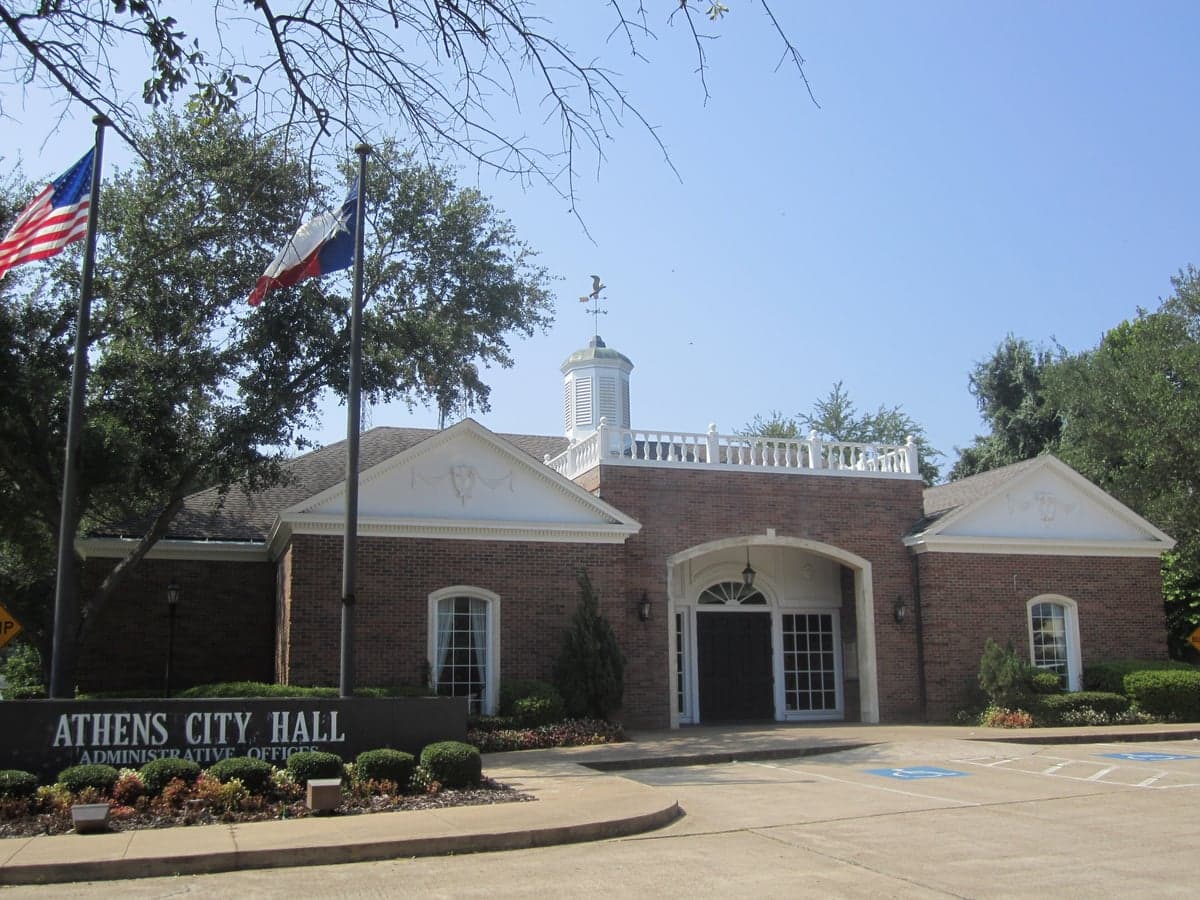
Athens, Texas, is a city of roughly 13,000 residents where no single group holds a majority—a demographic reality that shapes its identity as a working-class East Texas hub. The population is 48.0% White, 32.4% Hispanic, 14.1% Black, and 1.9% East/Southeast Asian, with 7.0% of residents born outside the United States. This is a community built on agriculture, manufacturing, and county government, where the Henderson County courthouse square remains the social and civic anchor. The city’s character is distinctly Texan—church-centered, family-oriented, and increasingly diverse in its schools and neighborhoods.
How the city was settled and grew
Athens was founded in 1850 as the seat of the newly created Henderson County, named after the Greek city by early settlers who saw the rolling piney woods as reminiscent of the Mediterranean. The original population was overwhelmingly Anglo-American, arriving from the Upper South—Tennessee, Kentucky, and the Carolinas—drawn by cheap land and the promise of cotton cultivation. These founding families built the first homes around the courthouse square in what is now the Downtown Historic District, a neighborhood that still contains several antebellum-era structures. The arrival of the Texas State Railroad in the 1880s shifted the town’s center of gravity eastward, creating the Railroad Addition neighborhood, where the first wave of Black families settled as they came to work in the rail yards and supporting businesses. By 1900, Athens had a small but established Black community centered on the east side, with its own churches, schools, and commercial strip along what is now East Tyler Street.
The early 20th century brought a second wave of White migration, this time from the Deep South, as the discovery of natural gas in the 1910s and the rise of tomato farming created new jobs. These newcomers largely settled in the West Athens area, building modest frame houses on the grid streets that still define the neighborhood today. The city’s Black population continued to grow through the 1920s and 1930s, concentrated in the Southside neighborhood, which became the cultural heart of Black Athens—home to the Lincoln High School, several Baptist churches, and a thriving small-business corridor. This pattern of distinct, racially defined neighborhoods persisted through the Jim Crow era and into the 1960s.
Modern era (post-1965)
The passage of the Immigration and Nationality Act of 1965 had little immediate effect on Athens, as the city saw almost no foreign-born residents until the 1990s. The more significant shift was domestic: the expansion of Tyler’s medical and manufacturing economy, about 30 miles north, began pulling Athens residents into a commuter orbit. The construction of U.S. Highway 175 in the 1970s opened the North Athens corridor to suburban-style development, attracting middle-class White families who worked in Tyler but wanted the lower housing costs and smaller schools of Athens. This period also saw the beginning of Black suburbanization, as upwardly mobile Black families moved out of the historic Southside into newer subdivisions like Lakeview Estates, built in the late 1970s on the city’s southwest edge.
The Hispanic population, which was negligible as recently as 1990, grew rapidly after 2000, driven by the expansion of the poultry processing industry in nearby Mount Pleasant and the construction boom in the Dallas-Fort Worth metroplex. These newcomers, primarily of Mexican descent, settled initially in the East Athens area near the industrial parks, where rental housing was affordable and jobs were within walking distance. Today, Hispanic residents are the fastest-growing segment of the population, and the East Athens corridor has developed a visible Spanish-language commercial presence, including grocery stores, taquerias, and a Pentecostal church that holds services in Spanish. The city’s small East/Southeast Asian population, at 1.9%, is concentrated among a handful of Vietnamese and Filipino families who arrived in the 1980s and 1990s, largely as professionals at the local hospital and the Athens ISD.
The future
Athens is becoming more diverse, and the trend shows no sign of reversing. The Hispanic share of the population has roughly doubled since 2010, and the school district’s enrollment is now majority-minority, a leading indicator of the city’s demographic future. The White population, while still the largest single group, is aging—the median age of White residents is over 45, compared to under 25 for Hispanic residents—which means the gap will continue to narrow through natural population dynamics alone. New residential construction is concentrated in the Lake Athens area on the city’s east side, where a mix of single-family homes and townhouses is attracting both young Hispanic families and White retirees drawn to the lake’s recreational amenities. This is dispersing the population away from the historic ethnic enclaves, creating a more integrated pattern of settlement than the city has ever known.
The college-educated share of the population, at 21.9%, is below the state average, and the city’s economic base remains heavily reliant on manufacturing, healthcare, and county government. This suggests that Athens will continue to be a working-class community, with the demographic change driven by economic opportunity rather than by an influx of remote workers or professionals. The cultural identity is evolving from a historically biracial Black-White Southern town into a tri-ethnic community, with the public schools, the county fair, and the courthouse square serving as the shared spaces where these groups interact.
For someone moving to Athens now, the city offers a stable, affordable, and genuinely diverse small-town environment. The historic neighborhoods—Downtown, Railroad Addition, Southside, West Athens—retain their distinct characters, but the newer developments around Lake Athens and North Athens are more integrated. The city is not becoming a cosmopolitan suburb; it is becoming a more layered version of what it has always been: a working Texas town where the population is changing, but the values of church, family, and community remain constant.

* Values derived from national, state, county, city and local statistics and may differ in a specific area. Last updated: 2026-10-21T10:06:11.000Z
Narrative content on this page is AI-generated and may contain mistakes. Verify any details that matter before acting on them.
ReloMaps may earn a commission from affiliate links at no extra cost to you.

