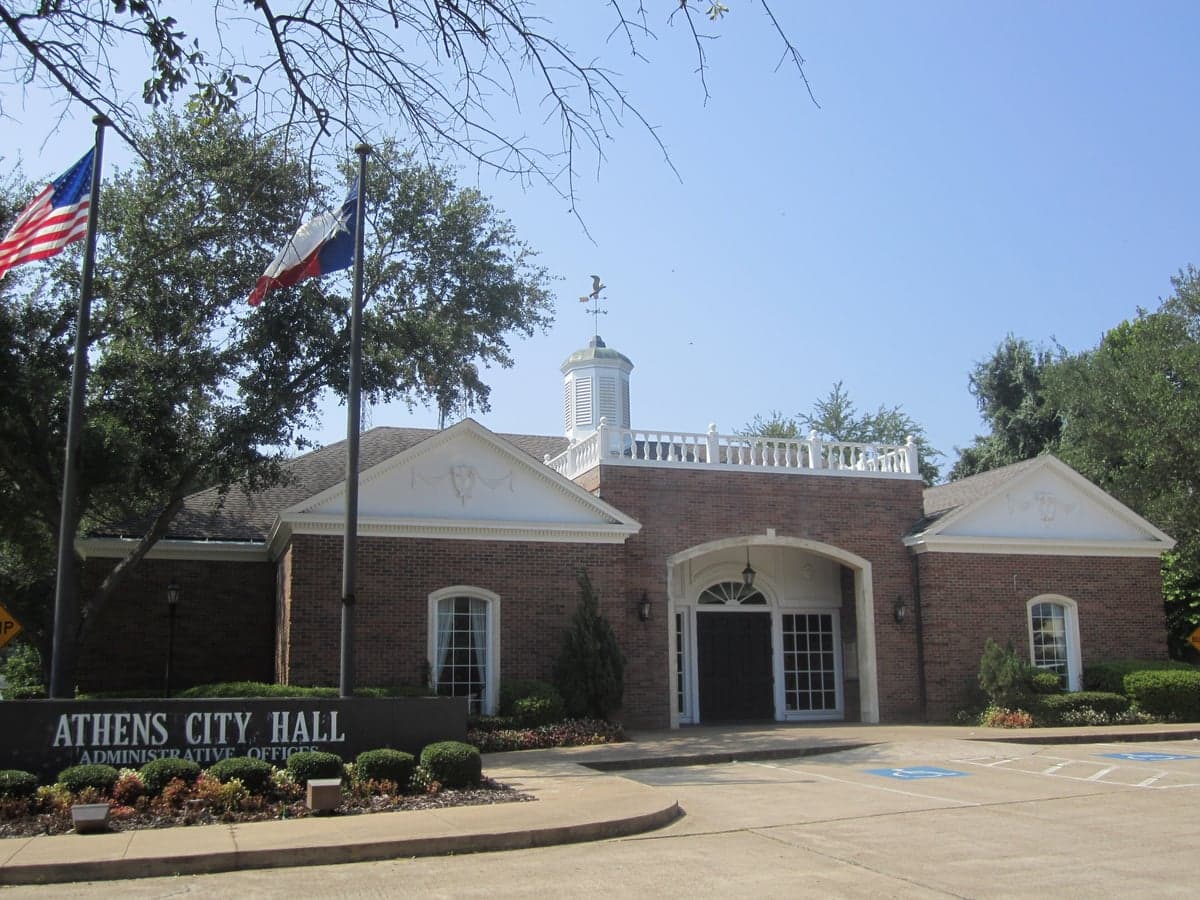
Photo: Wikipedia
Strategic Assessment of Athens, TX
Meaningful friction. Expect exposure to either population pressure, blast zones, or natural disaster risk. Consider buying a retreat property.
What does the Strategic Assessment tell us?
Our Strategic Assessment grades tactical survivability of an area. Major population centers, military targets, fallout zones, natural disasters, and border exposure all drive risk — lower exposure means a more defensible position in a crisis.
This is heavily inspired by Joel Skousen's Strategic Relocation book. Highly recommended you checkout the book ($)What does this tell us?
Our Strategic Assessment grades tactical survivability of an area. Major population centers, military targets, fallout zones, natural disasters, and border exposure all drive risk — lower exposure means a more defensible position in a crisis.
This is heavily inspired by Joel Skousen's Strategic Relocation book. Highly recommended you checkout the book ($)Strategic Pillars
Key Distances
Regional Safe Places
Below is our recommended "safe zones" in Texas and the surrounding area based on our strategic heuristics. For most people, it's unrealistic to live in a “safe zone” full-time due to work, family or other personal reasons. They tend to be more rural. However, many of these areas are perfect for second homes and retreat properties that double as a vacation home or even a short-term rental.

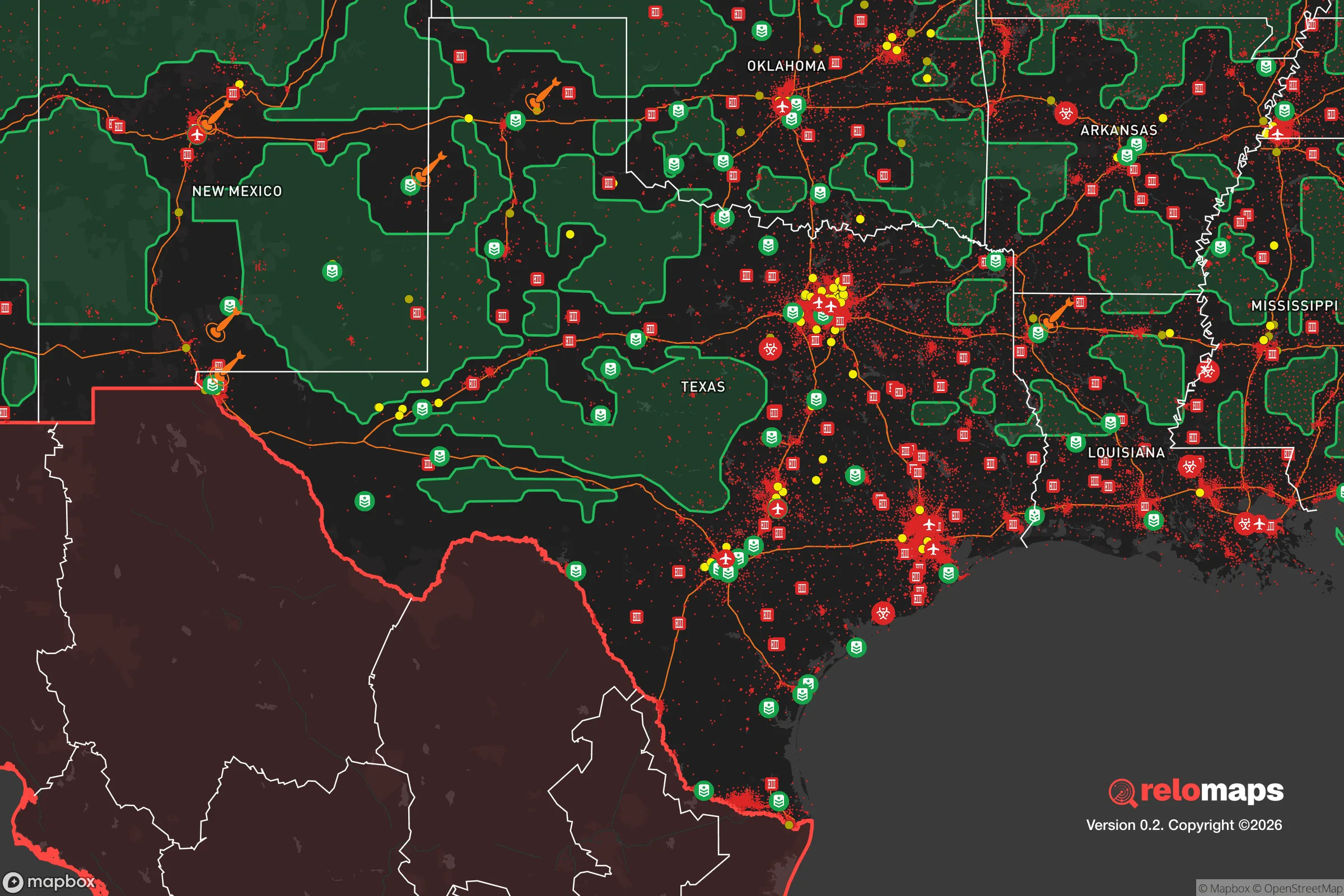


Important Note: For informational purposes only. This does not mean nothing bad ever happens in the green zones. Please use common sense. This is based on public data and modeled with AI. We tried to take a conservative approach but mistakes happen. We update this regularly as new information becomes available.
Solar Generator Recommendations
Backup power matters more here than in safer locations. We've picked three solar generators across budgets and capacity tiers — start with the budget unit if you only need a few essentials, or step up if you want to run a fridge and HVAC for days at a time.
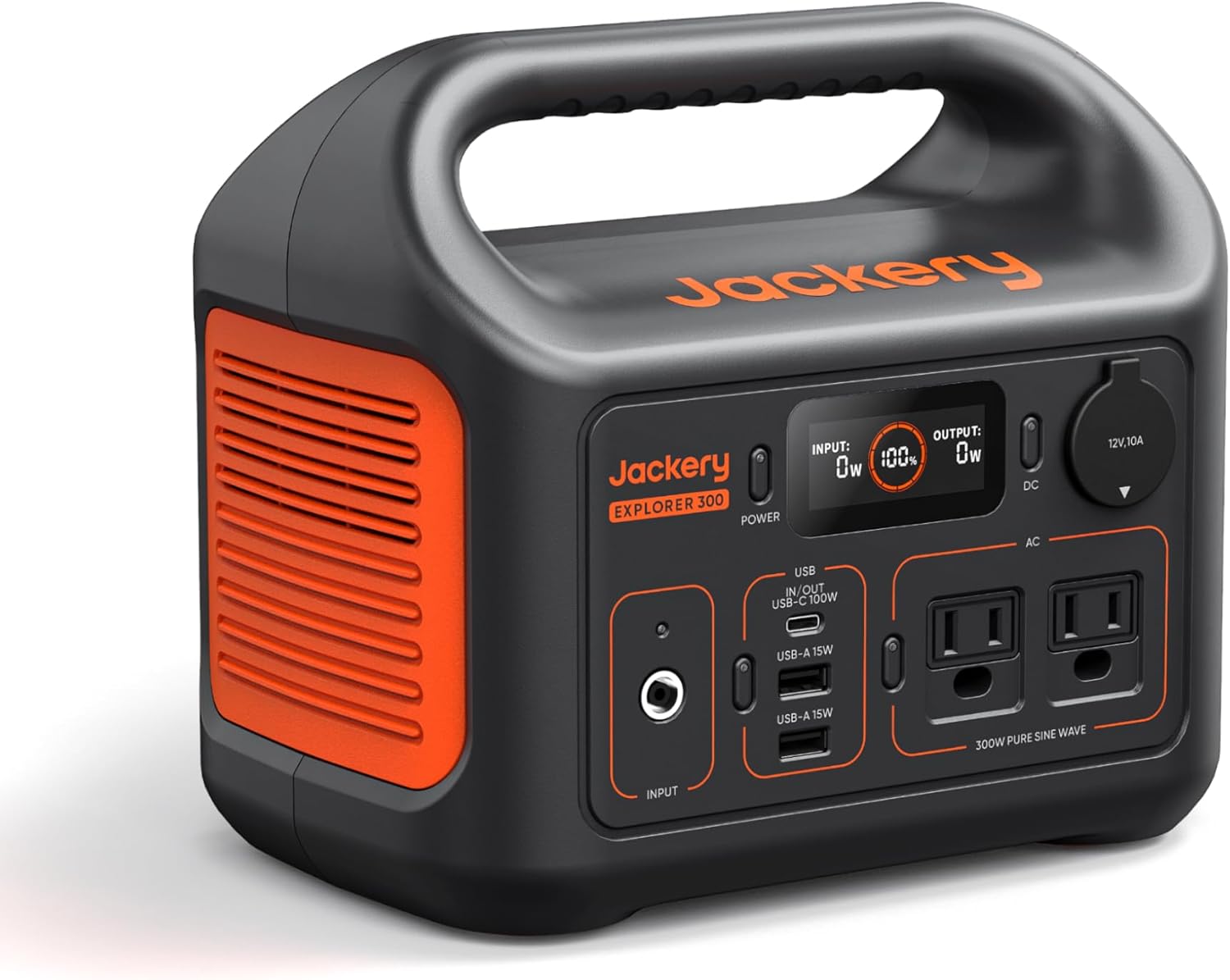
Jackery Portable Power Station Explorer 300
Budget OptionPower on the Go: Weighing only 11 lbs, it's convenient to set up and store with book-sized foldable solar panels

BLUETTI Portable Power Station AC180
Designed for both indoor and outdoor scenarios, AC180 is highly capable as it has a robost capacity and continuous output power.

EF ECOFLOW DELTA Pro Ultra Power Station
Upgraded PickEcoFlow DELTA Pro Ultra is a whole-home energy system designed to grow with your family. Integrated with the Smart Home Panel 2, it scales to meet your evolving energy needs — keeping your home powered, intelligent, and secure through every stage of life.
We earn a commission, at no additional cost to you.
Strategic Assessment Analysis
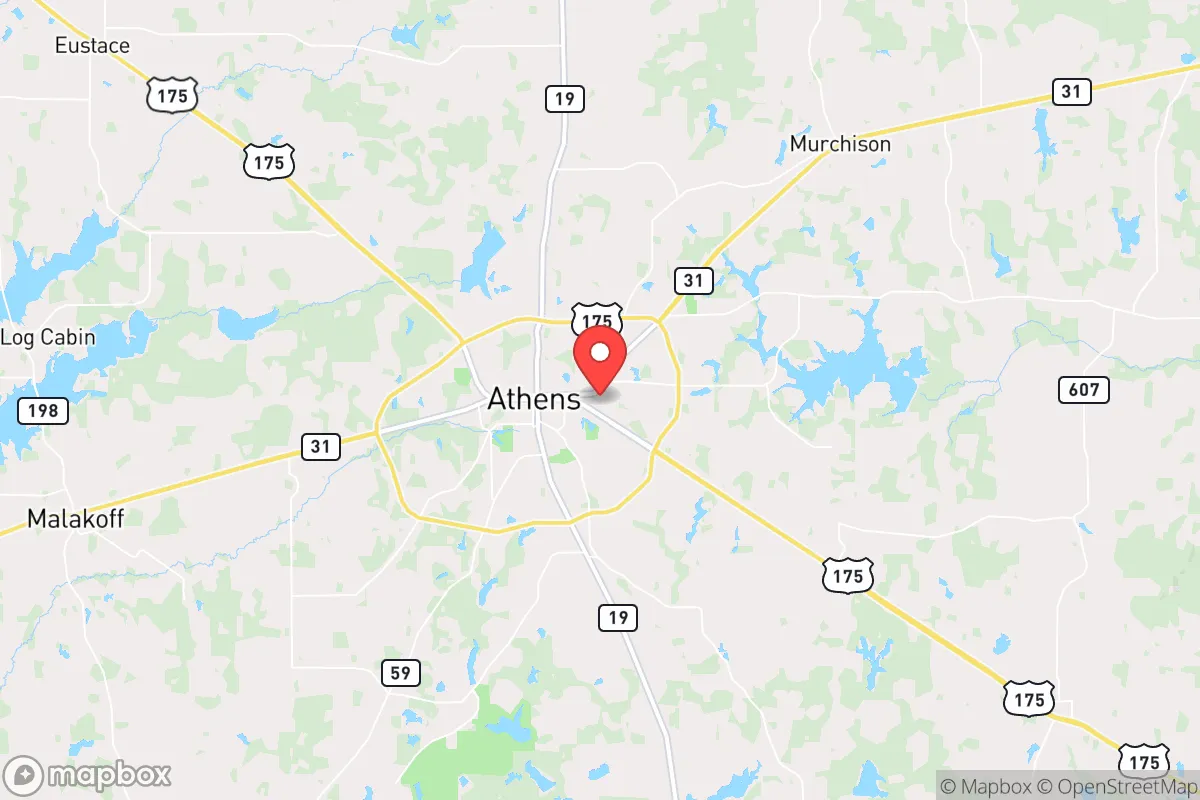
Athens, Texas, sits in a sweet spot that resilience-minded relocators rarely find: close enough to major infrastructure to matter, far enough from the blast zones to survive them. Roughly 75 miles southeast of Dallas and 50 miles west of Tyler, this Henderson County seat of about 13,000 people offers a mix of rural self-sufficiency and small-city services that makes it a credible base for a prepared household. The strategic question isn't whether Athens is perfect — it isn't — but whether its advantages outweigh its exposures for someone serious about disaster readiness.
Geographic position and natural advantages for long-term stability
Athens sits on the western edge of the East Texas Piney Woods, a transition zone where the terrain rolls gently and the soil is workable. The elevation runs roughly 450–500 feet, which puts it above the worst flood plains of the Trinity River system to the west and the Neches drainage to the east. That matters: much of the surrounding countryside drains well, and the area is not prone to the catastrophic flash flooding that hits Hill Country towns or the Gulf Coast. The local climate is humid subtropical, with about 45 inches of rain annually — enough to support serious gardening, rainwater catchment, and pond stocking without the drought stress that plagues West Texas.
The lake is the headline feature. Lake Athens, a 1,800-acre reservoir owned by the city, is the municipal water supply and a working asset for fishing and recreation. For a relocator, that means the town has a vested interest in maintaining water quality and infrastructure. The Cedar Creek Reservoir, about 20 miles northwest, and Lake Palestine, roughly 25 miles east, add redundancy. The land around Athens is also comparatively affordable — Henderson County's median home price sits well below the Dallas metro, and acreage with trees and water access is still findable in the $4,000–$8,000-per-acre range depending on proximity to the lake. That combination of water, arable land, and moderate pricing is the core of Athens's strategic appeal.
Risk exposure, severe weather, and proximity to high-value targets
No place in Texas is free of severe weather, and Athens has its share. The area sits in the southern tier of Tornado Alley's influence; Henderson County sees a handful of tornado warnings each spring, though direct strikes are infrequent. The bigger seasonal threat is hail and straight-line wind, which can damage roofs and outbuildings. Summer heat is real — 95–100°F days are routine in July and August — but the tree cover and lake breeze moderate it compared to open prairie towns. Winter ice storms occasionally knock out power for days, which is the single most likely grid-disruption event a relocator will face.
The man-made risk picture is where Athens gets interesting. The town is roughly 75 miles from Dallas-Fort Worth, a metropolitan area of 8 million people that would be a primary target in any major conflict scenario. That distance is a double-edged sword. At 75 miles, a ground-level nuclear detonation in downtown Dallas would not produce lethal fallout at Athens under most wind patterns — the lethal zone for prompt radiation is typically within a 10–20 mile radius, and significant fallout deposition is highly wind-dependent. But the town is not out of the woods. Prevailing winds in North Texas are from the south and southeast, which means fallout from a strike on Dallas would likely drift northeast, away from Athens. A strike on the Comanche Peak nuclear plant, about 90 miles west-southwest, or on the strategic bomber fleet at Dyess AFB near Abilene, 180 miles west, would pose more complex wind-dependent risks.
The more realistic man-made concern is cascading disruption. Athens sits at the junction of State Highways 31 and 19, and it's a natural chokepoint for evacuees fleeing the DFW metro. In a regional crisis, U.S. Highway 175 and I-20 would clog within hours, and Athens could see a surge of transient population seeking fuel, food, and lodging. That's not a reason to avoid the town — it's a reason to have supplies on hand and a plan to stay put rather than evacuate toward the metro.
Practical resilience: food, water, energy, and defensibility for a relocator
Athens's practical resilience is genuinely good for a town its size. The water situation is the strongest card: the city draws from Lake Athens, and most rural properties in the county rely on private wells that tap into the Carrizo-Wilcox aquifer, one of the more productive aquifers in Texas. A well-drilled household with a solar pump and a storage tank can be functionally water-independent. Rainwater catchment is viable here, too — the 45 inches of annual rainfall means a modest roof can fill a 5,000-gallon cistern several times over in a wet year.
Food security is workable but not automatic. Henderson County has a genuine agricultural base — cattle, hay, and poultry operations are common — and the Athens Farmers Market runs seasonally. But the town itself is not a food-production hub; it's a retail and services center. A relocator serious about self-sufficiency should plan to grow a significant portion of their own calories, because grocery supply chains into East Texas are not robust enough to survive a multi-week disruption. The growing season is long — roughly 240 days — and the soil, while sandy and acidic in places, responds well to compost and raised beds. Local feed stores and farm supply outlets are plentiful, which matters for anyone keeping chickens, goats, or a milk cow.
Energy resilience is the weakest link. Athens is served by the ERCOT grid, which has demonstrated fragility during winter storms — the February 2021 freeze left much of Henderson County without power for days. Natural gas is the dominant home heating fuel in the area, and propane is widely available for backup. Solar is viable — the region gets about 5.0–5.5 peak sun hours daily — but a grid-tied system without battery storage is useless in an outage. A serious relocator should budget for a battery bank or a whole-home generator. Wood heat is a practical supplement; the surrounding pine and oak forests provide ample fuel, and most rural properties have space for a woodpile.
Defensibility is moderate. Athens is not a fortress town, and it doesn't need to be. The terrain is gently rolling with good sightlines, and the tree cover offers both concealment and fuel for wildfires — a trade-off. Rural properties with a single driveway and a perimeter of open pasture are inherently more defensible than suburban lots. The local law enforcement presence is solid: the Henderson County Sheriff's Office and Athens PD are professional and responsive, and the community is small enough that neighbors know each other. That social cohesion is a resilience asset that doesn't show up in data sheets.
The overall strategic picture for Athens is favorable for a relocator who wants rural capability without total isolation. It's not a remote mountain redoubt — it's a working Texas town with a lake, a real water supply, and a location that puts it outside the immediate blast radius of the DFW metroplex while keeping it close enough to access specialty medical care, major airports, and big-box retail when times are normal. The weaknesses — ERCOT grid dependence, moderate tornado risk, and the potential for evacuee surges — are manageable with planning. For a family or individual who wants to be prepared without living off-grid in the absolute middle of nowhere, Athens is a defensible choice. The land is affordable, the water is real, and the community is the kind that pulls together when the lights go out. That's the best strategic endorsement a place can earn.

* Values derived from national, state, county, city and local statistics and may differ in a specific area. Last updated: 2026-10-21T10:06:11.000Z
Narrative content on this page is AI-generated and may contain mistakes. Verify any details that matter before acting on them.
ReloMaps may earn a commission from affiliate links at no extra cost to you.

