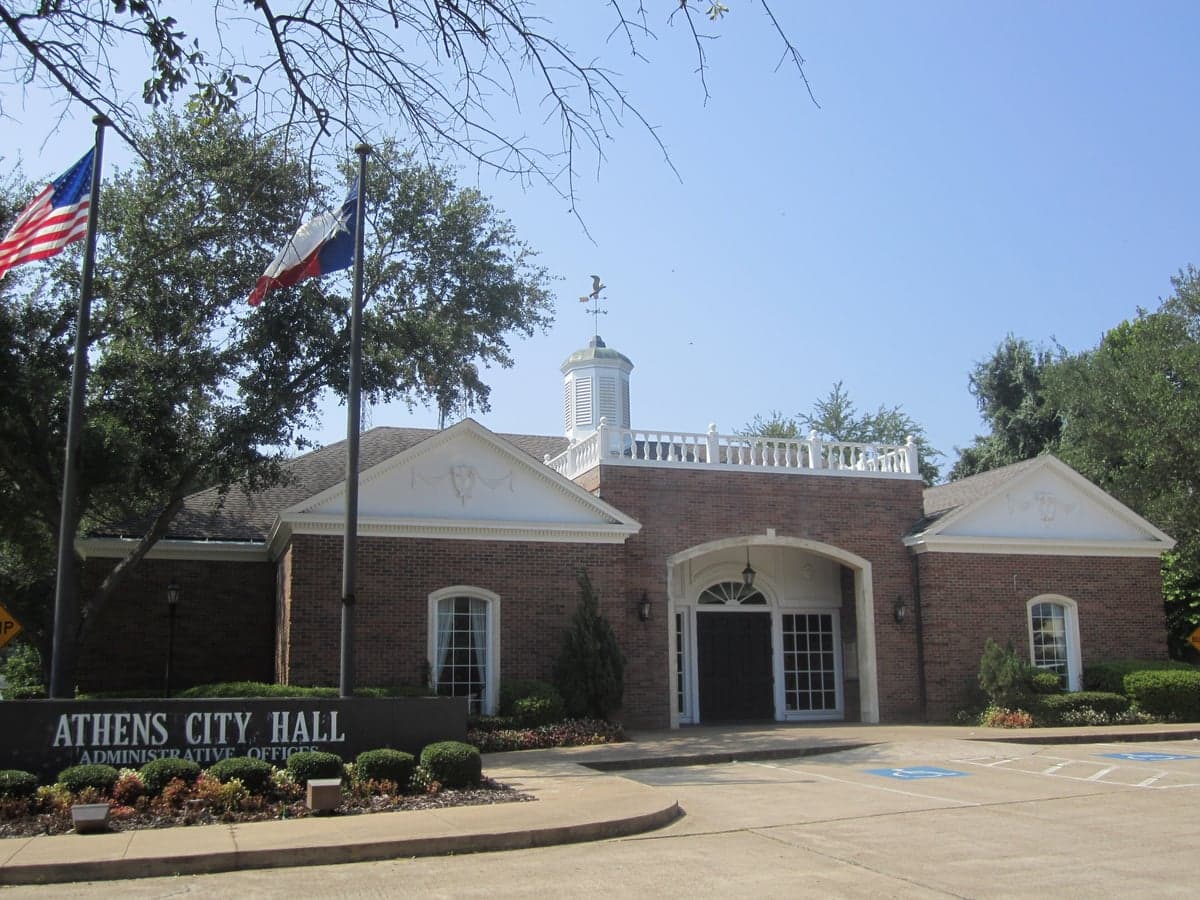
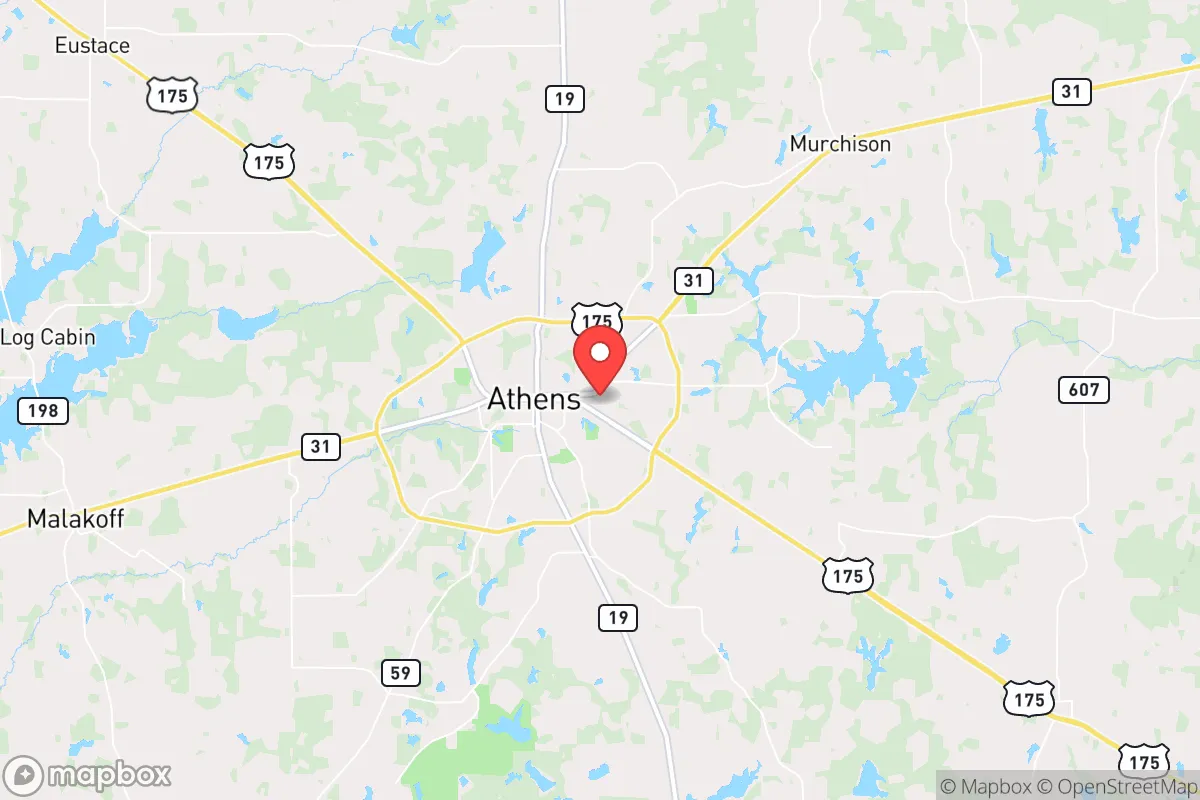
Photo: Wikipedia
Personal Sovereignty in Athens, TX
Strong independent fundamentals that actively favor personal liberty and low regulation.
What does Personal Sovereignty tell us?
Personal Sovereignty measures your capacity for self-reliance and independence with minimal government friction. Higher scores mean fewer barriers between you and the way you want to live... but it assumes you have the space you need and good neighbors.
What does this tell us?
Personal Sovereignty measures your capacity for self-reliance and independence with minimal government friction. Higher scores mean fewer barriers between you and the way you want to live... but it assumes you have the space you need and good neighbors.
State Policy
Energy independence: Net exporter (220% of energy produced in-state)
Personal Liberty
Homesteading

Personal Liberty Analysis
Athens, Texas, offers a notably high degree of personal sovereignty, anchored in Texas’s broad preemption of local regulations, a complete absence of state income tax, and some of the most permissive self-defense statutes in the nation. For a relocation audience weighing autonomy, the practical question is how Henderson County’s rural character and small-city governance translate into daily freedom. The short answer: the regulatory ceiling is low, the legal framework favors individual initiative, and the practical barriers to self-reliant living are minimal compared to most metro areas.
Tax burden and regulatory posture in Henderson County
Texas levies no state personal income tax, and Athens residents face a combined state and local sales tax rate of 8.25 percent — the state maximum, but with no wage withholding, the effective annual burden depends heavily on spending habits. Property taxes are the primary recurring cost, and Henderson County’s effective rate hovers around 1.5 to 1.7 percent of assessed value, which is mid-range for Texas but roughly double the national average. The trade-off is structural: the state funds services through consumption and property rather than earnings, meaning a household that keeps spending lean and property modest retains more of its gross income than in most states.
Regulatory posture is where Athens stands out. Texas’s 2019 law preempting local tree, fence, and vegetation ordinances means Henderson County cannot impose the kind of landscaping mandates common in suburban Houston or Dallas. There is no county-wide zoning in unincorporated Henderson County; land use is governed by subdivision regulations and state health codes rather than a planning commission’s aesthetic discretion. Inside Athens city limits, zoning exists but is light-touch — agricultural and residential uses are broadly permitted, and the city’s development code is a fraction of the length of comparable Texas towns. Permitting for a basic residential structure runs a few weeks, not months, and there is no county-wide building permit requirement for agricultural outbuildings on properties over 10 acres.
Self-defense and gun law specifics in Athens
Texas is a permitless carry state, and Athens fully reflects that. Since 2021, any adult 21 or older who can legally possess a firearm may carry it openly or concealed without a license, and Henderson County’s sheriff’s office has publicly stated it will not act as a de facto licensing authority. For those who still want a License to Carry for reciprocity in other states, the process is straightforward: a four-to-six-hour course, a background check, and a fee under $100, with Henderson County’s processing typically taking under 30 days.
Use-of-force law is equally permissive. Texas Penal Code Chapter 9.42 allows deadly force to protect property — not just person — during the nighttime, and the Castle Doctrine presumes a homeowner’s reasonable fear of deadly threat against an intruder. Stand-your-ground provisions mean no duty to retreat anywhere you are lawfully present. For practical purposes, an Athens resident has broader legal latitude to defend home, vehicle, and workplace than residents of all but a handful of other states. One caveat: 30.06 and 30.07 signage is enforceable, so businesses that post compliant notices can restrict carry, but Athens’s commercial district has few such postings.
Self-reliance and homesteading viability: lot sizes, zoning, and off-grid feasibility
Henderson County’s rural land market makes genuine homesteading attainable. Unincorporated county land has no minimum lot size for agricultural use; a 5-acre parcel is typical for a hobby farm, and 20-to-50-acre tracts are common within 15 minutes of downtown Athens. The county’s agricultural appraisal (1-d-1) can cut property taxes by 50 to 75 percent if the land is used for livestock, hay, or timber — a meaningful incentive for self-reliant households. Inside city limits, minimum lot sizes run 7,500 square feet in older neighborhoods and 10,000 square feet in newer subdivisions, which is ample for substantial vegetable gardens and small livestock, though chickens are capped at six hens per household in town.
Off-grid feasibility is real but not frictionless. Texas has no state law prohibiting rainwater harvesting — in fact, it incentivizes it with a property tax exemption for rainwater collection equipment — and Henderson County imposes no restrictions on cisterns or wells. Solar panels require only an electrical permit, and net metering is available through the local electric cooperative, Trinity Valley EC, though at a buyback rate below retail. The practical constraint is wastewater: the county requires a licensed septic system for any habitable structure, and composting toilets alone do not satisfy the health code. A household wanting full off-grid independence should budget $15,000 to $25,000 for a conventional septic system, which is the single largest regulatory hurdle to complete autonomy.
Personal liberties: parental rights, medical autonomy, speech, and property
Parental rights in Athens are among the strongest in the nation, reflecting Texas’s 2023 reforms that barred school mask mandates, prohibited most library content challenges from overriding parental objections, and created a private right of action against school districts that withhold information from parents. Athens ISD, a district of roughly 3,000 students, has no mask policy, no vaccine requirement beyond state exemptions, and its curriculum transparency portal allows parents to review all instructional materials. The district’s board has been consistently conservative on parental notification issues, and the state’s 2021 law requiring schools to notify parents of any mental health or counseling services remains fully implemented.
Medical autonomy is more mixed. Texas has no state income tax and no mandate for employer-provided health coverage, but it also has not expanded Medicaid, so low-income self-employed residents face a coverage gap. For those paying out of pocket, direct primary care practices are available in nearby Tyler and a handful in Athens, with monthly memberships typically $75 to $150. The state’s 2021 abortion law and 2023 gender-transition restrictions for minors mean medical choices for families are heavily constrained by state policy — a factor that cuts both ways depending on the reader’s values. For the conservative-leaning audience, the state’s posture on parental consent for minors’ medical care is a clear positive; for those seeking broad reproductive autonomy, it is a limitation.
Speech and property rights are lightly burdened. Athens has no noise ordinance beyond a general nuisance clause, no sign ordinance restricting political yard signs beyond size limits, and Henderson County does not enforce HOA covenants outside platted subdivisions. Property rights are further protected by Texas’s 2011 eminent domain reform, which requires condemning authorities to prove public use and pay fair market value plus attorney fees. The practical effect: a resident can fly a flag, post a sign, or run a small home business with minimal interference, provided the business does not generate excessive traffic or noise complaints.
Relative to other relocation destinations, Athens sits near the top of the sovereignty spectrum for a small Texas city. The combination of no income tax, permitless carry, stand-your-ground law, agricultural property tax relief, and minimal county zoning places it in the same tier as rural counties in Oklahoma, Wyoming, or Idaho — but with the advantage of Texas’s robust economy and the Dallas–Fort Worth metroplex within a 90-minute drive. The trade-offs are the property tax burden and the septic system requirement for off-grid living, both of which are manageable with planning. For a household that values keeping government at arm’s length while retaining access to urban infrastructure, Athens delivers a high degree of personal sovereignty with few practical compromises.

* Values derived from national, state, county, city and local statistics and may differ in a specific area. Last updated: 2026-10-21T10:06:11.000Z
Narrative content on this page is AI-generated and may contain mistakes. Verify any details that matter before acting on them.
ReloMaps may earn a commission from affiliate links at no extra cost to you.

