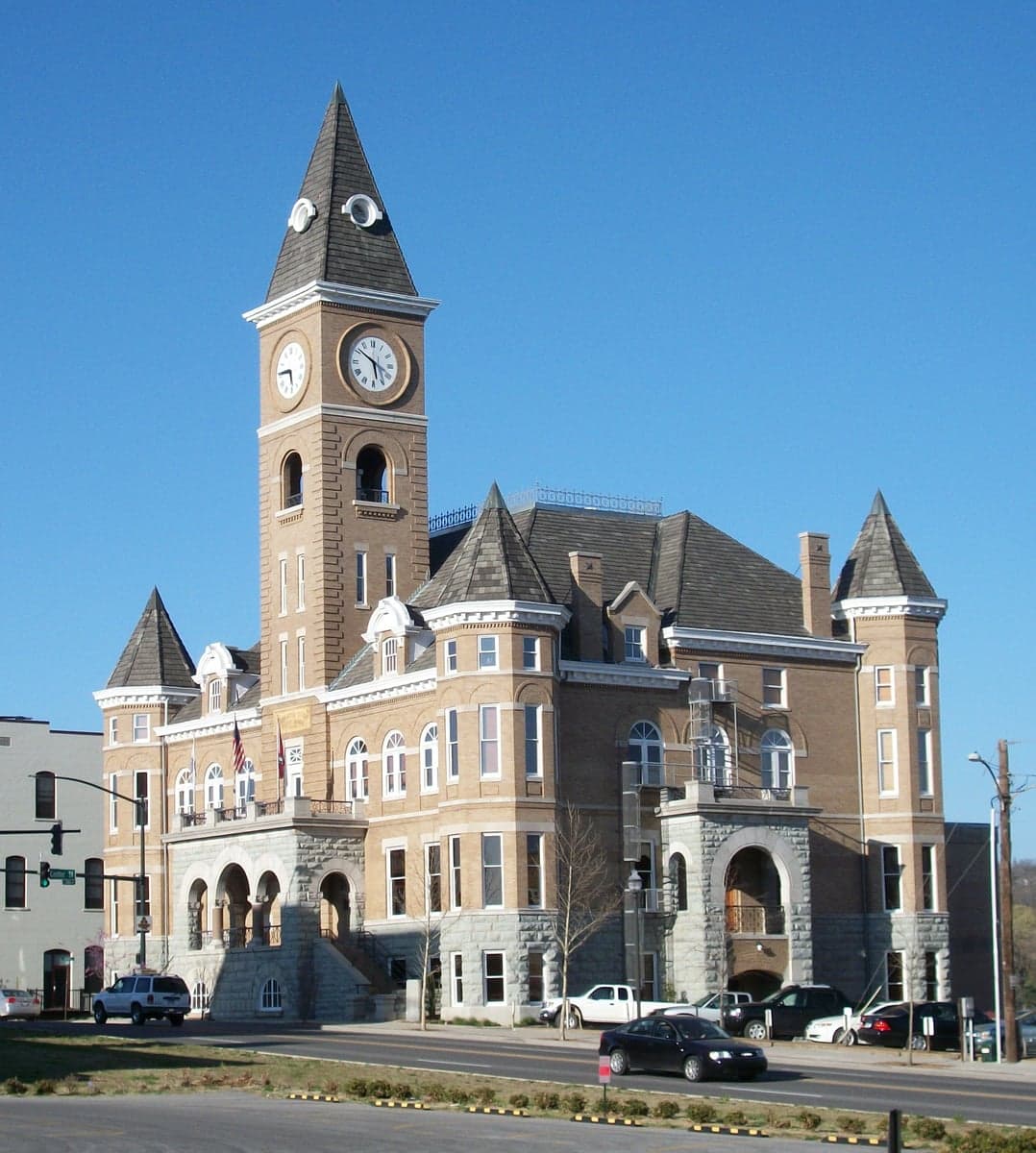
Photo: Wikipedia
Demographics of Washington County
Affluence Level in Washington County
A middle-class area roughly in line with national averages across income, home values, education, and employment.
People of Washington County
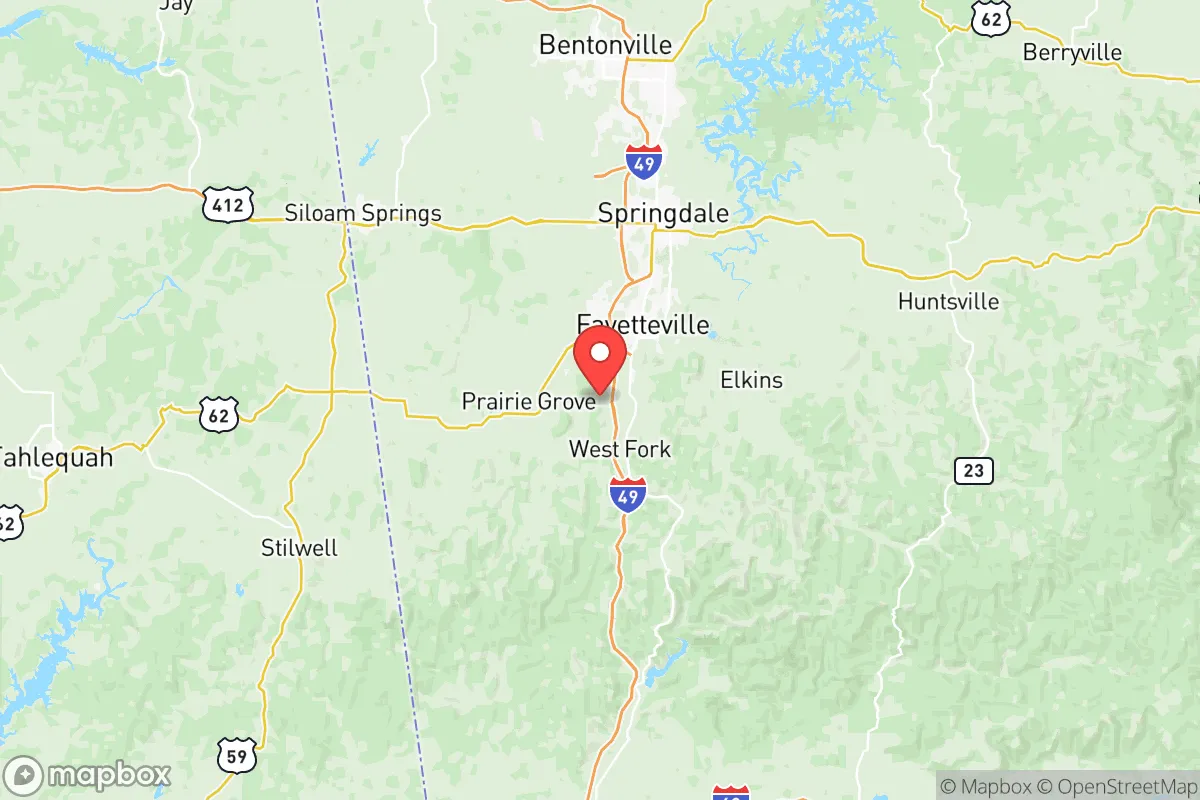
Today, the people of Washington County, Arkansas form a rapidly growing, increasingly diverse population of 251,863, anchored by the twin cities of Fayetteville and Springdale. The county is characterized by a youthful, college-educated workforce—34.6% hold a bachelor's degree or higher—driven by the presence of the University of Arkansas in Fayetteville, while maintaining a distinctly conservative-leaning cultural identity in its rural and suburban stretches. A majority-white population (62.7%) coexists with a substantial and growing Hispanic community (18.3%), a smaller but established Black population (3.1%), and growing East/Southeast Asian (1.9%) and Indian-subcontinent (0.4%) communities, creating a demographic profile that blends traditional Ozarks roots with new immigrant energy.
Settlement & growth (pre-1960)
Long before European settlement, the area now known as Washington County was home to the Osage and Caddo nations, who used the Ozark highlands and the Illinois River Valley for hunting and seasonal habitation. The first permanent American settlers arrived in the 1820s and 1830s, primarily Scots-Irish and English families migrating from Tennessee, Kentucky, and Missouri. These early pioneers were drawn by the promise of cheap, fertile land in the Arkansas Ozarks, establishing small farms and crossroads communities. The county was formally organized in 1828, and the town of Cane Hill became an early cultural and educational center, home to Cane Hill College (founded 1834), one of the first institutions of higher learning in the region.
The arrival of the St. Louis–San Francisco Railway (the "Frisco") in the 1880s transformed the county's settlement patterns. The railroad bypassed older towns like Cane Hill and Evansville, instead spurring rapid growth in Fayetteville, which became the county seat and commercial hub, and in Springdale, which emerged as a railroad town and agricultural shipping point. During this period, a small wave of German and Swiss immigrants settled in the county, particularly around Elm Springs and Tonitown, the latter founded by Italian immigrants in the 1890s as a wine-growing and fruit-farming colony. These European enclaves remained distinct for generations, with Tonitown's Italian heritage still visible in its annual grape festival and local surnames.
The early 20th century brought the poultry industry, which would come to define the county's economy and population growth. Springdale became the headquarters of Tyson Foods, founded in 1935, which drew a steady stream of domestic migrants from the rural South and Midwest seeking processing-plant and farming jobs. The Dust Bowl and Great Depression pushed additional families from Oklahoma and Texas into the county, many of them settling in Prairie Grove and Lincoln as tenant farmers or poultry growers. By 1960, Washington County's population had reached roughly 55,000, still overwhelmingly white and native-born, with a strong rural character centered on poultry, dairy, and apple orchards.
Modern era (post-1965)
The 1965 Hart-Cellar Act, combined with the explosive growth of the poultry industry, fundamentally reshaped Washington County's demographics. Beginning in the 1970s and accelerating through the 1990s, Tyson Foods and other poultry processors actively recruited immigrant labor to fill plant jobs that domestic workers increasingly avoided. The first major wave was of Marshallese immigrants from the Republic of the Marshall Islands, who began arriving in the 1970s under the Compact of Free Association; today, Springdale is home to the largest Marshallese community in the continental United States, estimated at over 10,000 people. A concurrent and larger wave of Mexican and Central American immigrants arrived from the 1980s onward, settling heavily in Springdale and Rogers (in adjacent Benton County), working in poultry processing, construction, and service industries. The Hispanic share of the county's population grew from negligible in 1970 to 18.3% by the 2020s, with vibrant commercial corridors along U.S. Highway 412 in Springdale and along Township Street in Fayetteville.
Domestic migration also accelerated dramatically after 1965, driven by the expansion of the University of Arkansas and the rise of Northwest Arkansas as a corporate hub. Fayetteville attracted a steady influx of college students, faculty, and professionals from across the country, giving the city a noticeably more liberal and cosmopolitan character than the rest of the county. The arrival of Walmart's headquarters in neighboring Bentonville (Benton County) and the growth of J.B. Hunt Transport and other corporations drew educated professionals from the Midwest, Northeast, and West Coast, many of whom settled in Fayetteville and the rapidly suburbanizing areas of Elm Springs and Johnson. This wave was predominantly white and college-educated, contributing to the county's high educational attainment rate (34.6%) and its political and cultural divide between the university town of Fayetteville and the more conservative, industrial suburbs and rural areas.
More recent immigration, post-2000, has added smaller but notable communities. A growing East/Southeast Asian population (1.9%) includes Vietnamese, Filipino, and Chinese families, many drawn by professional opportunities in the corporate and healthcare sectors. An Indian-subcontinent community (0.4%), primarily professionals in technology, medicine, and academia, has concentrated in Fayetteville near the university and in newer subdivisions. The Black population (3.1%) has grown modestly, with families settling across the county but with a visible presence in Fayetteville and Springdale, drawn by employment and the region's relatively lower cost of living compared to the West Coast or Northeast.
The future
Washington County is projected to continue growing at a rapid pace, with the Northwest Arkansas Council estimating the region could add another 100,000 residents by 2040. The county is becoming more diverse, driven primarily by the continued growth of the Hispanic population through both immigration and natural increase, and by the steady inflow of domestic migrants from more diverse states. The Marshallese community in Springdale is also growing through high birth rates, making the city one of the most ethnically distinct in the South. The East/Southeast Asian and Indian-subcontinent populations, while small, are likely to grow as the region's tech and healthcare sectors expand, though they will probably remain dispersed rather than forming dense ethnic enclaves.
The cultural identity of the county is evolving into a three-part divide: the liberal, university-oriented city of Fayetteville; the working-class, immigrant-rich, and conservative-leaning industrial corridor of Springdale and Johnson; and the rural, traditionally white, and deeply conservative towns of Prairie Grove, Lincoln, and West Fork. This fragmentation means that newcomers will find very different social and political environments depending on where they settle. The county is unlikely to become a uniformly liberal or uniformly conservative place; instead, it will remain a patchwork of distinct communities, each with its own demographic trajectory.
For someone moving in now, Washington County offers a choice: the college-town energy and cultural amenities of Fayetteville, the diverse, family-oriented, and industrious atmosphere of Springdale, or the quiet, traditional small-town life of Prairie Grove or Lincoln. The county's population is young, growing, and increasingly varied, but its political and cultural divisions mean that the experience of living here depends heavily on which of its many communities you call home.

* Values derived from national, state, county, city and local statistics and may differ in a specific area. Last updated: 2026-07-03T20:03:58.000Z
Narrative content on this page is AI-generated and may contain mistakes. Verify any details that matter before acting on them.
ReloMaps may earn a commission from affiliate links at no extra cost to you.

