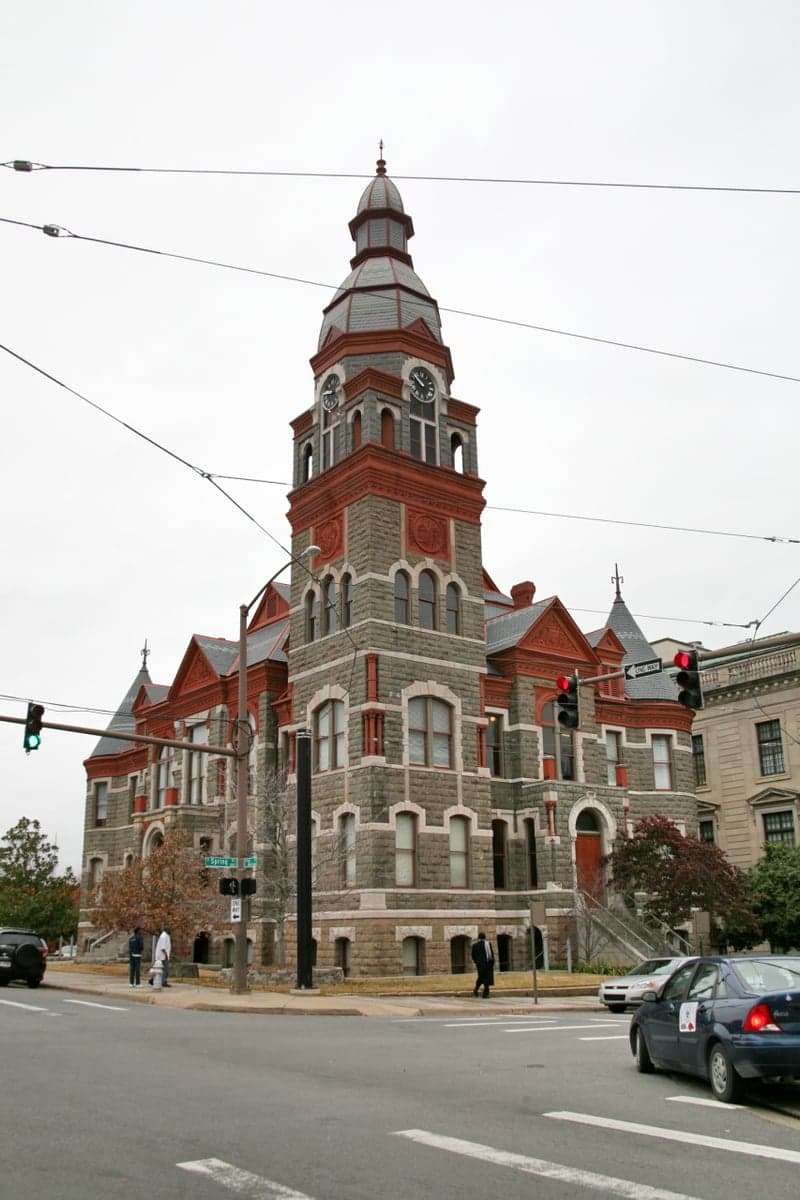
Photo: Wikipedia
Quality of Life in Pulaski County
A livable area that tracks near national norms for affordability, walkability, and neighborhood health.
What does Quality of Life tell us?
Quality of Life measures an area by evaluating factors like cost of living, nearby amenities, country club access, airport proximity, socioeconomic signals and neighborhood character. For large states, this is a general average — quality of life can vary dramatically between metro areas, suburbs, and rural communities within the same state.
What does this tell us?
Quality of Life measures an area by evaluating factors like cost of living, nearby amenities, country club access, airport proximity, socioeconomic signals and neighborhood character. For large states, this is a general average — quality of life can vary dramatically between metro areas, suburbs, and rural communities within the same state.
Cost of Living
18% below national average
106%
The Real Cost of Living in Pulaski County for 2026
| Tier | Individual | Family (4) |
|---|---|---|
| Survival | $17k | $31k |
| Comfortable | $39k | $57k |
| Luxury | $109k+ | $169k+ |
| Elite (Top 5%) | $161k+ | $250k+ |
Quality-of-Life Analysis
Pulaski County, Arkansas, offers a broad quality-of-life spectrum that ranges from the dense urban core of Little Rock to quiet, unincorporated crossroads communities, making it one of the most internally diverse counties in the state. The county’s character shifts noticeably as you move outward from the capital: young professionals and creatives cluster in the walkable neighborhoods of central Little Rock, families and commuters fill the suburban rings of North Little Rock and Sherwood, while retirees and rural homesteaders gravitate toward the lower-cost, slower-paced pockets near Wrightsville and the far reaches of the county’s eastern and western edges.
Largest town(s) & population centers
Little Rock, the state capital and the county’s anchor, is home to roughly 202,000 residents and serves as the region’s employment, cultural, and medical hub. Daily life here is defined by a mix of professional opportunities — major employers include the University of Arkansas for Medical Sciences (UAMS), the state government, and Dillard’s corporate headquarters — alongside a lively arts scene anchored by the Arkansas Arts Center and the River Market District. North Little Rock, with about 65,000 residents, sits directly across the Arkansas River and offers a more suburban feel with its own downtown revival along Main Street, plus the massive Burns Park recreation complex. Sherwood (pop. ~32,000) and Jacksonville (pop. ~29,000) function as classic bedroom communities: Sherwood is known for its strong school system and newer housing developments, while Jacksonville’s economy is heavily tied to the Little Rock Air Force Base and its 5,000 active-duty personnel. Commute times across these population centers average just over 20 minutes, well below the national norm, which is a significant draw for workers who want urban amenities without long drives.
Smaller towns & rural pockets
Beyond the main cities, Pulaski County contains several distinct smaller communities that offer a markedly different pace. Maumelle (pop. ~19,000) is a planned community northwest of Little Rock that blends suburban convenience with lake access — it consistently ranks among Arkansas’s safest cities and attracts families willing to pay a slight premium for newer infrastructure. Cammack Village, a tiny independent city of about 800 residents entirely surrounded by Little Rock, maintains its own police force and zoning laws, giving it a small-town feel within the metro area. On the rural side, Wrightsville (pop. ~2,100) in the southern part of the county is a low-density farming community with a median home value around $100,000 — roughly half the county average — and limited retail options. Unincorporated areas like Sweet Home and Gravel Ridge offer true rural living with well water and septic systems, though residents must commute 15–25 minutes to reach grocery stores or medical facilities. The county’s far eastern edge, near the Pulaski/Lonoke county line, consists of scattered homes on acreage with no municipal services, appealing to those who prioritize land and privacy over convenience.
Cost & lifestyle range
The countywide cost of living index of 82 (100 = U.S. average) masks significant internal variation. At the high end, Maumelle and the Chenal Valley area of west Little Rock see median home values above $350,000 and monthly rents exceeding $1,400, reflecting newer construction, golf course communities, and proximity to top-rated schools like Pulaski Academy. At the low end, Wrightsville and parts of southwest Little Rock (ZIP 72206) have median home values below $120,000 and rents as low as $750, with older housing stock and fewer nearby amenities. The county median home value of $199,600 and median rent of $1,036 sit squarely in the middle, meaning a household earning $55,000 can afford a typical mortgage or lease in most areas — but the same budget buys a 1,500-square-foot house in Sherwood versus a 2,500-square-foot house on acreage in rural eastern Pulaski. Amenity access follows the same gradient: residents in central Little Rock walk to restaurants and museums, while those in Gravel Ridge drive 20 minutes for a sit-down meal. Property taxes also vary, with millage rates ranging from roughly 42 mills in Maumelle to 55 mills in parts of the Little Rock School District, directly affecting monthly housing costs.
Pulaski County best suits people who want the economic and cultural opportunities of a mid-sized capital city but need the flexibility to choose their preferred density and price point. Young professionals and empty-nesters thrive in the walkable, amenity-rich core of Little Rock and North Little Rock. Families with school-age children tend to favor Sherwood, Maumelle, or the Chenal Valley corridor for their school ratings and newer housing stock. Rural homesteaders and budget-conscious buyers find their niche in Wrightsville, Sweet Home, or the unincorporated eastern fringe, where land is cheap and neighbors are few. The county’s internal diversity means that a single metro area can accommodate a software engineer, a farmer, and a retiree — each living in a fundamentally different environment, yet all within a 25-minute commute of the state capitol.

Crime in Pulaski County
Crime rates similar to the national median for U.S. locations.
Violent CrimeViolent Crime Analysis
Property CrimeProperty Crime Analysis
Crime Analysis
Pulaski County's violent crime rate of 523.1 incidents per 100,000 residents exceeds the national average by over 30%, while property crime at 1,634.7 per 100,000 remains well above Arkansas's state average—a pattern driven largely by Little Rock and North Little Rock under progressive prosecutorial policies. The county's overall safety picture is uneven, with some suburbs reporting dramatically lower crime rates while the urban core struggles with recidivism and under-enforcement. Residents considering relocation should weigh these disparities carefully, especially given the influence of elected district attorneys who emphasize alternatives to incarceration over public safety.
Crime in context
Pulaski County's violent crime rate of 523.1 per 100K is roughly 35% higher than the national average (approximately 380 per 100K) and comparable to or above the Arkansas state rate, which hovers near 550 per 100K. Property crime at 1,634.7 per 100K exceeds both the U.S. average (about 1,950 per 100K) and the state average (roughly 2,500 per 100K) when factoring in theft- and burglary-heavy municipalities like Jacksonville. A key driver is the Sixth Judicial District, which covers Pulaski County and has been led by progressive prosecutors who support diversion programs, reduced bail, and minimal jail time for nonviolent offenders. Critics argue that these policies increase recidivism and embolden property and street-level violent crime, as repeat offenders cycle quickly back into neighborhoods. Little Rock alone accounts for the majority of the county's violent incidents, with North Little Rock adding a disproportionate share.
What residents experience
Daily life for Pulaski County residents varies sharply by jurisdiction. In Little Rock, vehicle break-ins, package thefts, and aggravated assaults are common concerns, particularly in central and southwest neighborhoods. North Little Rock sees similar patterns, with property crimes concentrated near commercial corridors like McCain Boulevard and Interstate 40. Meanwhile, suburbs such as Maumelle and Sherwood report significantly lower crime rates—Maumelle's violent crime rate is roughly one-third of Little Rock's—thanks to smaller populations and more conservative municipal courts. Residents in these safer areas still experience occasional thefts but describe day-to-day security as closer to national suburban averages. Jacksonville, home to the Little Rock Air Force Base, has moderate property crime but lower violent crime than the urban core, though the city's proximity to North Little Rock can spill occasional incidents.
Neighborhood-level variation is stark. West Little Rock (ZIP 72223) and the Chenal Valley area have rates well below the county average, supported by private patrols and higher property values. Conversely, downtown Little Rock, the John Barrow neighborhood, and parts of South Little Rock near Asher Avenue and the I-30 corridor see violent crime rates two to three times the county average. The Pulaski County Sheriff's Office and local police departments have adopted community policing and targeted patrols, but the overall impact is blunted by district court policies that favor plea bargains and early release. For prospective residents, maumelle, sherwood, and selected west little rock communities offer the lowest objective risk, while anyone considering central Little Rock or North Little Rock should research block-level statistics and attend local crime-prevention meetings.
* Values derived from national, state, county, city and local statistics and may differ in a specific area. Last updated: 2026-06-16T02:00:33.000Z
Narrative content on this page is AI-generated and may contain mistakes. Verify any details that matter before acting on them.
ReloMaps may earn a commission from affiliate links at no extra cost to you.

