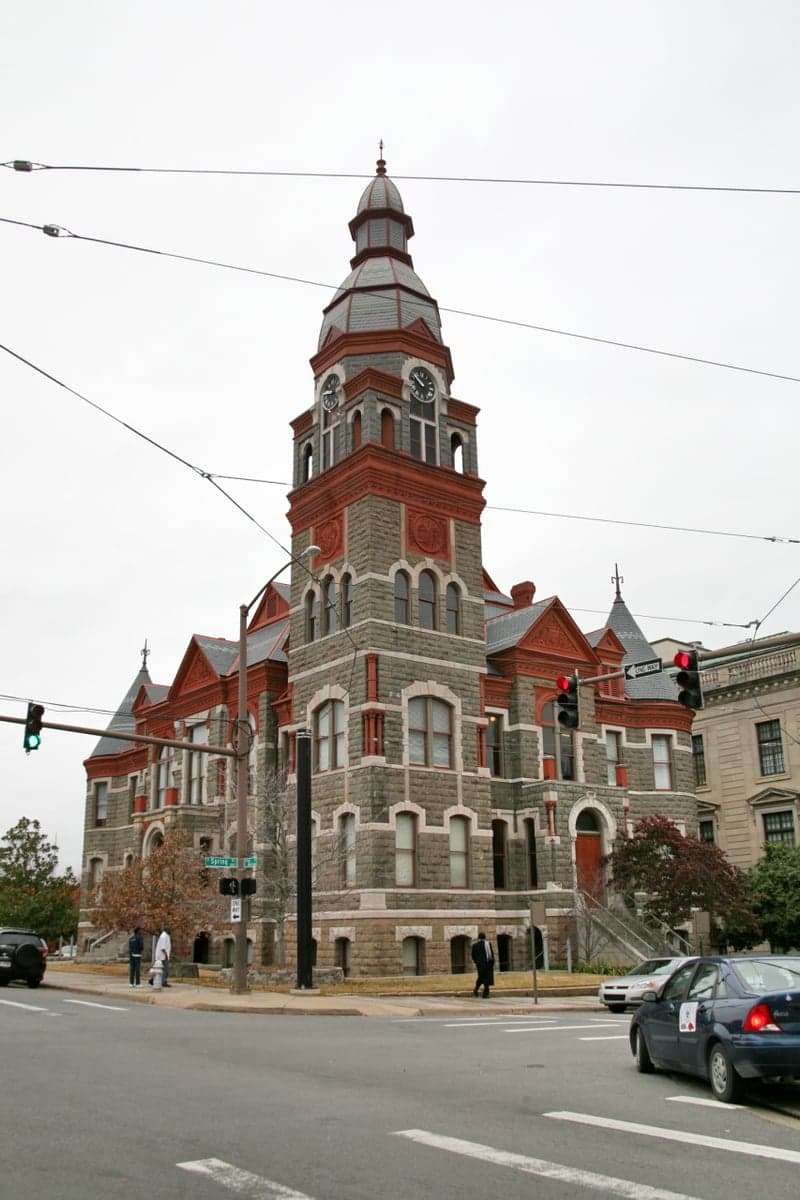
Photo: Wikipedia
Personal Sovereignty in Pulaski County
Viable for self-reliance. Generally workable, though some barriers may limit total independence.
What does Personal Sovereignty tell us?
Personal Sovereignty measures your capacity for self-reliance and independence with minimal government friction. Higher scores mean fewer barriers between you and the way you want to live... but it assumes you have the space you need and good neighbors.
What does this tell us?
Personal Sovereignty measures your capacity for self-reliance and independence with minimal government friction. Higher scores mean fewer barriers between you and the way you want to live... but it assumes you have the space you need and good neighbors.
State Policy
Energy independence: Importer (35% of energy produced in-state)
Personal Liberty
Homesteading

Personal Liberty Analysis
Pulaski County, Arkansas, offers a notably high degree of personal sovereignty relative to many urbanized Southern counties, blending a generally light-touch state regulatory environment with the practical realities of a mid-sized metropolitan area centered on Little Rock. While Arkansas as a whole leans heavily toward individual autonomy in areas like taxation, self-defense, and property rights, Pulaski County’s status as the state’s population and government hub introduces some localized nuances—particularly within the Little Rock city limits versus its more rural suburbs and unincorporated areas. For a conservative-leaning individual or family weighing relocation, the county presents a spectrum of freedom, from the relatively hands-off posture of outlying communities like Maumelle, Sherwood, and North Little Rock to the more regulated environment inside Little Rock proper and the distinctively independent vibe of Jacksonville and Alexander.
Tax burden and regulatory posture: How Arkansas compares to surrounding states
Arkansas maintains one of the lighter tax and regulatory climates in the South, and Pulaski County largely reflects that state-level posture. There is no state-level property tax; instead, property taxes are assessed at the county and municipal level, with Pulaski County’s millage rate averaging around 55 to 60 mills depending on the city and school district. This is moderate by national standards but noticeably lower than in high-tax states like New York or Illinois. The state income tax is a flat 4.4% (as of 2026) on most income, with a lower rate for lower brackets—competitive with neighboring Tennessee (which has no income tax but higher sales taxes) and Texas (no income tax, but higher property taxes). Sales tax in Pulaski County varies by city: Little Rock’s combined rate is 9.125%, while Maumelle and Sherwood sit at 8.5% and Jacksonville at 9.0%. Regulatory posture is generally business-friendly at the state level, with no state-level minimum wage above the federal $7.25, no state-level paid leave mandates, and a right-to-work law. However, within Pulaski County, Little Rock has enacted a local minimum wage ordinance ($13.00/hour as of 2026) and has stricter rental inspection and zoning codes than its suburbs. For a reader prioritizing low regulatory overhead, the unincorporated areas of the county or cities like Maumelle and Sherwood offer a notably lighter touch than the capital city itself.
Self-defense and gun law specifics: Constitutional carry and local enforcement culture
Arkansas is a constitutional carry state, meaning no permit is required to carry a concealed or open handgun for anyone legally allowed to possess a firearm. This applies uniformly across Pulaski County, with no local ordinances that override state preemption—a critical point for sovereignty-minded residents. The state also has a strong "stand your ground" law with no duty to retreat in any place where a person is lawfully present. Pulaski County’s sheriff’s office and local police departments generally respect these laws, though enforcement culture varies: Little Rock police have a reputation for being more proactive in stops and checks, while Sherwood and Maumelle departments are known for a more hands-off, community-oriented approach. The county does have a higher violent crime rate than the state average—Little Rock’s violent crime rate is roughly 1,500 per 100,000 residents, compared to the state average of about 600—which makes the practical exercise of self-defense rights more relevant for daily life. Gun ranges and training facilities are plentiful, with Arkansas Armory in North Little Rock and Central Arkansas Gun Club in Alexander offering both indoor and outdoor options. For a family or individual who views firearm ownership as a core personal liberty, Pulaski County provides a legal framework that is among the most permissive in the nation, with the caveat that the higher-crime areas of Little Rock make situational awareness and defensive capability more than theoretical.
Self-reliance and homesteading viability: Lot sizes, zoning, and off-grid feasibility
Homesteading and off-grid living are viable in Pulaski County, but feasibility varies dramatically by location. The county’s zoning is a patchwork: Little Rock’s city limits impose minimum lot sizes of 6,000 to 10,000 square feet in most residential zones, with strict building codes that effectively prohibit off-grid systems like composting toilets or solar-only power without permits and inspections. In contrast, unincorporated areas of Pulaski County—particularly around Alexander, Wrightsville, and the rural fringes near the Saline County line—have no minimum lot size in many agricultural zones, and county building codes are minimal. A five-acre parcel in Alexander can be purchased for under $50,000, and many properties already have wells and septic systems. Raising chickens, goats, or even a small cow is legal in unincorporated areas and in most of Jacksonville’s agricultural-residential overlay zones. Off-grid solar is permitted statewide with no net metering requirement, though connecting to the grid requires utility approval (Entergy Arkansas is the dominant provider). Rainwater collection is legal and encouraged. For a family seeking genuine self-reliance, the rural southern and western edges of Pulaski County—near the community of Hensley or along Highway 365—offer the most freedom, while the suburban cities like Maumelle and Sherwood allow hobby farming but with more restrictive covenants in newer subdivisions.
Personal liberties: Parental rights, medical autonomy, speech, and property
Arkansas has been a national leader in codifying parental rights, with the Arkansas Parental Rights Amendment (passed in 2024) enshrining parents’ authority over their children’s education, healthcare, and upbringing into the state constitution. This applies uniformly across Pulaski County, though school district policies vary: Little Rock School District has been more progressive on curriculum and health policies, while Pulaski County Special School District (covering most of the county outside Little Rock) and North Little Rock School District have adopted more traditional stances. Medical autonomy is strong—Arkansas has no state-level vaccine mandates for adults, and the Arkansas Medical Freedom Act (2023) prohibits discrimination based on vaccination status. However, hospitals in Little Rock (UAMS, Baptist Health) follow standard CDC protocols for inpatients. Speech protections are robust, with no state-level hate speech laws and a strong public forum tradition; the Arkansas Capitol grounds in Little Rock are a frequent site for protests and rallies without significant permit restrictions. Property rights are protected by a state-level private property rights protection act that requires compensation for any regulatory taking, and Pulaski County’s planning departments are generally responsive to landowners. For a reader prioritizing these liberties, the county offers a legal environment that is among the most protective in the South, with the primary friction point being the higher regulatory density inside Little Rock itself.
Overall, Pulaski County delivers a strong sovereignty profile for a metropolitan area, ranking favorably against peer counties like Shelby County (Memphis), TN, or Dallas County, TX, both of which have higher tax burdens and more restrictive gun laws. The key trade-off is between the convenience and amenities of Little Rock—which comes with more regulation and higher crime—and the greater autonomy found in the county’s suburban and rural communities. For a family or individual who values personal freedom above all, the unincorporated areas and smaller cities like Alexander, Wrightsville, and Hensley offer a level of self-reliance and low regulatory overhead that is rare within an hour’s drive of a state capital. The county is not a libertarian utopia—zoning and building codes exist, and property taxes are not negligible—but it provides a solid foundation for a life built on individual responsibility and minimal government interference.

* Values derived from national, state, county, city and local statistics and may differ in a specific area. Last updated: 2026-06-16T02:00:33.000Z
Narrative content on this page is AI-generated and may contain mistakes. Verify any details that matter before acting on them.
ReloMaps may earn a commission from affiliate links at no extra cost to you.

