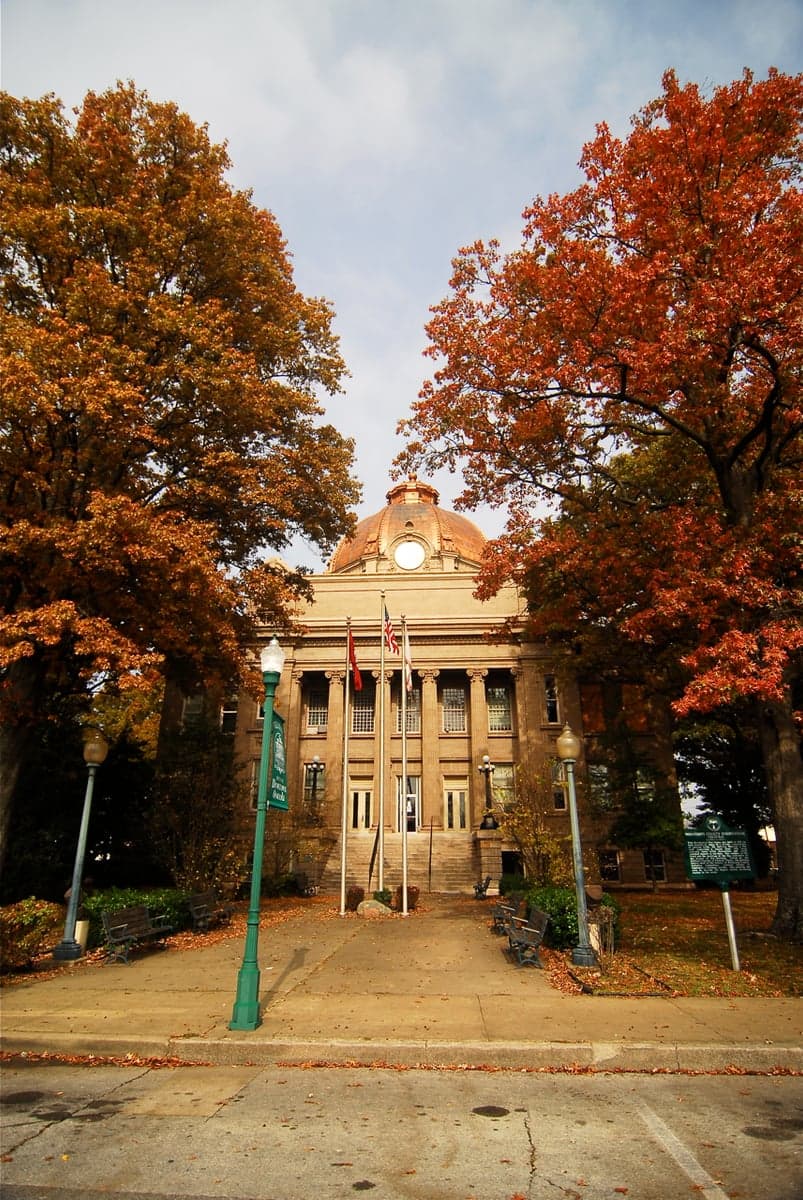
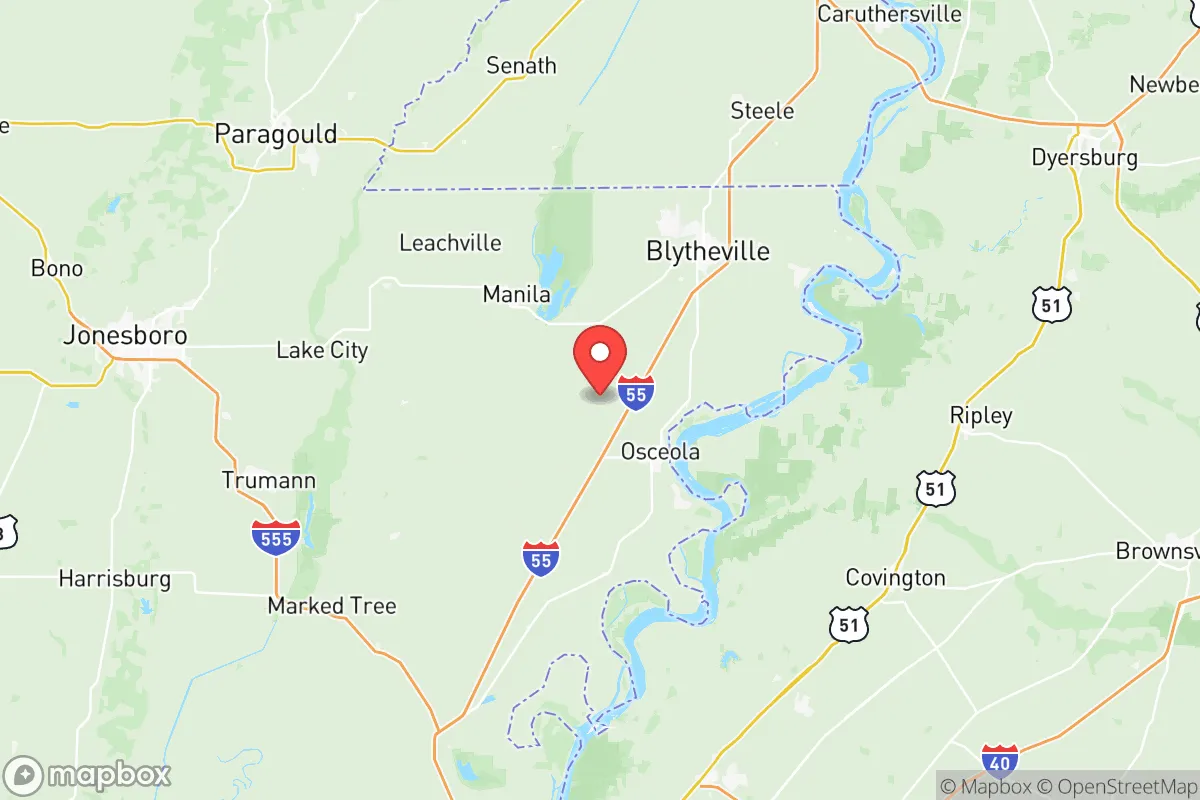
Photo: Wikipedia
Political ClimatePolitical Climate in Mississippi County
Showing district-level results — no local-only data available.
Local Political AnalysisPolitical Analysis of Mississippi County
Mississippi County, Arkansas, is one of the most reliably Republican areas in the entire state, carrying a Cook Partisan Voting Index (PVI) of R+23. That’s a full seven points more conservative than the state of Arkansas as a whole, which sits at R+16. This isn’t a recent shift—the county has been trending red for decades, and the 2024 presidential race saw it vote roughly 72% Republican, a margin that’s become the new normal. But if you spend any time here, you’ll notice the political reality isn’t a monolith; the county’s industrial and agricultural roots create a few interesting pockets of blue, particularly in the Mississippi River towns.
How it compares
The R+23 PVI puts Mississippi County in the same league as the state’s deepest-red rural counties, but its internal geography tells a more nuanced story. The county seat, Blytheville, is the largest population center and leans slightly more Democratic than the rest of the county, thanks to a higher concentration of union workers tied to the steel mills and manufacturing plants along the river. In 2020, Blytheville precincts around the industrial corridor voted about 55% Democratic, while the rural precincts outside town—places like Osceola and Luxora—went 75-80% Republican. The swing precincts are in the middle-ring suburbs of Manila and Keiser, where independent voters often decide local races. Compared to Arkansas as a whole, Mississippi County is less influenced by the urban-suburban split you see in Central Arkansas (Little Rock) or Northwest Arkansas (Fayetteville). Here, the divide is more about economic sector: agricultural landowners and small-town business owners vote solidly red, while hourly industrial workers in the river towns are the county’s only reliable blue bloc.
What this means for residents
For conservative residents, the political climate is comfortable and reflective of their values. Local offices—county judge, sheriff, quorum court—are held by Republicans, and policy tends to favor low taxes, gun rights, and limited regulation. The county’s economic development board, which focuses on attracting industrial investment to the Mississippi River ports, operates with strong GOP support. For liberal residents, the reality is more about finding community in specific neighborhoods or workplaces. The Democratic stronghold in Blytheville’s industrial wards means there’s a visible labor-union presence, and the local NAACP chapter remains active on voting access and equity issues. But statewide, the county’s R+23 lean means Democratic candidates rarely campaign here outside of the primary season. The practical effect for both sides: political conversations are common but rarely heated, as most people agree on the basics—jobs, infrastructure, and keeping the river ports competitive.
Culturally, Mississippi County stands apart from the rest of Arkansas in a few ways. The county’s location on the Missouri border and its history as a steel and cotton hub give it a distinct Mid-South identity, closer to Memphis than Little Rock. You’ll hear more talk about the Mississippi River levee system and barge traffic than about the Ozarks or the state capitol. Policy-wise, the county has been a testing ground for economic development incentives tied to the steel industry, with local leaders often pushing for state-level tax breaks that benefit industrial recruitment—a pragmatic approach that sometimes puts the county at odds with the more tourism-focused parts of Arkansas. The long-term trajectory looks steady: expect the R+23 lean to hold, with the industrial towns providing a small but persistent counterbalance to the rural Republican majority.

State Political ClimatePolitical Climate in Arkansas
State Political AnalysisPolitical Environment in the State
Arkansas is a deeply Republican state, carrying a Cook PVI of R+16, a shift that has solidified over the past two decades. The state was once a Democratic stronghold in the post-Reconstruction era, but a rapid realignment began in the 2000s, and today the GOP holds every statewide office, both U.S. Senate seats, and supermajorities in the state legislature. The dominant coalition is a mix of rural conservatives, evangelical Christians, and a growing number of transplants from other red states, while the Democratic base is increasingly confined to the urban cores of Little Rock, Fayetteville, and Pine Bluff, plus a handful of majority-Black counties in the Delta.
Urban vs. rural divide
The political map of Arkansas is starkly divided. The northwest corner, anchored by Fayetteville and Bentonville, is the state's economic engine and a Republican stronghold, though it has a small but growing progressive enclave around the University of Arkansas. Central Arkansas, including Little Rock and its suburbs, is more competitive: Pulaski County (Little Rock) is the state's only reliably blue urban county, but the surrounding suburbs like Conway and Bryant lean heavily red. The Delta region, including Pine Bluff and West Memphis, is predominantly Black and votes Democratic, but turnout is low and populations are shrinking. The rest of the state — the Ozarks, the River Valley, and the southern timberlands — is overwhelmingly Republican, with many counties routinely voting 70-80% for the GOP. The divide is less about culture war flashpoints and more about economic geography: the northwest is booming with corporate headquarters (Walmart, Tyson, J.B. Hunt), while the Delta and parts of the south are struggling with population loss and limited opportunity.
Policy environment
Arkansas's policy environment is consistently conservative. The state has a flat income tax rate of 4.4% (down from 7% a decade ago), a low sales tax burden, and no estate tax. Property taxes are among the lowest in the nation, though local school millage rates vary. The regulatory posture is business-friendly, with right-to-work laws and minimal zoning restrictions outside of a few cities. Education policy has been a battleground: the state passed the LEARNS Act in 2023, which created a universal school voucher program, expanded charter schools, and banned "critical race theory" and "indoctrination" in classrooms. Healthcare is a mixed bag: Arkansas expanded Medicaid under the private option model, but the state has some of the strictest abortion laws in the country, with a near-total ban in effect since the 2022 trigger law. Election laws have tightened: voter ID is required, absentee ballot drop boxes are banned, and early voting hours were reduced in 2021. The state also passed a law in 2023 making it a felony for non-citizens to vote, though such cases are virtually nonexistent.
Recent policy direction
The last three years have seen a sharp rightward turn. On gun rights, Arkansas became a permitless carry state in 2021, and in 2023 it passed a "Second Amendment Sanctuary" law prohibiting state enforcement of any future federal gun restrictions. On parental and education rights, the LEARNS Act (2023) is the flagship: it allows state funds to follow students to private or homeschool settings, bans instruction on sexual orientation and gender identity in K-3, and requires schools to notify parents of any "mental, emotional, or physical health" changes in their child — a provision critics say targets LGBTQ+ students. On speech and privacy, the state passed a law in 2023 requiring age verification for adult websites and another restricting social media platforms from "censoring" political speech. Medical and bodily autonomy is heavily restricted: abortion is banned with no exceptions for rape or incest, only to save the mother's life. Gender-affirming care for minors was banned in 2021, and the state has threatened to prosecute doctors who provide it. Property rights are generally strong, with no statewide rent control and limited eminent domain use. Taxation is trending downward: the flat income tax is scheduled to drop to 3.9% by 2027. Voting access has been restricted: the 2021 law eliminated straight-ticket voting, shortened the early voting window, and made it harder to cure absentee ballot errors.
Civil unrest & political movements
Arkansas has not seen the large-scale protests of states like Oregon or Georgia, but there have been notable flashpoints. In 2020, Little Rock saw several nights of protests after the George Floyd killing, with some property damage and a heavy police response. The state's largest organized activist movement is on the right: the Arkansas Family Council and local Moms for Liberty chapters have been highly effective at pushing school board elections and curriculum battles, particularly in Bentonville and Rogers. On the left, the Arkansas Public Policy Panel and Indivisible chapters in Fayetteville and Little Rock organize around voting rights and Medicaid expansion. Immigration politics are less heated than in border states, but Springdale and Rogers have growing Marshallese and Hispanic populations, leading to some local tensions over housing and language access. There is no serious secession or nullification movement, though the state's 2023 "Second Amendment Sanctuary" law is a form of nullification rhetoric. Election integrity controversies have been minimal compared to states like Arizona or Georgia; the 2020 and 2022 elections were administered without major incident, though the state GOP has pushed for further restrictions.
Projection
Over the next 5-10 years, Arkansas is likely to become even more Republican, but with a twist. The northwest corridor — Fayetteville, Bentonville, Rogers, and Springdale — is growing fast, attracting both conservative families from California and Texas and a smaller number of younger, more liberal professionals. This could create a Bentonville suburb that is less uniformly red than the rest of the state, similar to what happened in the Dallas-Fort Worth suburbs. Meanwhile, the Delta will continue to shrink and lose political clout. The state's tax-cutting trajectory is likely to continue, with the flat income tax possibly eliminated entirely. Social policy will remain conservative, but there may be a slight moderation on economic issues as the business community pushes for workforce development and infrastructure. The biggest wildcard is the LEARNS Act: if it succeeds in improving educational outcomes, it could cement the state's reputation as a school choice leader; if it fails, it could spark a backlash. For a new resident, the state will remain a low-tax, low-regulation environment with a strong conservative social culture, but the urban-rural gap will widen, and the northwest will become increasingly distinct from the rest of the state.
For a new resident, the bottom line is this: Arkansas is a state where conservative values are the default in both policy and daily life, and where the government is generally hands-off on economic matters but highly involved in social ones. If you're a conservative, you'll find a welcoming environment with low taxes, strong gun rights, and a school choice system that is expanding rapidly. If you're a liberal, you'll find a small but active community in Little Rock and Fayetteville, but you'll also face a state government that is actively hostile to many of your priorities, from abortion access to LGBTQ+ rights to voting access. The state is not a battleground — it's a settled red state, and the direction of travel is clear. The practical takeaway: know what you're signing up for, and choose your city carefully, because the experience of living in Bentonville versus Pine Bluff is as different as two states.
* Values derived from national, state, county, city and local statistics and may differ in a specific area. Last updated: 2026-06-23T15:07:02.000Z
Narrative content on this page is AI-generated and may contain mistakes. Verify any details that matter before acting on them.
ReloMaps may earn a commission from affiliate links at no extra cost to you.

