
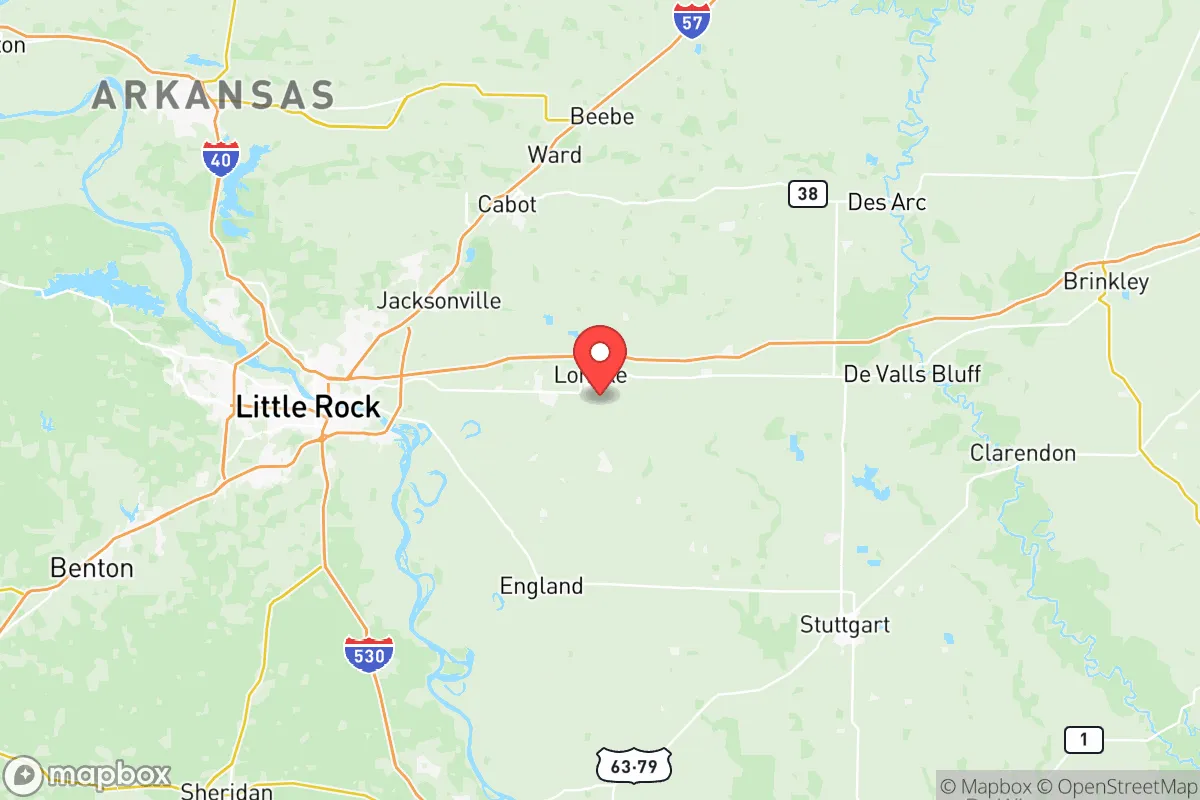
Photo: Wikipedia
Personal Sovereignty in Lonoke County
Viable for self-reliance. Generally workable, though some barriers may limit total independence.
What does Personal Sovereignty tell us?
Personal Sovereignty measures your capacity for self-reliance and independence with minimal government friction. Higher scores mean fewer barriers between you and the way you want to live... but it assumes you have the space you need and good neighbors.
What does this tell us?
Personal Sovereignty measures your capacity for self-reliance and independence with minimal government friction. Higher scores mean fewer barriers between you and the way you want to live... but it assumes you have the space you need and good neighbors.
State Policy
Energy independence: Importer (35% of energy produced in-state)
Personal Liberty
Homesteading

Personal Liberty Analysis
Lonoke County, Arkansas, offers a notably high degree of personal sovereignty, grounded in the state’s strong constitutional protections for individual rights and a consistently low-tax, low-regulation environment. For those prioritizing autonomy—whether in self-defense, family decisions, or self-reliant living—the county provides a legal and cultural framework that is among the most permissive in the South. While the county seat of Lonoke and the growing suburb of Cabot exhibit slightly more structured governance, the broader rural landscape, including towns like England, Carlisle, and Ward, leans heavily toward minimal government interference in daily life.
Tax burden and regulatory posture in Lonoke County
Arkansas maintains one of the lightest tax burdens in the nation, and Lonoke County residents benefit directly. There is no state-level property tax; instead, local millage rates apply, typically ranging from 45 to 55 mills depending on the school district. For a $200,000 home, annual property taxes often fall between $900 and $1,100—significantly lower than in neighboring states like Texas or Tennessee. The state income tax is a flat 4.9% as of 2026, with a standard deduction that shelters much of a middle-class family’s earnings. Sales tax in the county is 9.5% (6.5% state plus 3% county), which is moderate for the region. Regulatory posture is equally hands-off: there is no statewide building code in unincorporated areas, no mandatory vehicle emissions testing, and business licensing requirements are minimal. In towns like Austin and Ward, starting a home-based business requires only a simple local permit, and zoning is largely absent outside of Cabot’s planned subdivisions. This creates an environment where residents can build, operate, and live with far fewer bureaucratic hurdles than in most metropolitan areas.
Self-defense and gun law specifics in Arkansas
Arkansas is a constitutional carry state, meaning no permit is required to carry a concealed or open handgun for anyone legally allowed to possess a firearm. Lonoke County’s sheriff’s office, led by a pro-Second Amendment sheriff, issues enhanced concealed carry permits (for reciprocity with other states) on a shall-issue basis, typically within 30 days. The state’s “Stand Your Ground” law, codified in Arkansas Code § 5-2-626, removes any duty to retreat before using deadly force in self-defense, both inside the home and in public places. Castle Doctrine protections are also robust, extending to occupied vehicles and workplaces. There are no firearm-specific storage laws, no waiting periods, and no state-level magazine capacity restrictions. In practice, this means a resident of England or Carlisle can legally carry a sidearm into most businesses (unless posted), and the local culture strongly supports that right. The only notable restriction is that firearms are prohibited in K-12 school zones without a concealed carry license, though licensed teachers and staff may carry under the state’s School Safety Act. For those moving from states with more restrictive gun laws, the shift to Arkansas’s legal framework is dramatic and immediate.
Self-reliance and homesteading viability: lot sizes, zoning, and off-grid feasibility
Lonoke County is one of the most viable areas in central Arkansas for self-reliant living. Unincorporated areas have no county-wide zoning, allowing residents to keep livestock, build workshops, and operate small farms without permits. Minimum lot sizes vary by township but are generally 1 to 5 acres in rural zones; in towns like Ward and Austin, 1-acre lots are common, while areas near the Arkansas River in England and Carlisle offer 5- to 20-acre parcels at prices under $5,000 per acre. Off-grid living is legally straightforward: there are no state laws prohibiting rainwater collection, composting toilets, or solar panel installation. The Arkansas Energy Office provides net metering for grid-tied solar, but going fully off-grid requires only compliance with local health department rules for septic systems. Well drilling is permitted with a simple permit from the Arkansas Department of Health, and most rural properties have access to groundwater at depths of 100-300 feet. Cabot, the county’s largest city, does enforce subdivision covenants that may restrict livestock or outbuildings, but even there, the city limits are small relative to the county’s 800 square miles. For a family seeking to grow food, generate power, and minimize utility dependence, the rural stretches between Lonoke and Carlisle offer some of the best conditions in the state.
Personal liberties: parental rights, medical autonomy, speech, and property
Arkansas law strongly protects parental rights, particularly in education and healthcare. The state’s LEARNS Act (2023) expanded school choice, allowing parents to use public funds for private or homeschool expenses, and there is no state mandate for vaccination of schoolchildren—only a requirement to file an exemption form. Medical autonomy is similarly broad: Arkansas does not require a prescription for most over-the-counter medications, and the state’s medical marijuana program (Amendment 98) allows qualifying patients to possess up to 2.5 ounces per 14-day period. Dispensaries are located in Cabot and Lonoke, providing local access. Free speech protections are robust, with no state-level hate speech laws or social media content restrictions. Property rights are reinforced by Arkansas’s “Right to Farm” Act, which shields agricultural operations from nuisance lawsuits if they predate nearby residential development—a significant protection for those raising animals or operating farms in growing areas like Ward and Austin. The only notable limitation is that the county does enforce building permits for new structures within city limits, but in unincorporated areas, property owners have near-total discretion over land use.
Overall, Lonoke County ranks among the most sovereignty-friendly areas in the South, comparable to rural counties in Missouri or Oklahoma but with better access to central Arkansas’s job market and services. The combination of constitutional carry, no zoning in rural areas, low property taxes, and strong parental rights creates a legal environment where personal autonomy is the default, not the exception. For a single individual or family moving from a high-regulation state, the shift is immediate and tangible—particularly in towns like England, Carlisle, and Ward, where the culture of self-reliance is still the norm. Cabot and Lonoke offer more amenities but slightly more rules; the choice between them depends on whether proximity to schools and shopping outweighs the desire for maximum independence.

* Values derived from national, state, county, city and local statistics and may differ in a specific area. Last updated: 2026-06-15T22:00:17.000Z
Narrative content on this page is AI-generated and may contain mistakes. Verify any details that matter before acting on them.
ReloMaps may earn a commission from affiliate links at no extra cost to you.

