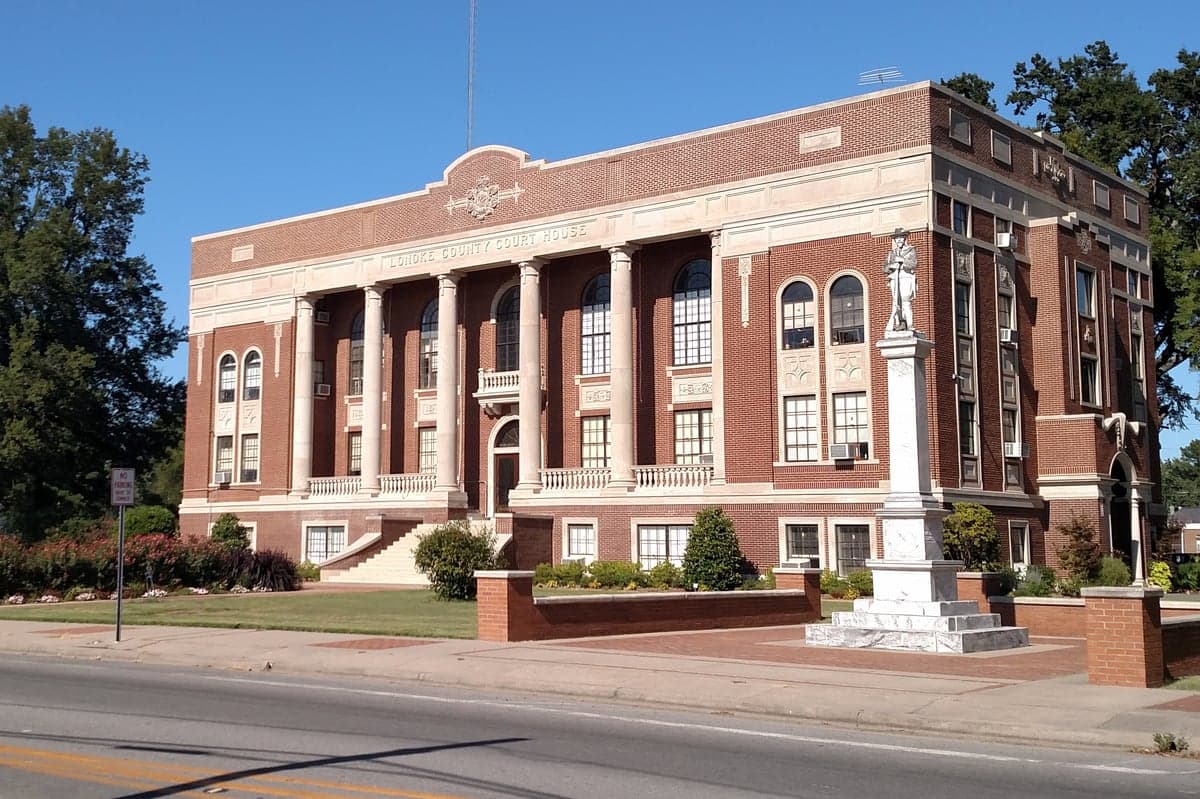
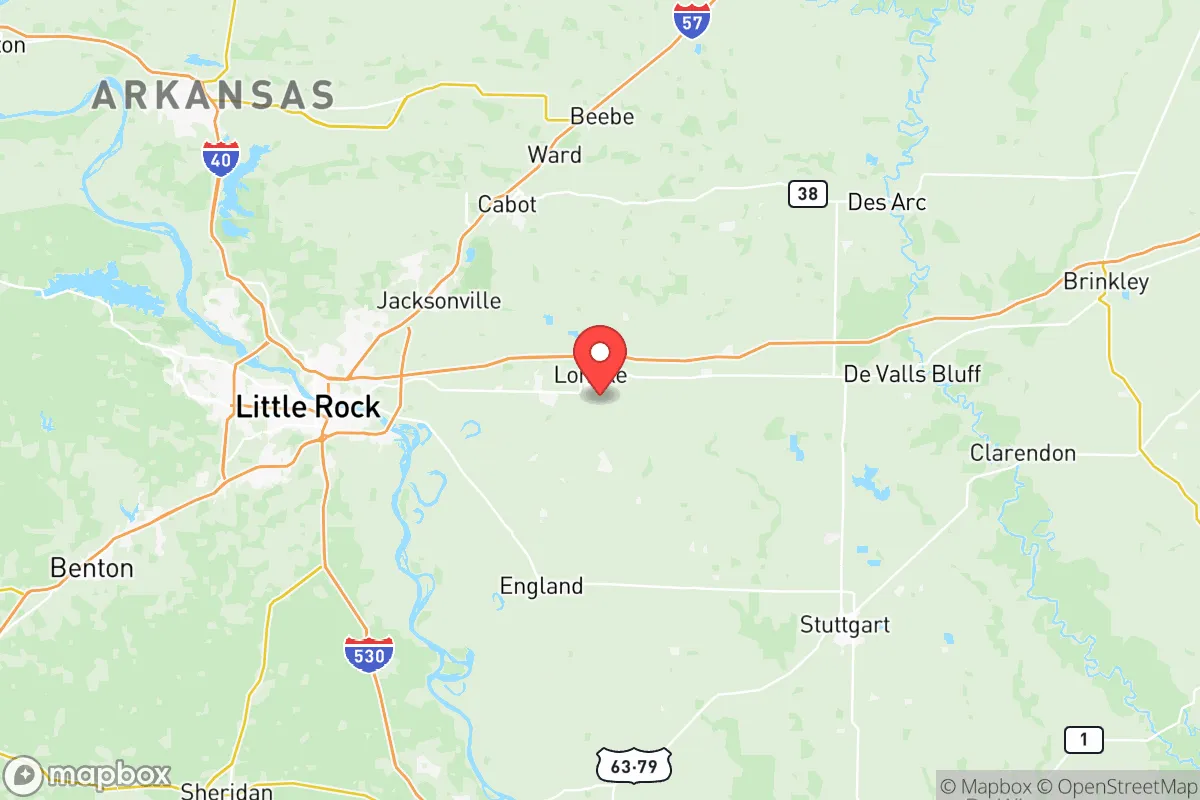
Photo: Wikipedia
Demographics of Lonoke County
Affluence Level in Lonoke County
A middle-class area roughly in line with national averages across income, home values, education, and employment.
People of Lonoke County
Today, Lonoke County is a predominantly white, rural-suburban county of 74,747 residents, anchored by the cities of Lonoke, Cabot, and England. Its population is notably less diverse than the state average, with 83.6% identifying as white, and a foreign-born share of just 1.3% — one of the lowest in Arkansas. The county’s identity is shaped by its agricultural roots, its role as a bedroom community for Little Rock commuters, and a strong, conservative-leaning civic culture that prizes self-reliance and local governance.
Settlement & growth (pre-1960)
Before American settlement, the area that is now Lonoke County was part of the traditional territory of the Quapaw people, who lived in villages along the Arkansas River and its tributaries. The Quapaw were forcibly removed to Indian Territory (present-day Oklahoma) in the 1830s following the Indian Removal Act, opening the land to white settlers. The region saw no significant Spanish, French, or British colonial settlement — it remained a sparsely populated frontier until Arkansas achieved statehood in 1836.
The first major wave of American settlers arrived in the 1840s and 1850s, primarily Scots-Irish and English farmers moving west from Tennessee, Kentucky, and the Carolinas. They were drawn by the promise of cheap, fertile land in the Arkansas River Valley, particularly along the Bayou Two Prairie and the Arkansas River bottomlands. These early settlers established small farming communities that would later become the towns of Lonoke (founded 1869 as the county seat), Austin, and Carlisle. The Memphis and Little Rock Railroad, completed through the county in the 1870s, spurred growth by connecting these agricultural hamlets to regional markets.
After the Civil War, a small but significant population of freed slaves settled in the county, primarily working as sharecroppers and tenant farmers. By 1900, Black residents made up roughly 30% of the county’s population, concentrated in rural areas near England and Coy. This community established its own churches, schools, and mutual-aid societies, though it faced the full weight of Jim Crow segregation and disenfranchisement.
The early 20th century brought a second wave of domestic migration: poor white farmers from the Ozarks and the Mississippi Delta, displaced by agricultural mechanization and the boll weevil infestation. They settled in the county’s small towns and worked as cotton pickers, sawmill hands, and railroad laborers. The Great Depression and Dust Bowl pushed additional families from Oklahoma and Texas into the county, though in smaller numbers than in western Arkansas. By 1940, the county’s population had grown to roughly 30,000, almost entirely native-born and white.
World War II and the postwar era brought the first major suburban shift. The expansion of the Little Rock Air Force Base in nearby Jacksonville (Pulaski County) and the growth of manufacturing in central Arkansas drew new residents to northern Lonoke County. Cabot, once a tiny railroad stop, began its transformation into a commuter suburb, with new subdivisions sprouting along Highway 67/167. This period also saw the beginning of the Great Migration’s reverse flow: many Black families left the county for industrial jobs in Chicago, Detroit, and St. Louis, a trend that would continue for decades.
Modern era (post-1965)
The 1965 Hart-Cellar Act, which dramatically reshaped U.S. immigration patterns, had almost no direct impact on Lonoke County. The county’s foreign-born population remains minuscule at 1.3%, and there are no significant immigrant enclaves. The demographic story of the modern era is overwhelmingly one of domestic migration and suburbanization.
The defining trend since the 1970s has been the explosive growth of Cabot and the surrounding northern corridor. As Little Rock’s suburbs pushed outward, Cabot became a magnet for white families seeking larger homes, better schools, and lower crime rates. The city’s population grew from roughly 3,000 in 1970 to over 26,000 by 2020, making it the county’s largest municipality. This growth was almost entirely driven by native-born white Arkansans moving from Pulaski County and other parts of the state. The county’s Black population, meanwhile, declined from roughly 15% in 1970 to 5.5% today, as many families left for urban centers or were priced out of the new subdivisions.
Hispanic representation, while still modest at 5.2%, has grown steadily since the 1990s, driven by labor demand in poultry processing and construction. Most Hispanic residents are Mexican-American families who have settled in Lonoke and England, where they work at plants like the Tyson Foods facility in nearby Searcy. East/Southeast Asian residents (1.1%) are a small but visible presence, primarily professionals and business owners in Cabot. The Indian-subcontinent population is effectively zero.
The county’s educational profile reflects its working-to-middle-class character: only 21.0% of adults hold a bachelor’s degree or higher, well below the national average of roughly 34%. This is consistent with a population that values trade skills, farming, and public-sector employment over white-collar professions.
The future
Lonoke County’s population is projected to continue growing, driven by the ongoing expansion of the Little Rock metropolitan area. The county added roughly 8,000 residents between 2010 and 2020, and the pace is expected to hold steady through the 2030s. Most new development will concentrate in the northern corridor — Cabot, Ward, and Austin — where new subdivisions and retail centers are already under construction.
Demographically, the county is likely to become slightly more diverse, but only gradually. The Hispanic share may rise to 8-10% over the next two decades, driven by second-generation families and continued labor migration. The Black population share is expected to remain stable or decline slightly, as younger Black residents continue to move to larger cities for education and employment. The white share will remain dominant, though it may edge down from 83.6% as other groups grow from a small base.
Culturally, the county is becoming more suburban and less agricultural. The old farming towns of England and Carlisle are shrinking, while the commuter suburbs are absorbing most new growth. This shift is reshaping local politics, school priorities, and community identity — the county is becoming less about cotton and rice and more about school sports, church life, and the daily commute to Little Rock.
For someone moving in now, Lonoke County offers a stable, affordable, and culturally conservative environment with strong community ties and low crime. The trade-off is limited diversity, a modestly educated workforce, and a social landscape that can feel insular to newcomers. It is a place where the past — rural, white, and agricultural — is still very much present, even as the future leans suburban and slightly more varied.

* Values derived from national, state, county, city and local statistics and may differ in a specific area. Last updated: 2026-06-15T22:00:17.000Z
Narrative content on this page is AI-generated and may contain mistakes. Verify any details that matter before acting on them.
ReloMaps may earn a commission from affiliate links at no extra cost to you.

