
Photo: Wikipedia
Personal Sovereignty in Garland County
Viable for self-reliance. Generally workable, though some barriers may limit total independence.
What does Personal Sovereignty tell us?
Personal Sovereignty measures your capacity for self-reliance and independence with minimal government friction. Higher scores mean fewer barriers between you and the way you want to live... but it assumes you have the space you need and good neighbors.
What does this tell us?
Personal Sovereignty measures your capacity for self-reliance and independence with minimal government friction. Higher scores mean fewer barriers between you and the way you want to live... but it assumes you have the space you need and good neighbors.
State Policy
Energy independence: Importer (35% of energy produced in-state)
Personal Liberty
Homesteading

Personal Liberty Analysis
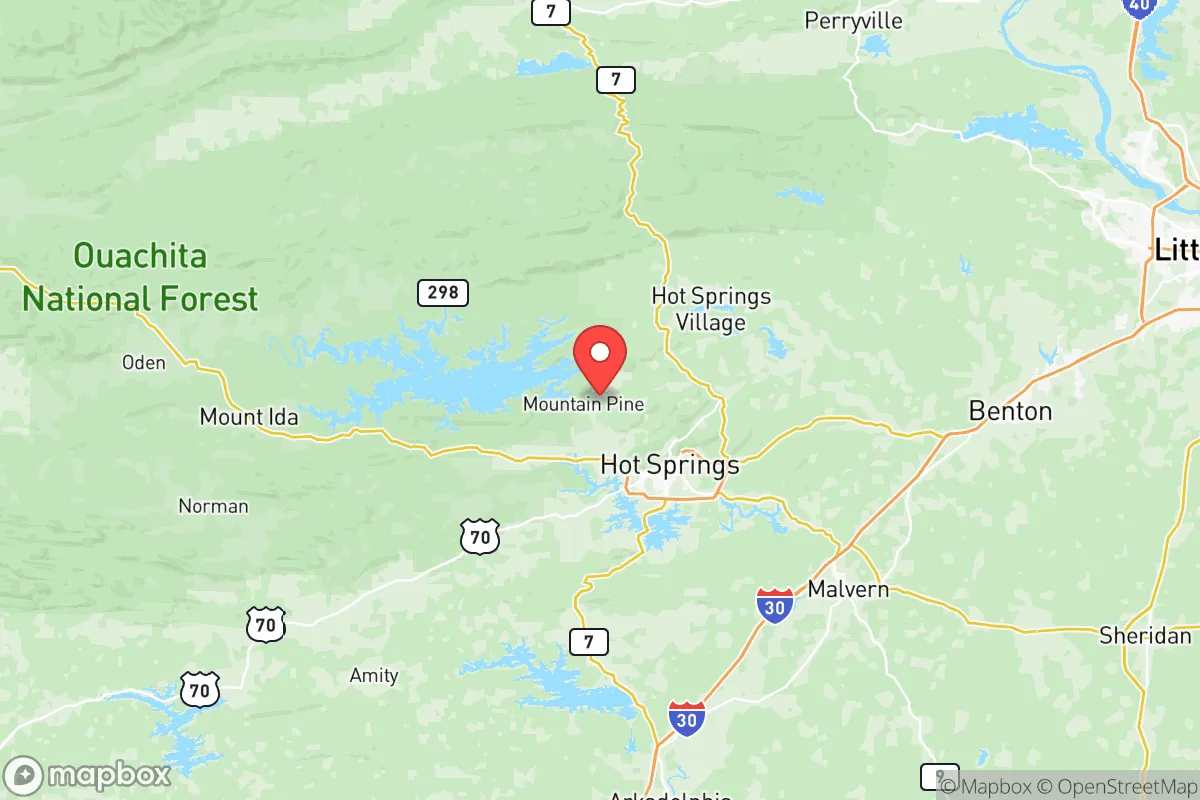
Garland County, Arkansas, offers a notably high degree of personal sovereignty, driven by a state-level commitment to limited government, strong gun rights, and a culture of self-reliance that permeates communities from Hot Springs to the rural outskirts of Mountain Pine and Jessieville. The county’s regulatory environment is generally light-touch, with local governance often deferring to state preemption on key issues like firearms and property rights. For individuals and families prioritizing autonomy, the area presents a compelling balance of rural freedom and access to the amenities of Hot Springs, the county seat and primary population center. However, the degree of personal sovereignty varies meaningfully between the more developed Hot Springs city limits and the unincorporated areas around Lake Ouachita and the Ouachita National Forest, where fewer local ordinances apply.
Tax burden and regulatory posture for residents and businesses
Arkansas maintains a relatively low tax burden compared to the national average, and Garland County reflects this posture. The state’s income tax is a flat 4.4% as of 2026, with no local income tax, and the state sales tax is 6.5%, with Garland County adding a local rate of 1.5% (total 8% in most areas, though Hot Springs city adds another 1% for a total of 9% within city limits). Property taxes are among the lowest in the nation, with Garland County’s effective rate averaging around 0.5% of assessed value. This means a $200,000 home carries an annual tax bill of roughly $1,000. The regulatory posture is similarly light: there is no state-level property tax on business inventory, and occupational licensing requirements are minimal for many trades. In unincorporated areas like Royal or Pearcy, there are no zoning ordinances, allowing residents to operate home-based businesses, keep livestock, or build structures without county-level permits. Within Hot Springs city limits, zoning is more structured but still permissive compared to larger metro areas, with no rent control and streamlined permitting for single-family homes. The overall environment encourages economic self-determination, with the state’s right-to-work law further reinforcing individual employment freedom.
Self-defense and gun law specifics in Garland County
Garland County is a stronghold for Second Amendment rights, with Arkansas operating under a constitutional carry law since 2021. No permit is required to carry a concealed or open firearm for any law-abiding adult 18 or older. The county sheriff’s office in Hot Springs issues concealed carry permits for reciprocity purposes, but the process is straightforward and typically completed within 30 days. Stand-your-ground and castle doctrine laws are fully in effect, with no duty to retreat in any place where a person is lawfully present. Local gun culture is robust: the Hot Springs Gun & Knife Show is a monthly event, and shooting ranges like the Ouachita Shooting Range in the national forest are free and open to the public. In the more rural areas of the county, such as the communities around Lake Ouachita and the town of Mountain Pine, firearm ownership is nearly universal, and self-defense is viewed as a personal responsibility. There are no county-level restrictions on magazine capacity, firearm types, or ammunition sales, and the state preempts all local gun ordinances, meaning Hot Springs cannot enact stricter rules than the state. For a reader prioritizing self-defense autonomy, Garland County offers one of the most permissive legal environments in the South.
Self-reliance and homesteading viability across the county
Homesteading and off-grid living are highly viable in Garland County, particularly in the unincorporated areas and smaller towns. Lot sizes vary widely: in the rural stretches around Jessieville and Royal, parcels of 5 to 40 acres are common and affordable, with raw land prices ranging from $3,000 to $8,000 per acre as of 2026. There are no county-level restrictions on rainwater collection, composting toilets, or solar panel installation, and the state’s net metering policy allows homeowners with solar arrays to sell excess power back to the grid. Off-grid feasibility is high, especially in areas without municipal water or sewer—well drilling and septic system installation are standard practices. Zoning is essentially nonexistent outside city limits, so residents can keep chickens, goats, or even larger livestock without permits. In the town of Lonsdale, for example, many properties operate as small hobby farms with no county interference. Within Hot Springs city limits, homesteading is more constrained: the city requires building permits for structures over 200 square feet and has noise ordinances that may limit certain activities. However, even there, backyard gardens and small-scale food production are common. The county’s extension office in Hot Springs offers free workshops on canning, soil testing, and livestock management, supporting a self-reliant lifestyle. For those seeking maximum autonomy, the rural fringes of the county—particularly around the Ouachita National Forest boundary—offer the most freedom to build and live independently.
Personal liberties: parental rights, medical autonomy, speech, and property
Garland County aligns with Arkansas’s broader emphasis on personal liberties, particularly in the areas of parental rights and medical autonomy. The state has a Parents’ Bill of Rights law that grants parents explicit authority over their children’s education, healthcare, and religious upbringing, and local school districts—including Hot Springs School District and Lakeside School District—generally defer to parental decisions on curriculum opt-outs and medical consent. Medical autonomy is supported by the state’s broad conscience protections for healthcare providers and patients, and there are no county-level mandates for vaccines or medical procedures. Freedom of speech is robust, with no local hate speech ordinances or permit requirements for public gatherings in most areas; the Hot Springs city park system requires permits for large events but does not restrict content. Property rights are strongly protected: Arkansas is a “measure of damages” state for eminent domain, meaning property owners are entitled to fair market value plus relocation costs, and the county has not pursued aggressive condemnation projects in recent years. In the unincorporated areas around Lake Hamilton and Lake Catherine, property owners enjoy near-total control over land use, with no homeowners’ associations or county design review boards. The overall legal framework in Garland County prioritizes individual decision-making over collective mandates, creating an environment where personal sovereignty is the default rather than the exception.
Compared to other regions in the South, Garland County ranks among the most freedom-oriented areas for personal sovereignty, particularly when weighed against more regulated counties in neighboring states like Texas or Tennessee. The combination of constitutional carry, low taxes, minimal zoning in rural areas, and strong parental and property rights creates a cohesive environment for self-reliant individuals and families. While Hot Springs city limits introduce some moderate regulations—primarily around building permits and business licensing—the county as a whole offers a level of autonomy that is rare even in Arkansas. For a reader seeking a place where personal responsibility is the governing principle and government interference is minimal, Garland County represents a strong candidate, especially in the rural communities of Mountain Pine, Jessieville, and Royal, where the regulatory footprint is lightest and the culture of independence is most pronounced.

* Values derived from national, state, county, city and local statistics and may differ in a specific area. Last updated: 2026-06-28T23:09:21.000Z
Narrative content on this page is AI-generated and may contain mistakes. Verify any details that matter before acting on them.
ReloMaps may earn a commission from affiliate links at no extra cost to you.

