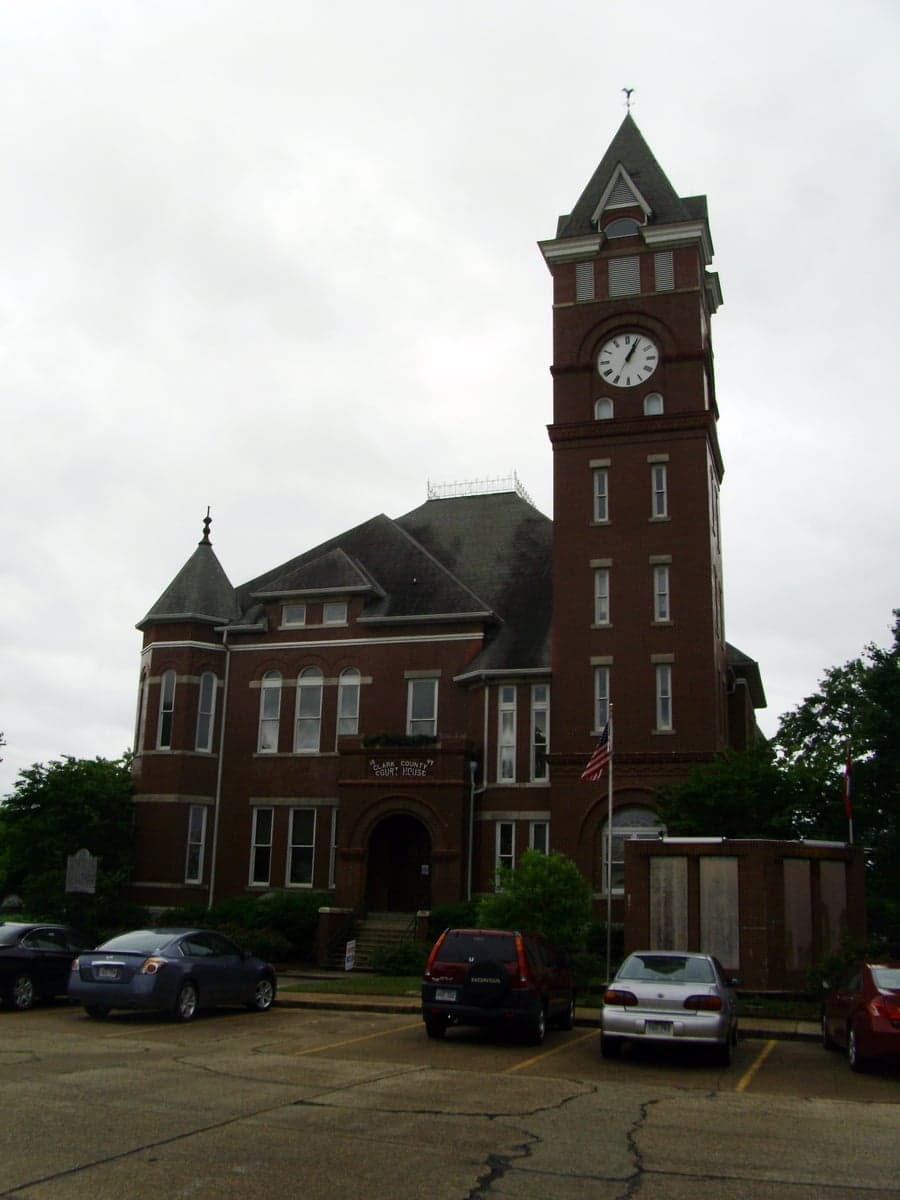
Photo: Wikipedia
Political ClimatePolitical Climate in Clark County
Showing district-level results — no local-only data available.
Local Political AnalysisPolitical Analysis of Clark County
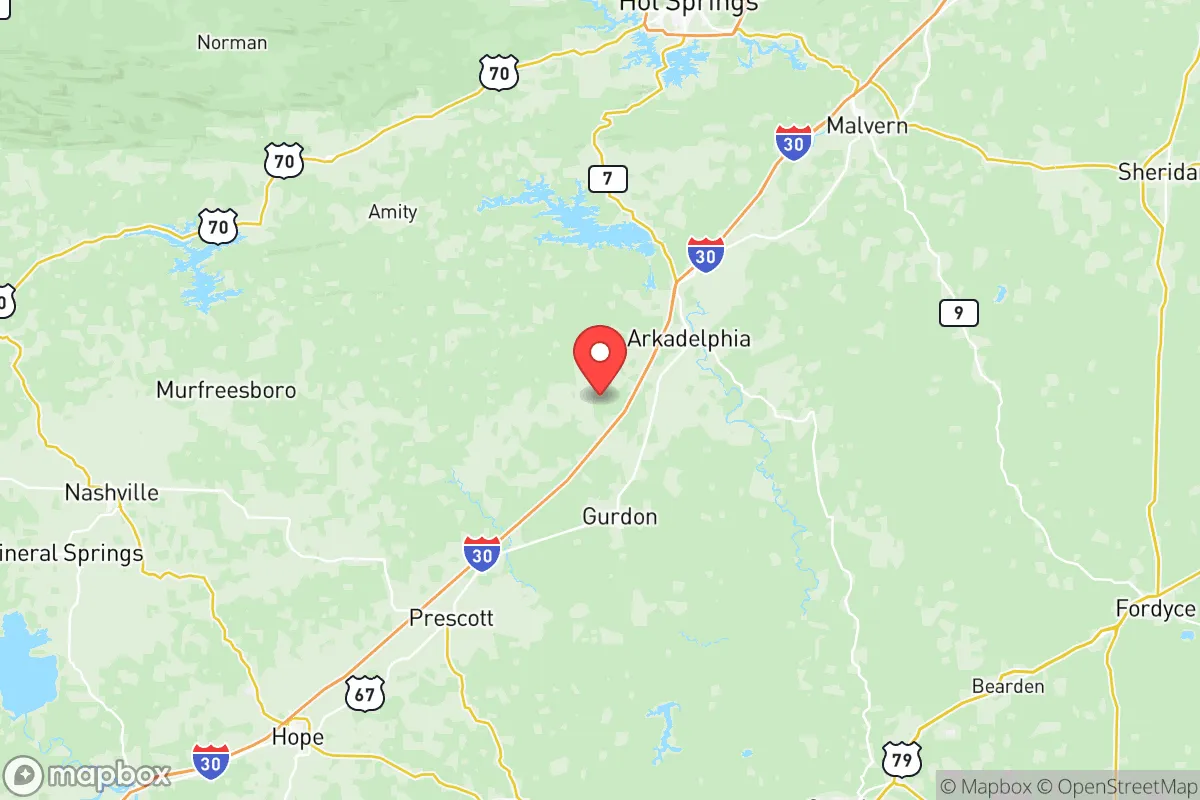
Clark County, Arkansas, is a reliably Republican area with a Cook PVI of R+20, making it four points more conservative than the state of Arkansas as a whole (R+16). This isn't a new development; the county has been trending red for decades, but the shift has accelerated since the 2010s. The county seat, Arkadelphia, is the political and economic heart, and it's where you'll find the most variation. The precincts around Henderson State University and Ouachita Baptist University, particularly those near the campus and the downtown core, tend to be more moderate or even lean Democratic, thanks to a younger, more transient population of students and faculty. In contrast, the rural precincts outside Arkadelphia—places like Gurdon, Caddo Valley, and the unincorporated areas around Hollywood—are deeply conservative, often voting 70-80% Republican in statewide races. The swing precincts are the newer subdivisions on the outskirts of Arkadelphia, where families and retirees from other parts of the state have settled; these areas are reliably Republican but not as overwhelmingly so as the deep rural precincts.
How it compares
Compared to the rest of Arkansas, Clark County is a bit of an outlier in its intensity. While the state as a whole is solidly red, Clark County's R+20 rating puts it in the same league as the most conservative counties in the Arkansas River Valley, like Pope or Johnson counties. The difference is that Clark County lacks a major urban anchor like Fort Smith or Fayetteville, so the conservative tilt is more uniform across the county. The university towns in Arkansas—Fayetteville, Conway, Jonesboro—all have a moderating influence from their student populations, but Arkadelphia's smaller size means that influence is less pronounced. In the 2024 presidential election, Clark County voted for the Republican candidate by a margin of roughly 68% to 30%, while the state overall was closer to 62% to 35%. That gap is consistent with the PVI difference. The county's Democratic base is concentrated almost entirely in Arkadelphia's Ward 2 and Ward 3 precincts, which include the university areas and some of the older, more established neighborhoods near the downtown historic district.
What this means for residents
For conservative residents, Clark County is a comfortable place to live politically. Local offices—county judge, sheriff, quorum court—are almost always held by Republicans, and the county's delegation to the state legislature is solidly red. There's a strong sense of community around the county fair, the local churches, and the annual events like the Clark County Fair and the Arkadelphia Festival of the Arts. For liberal residents, the reality is more nuanced. You can find like-minded people, especially in the university precincts and among the faculty at Henderson State, but you'll be in the minority in most public settings. The local Democratic Party organization is active but small, and its influence is mostly felt in city council races in Arkadelphia, where a few progressive candidates have won seats in recent years. The key cultural distinction in Clark County is the tension between the university community and the rural, agricultural base. The university brings in a more diverse and liberal population, which sometimes clashes with the county's traditional values, especially around issues like LGBTQ+ rights and public education funding. But for the most part, people get along. The county's economy is heavily tied to the universities, the lumber industry, and the medical center, so there's a pragmatic understanding that everyone needs to work together.
Looking ahead, Clark County is likely to stay R+20 or even drift a bit more conservative as the rural precincts continue to grow older and the university's influence remains contained. The county's politics are stable, not volatile. The biggest wildcard is the future of Henderson State University, which has faced enrollment challenges; if it shrinks, the moderating influence of the university precincts will diminish, and the county could become even more uniformly red. For now, though, the political reality is straightforward: Clark County is a place where conservative values dominate, but where a small, resilient liberal community exists in Arkadelphia, centered on the universities and the downtown area. If you're moving here, you'll find a welcoming community regardless of your politics, but you should be aware that the public discourse and local policy lean heavily conservative.

State Political ClimatePolitical Climate in Arkansas
State Political AnalysisPolitical Environment in the State
Arkansas is a solidly Republican state with a Cook PVI of R+16, meaning it votes about 16 points more Republican than the national average in presidential elections. This wasn’t always the case—as recently as the 1990s, Arkansas was a reliably Democratic state in state and local races, but a dramatic realignment over the past two decades has made the GOP dominant at every level. Today, the state’s political identity is shaped by a deep urban-rural split, a conservative policy environment that has shifted rightward since 2010, and a growing tension between the fast-growing Northwest Arkansas corridor and the rest of the state.
Urban vs. rural divide
The political map of Arkansas breaks down into three distinct regions. The most reliably Republican areas are the rural counties of the Ozarks and the Arkansas River Valley—places like Benton County (home to Bentonville and Rogers) and Washington County (Fayetteville) are now GOP strongholds, though Fayetteville itself has a notable liberal pocket around the University of Arkansas. The state’s two largest metro areas, Little Rock (Pulaski County) and Fayetteville, are the only real Democratic-leaning population centers. Pulaski County voted for Joe Biden by about 12 points in 2020, while the surrounding suburban counties like Saline and Faulkner are deeply red. The Delta region in eastern Arkansas—places like Pine Bluff and West Memphis—has a large African American population and votes reliably Democratic, but turnout is low and these areas have lost population for decades. The rural south and southwest, including Texarkana and El Dorado, are solidly Republican. The key takeaway: if you’re moving to Bentonville or Rogers, you’re in a conservative bubble; if you’re in downtown Little Rock or Fayetteville, you’ll find a more mixed environment.
Policy environment
Arkansas’s policy environment is among the most conservative in the country. The state has a flat income tax rate of 4.4% (down from 7% in 2015) and a state sales tax of 6.5%, with local add-ons that can push it over 9% in some cities. There is no property tax on vehicles, and property taxes on real estate are low—about 0.6% of assessed value on average. The state is a “right-to-work” state with weak unions, and it has no state-level minimum wage above the federal $7.25 (though a 2024 ballot measure raised it to $11, phased in by 2026). Education policy is dominated by school choice: Arkansas has a robust charter school sector and a universal school voucher program (the “Arkansas LEARNS Act”) passed in 2023, which provides $6,600 per student for private school tuition. Healthcare is a mixed bag—the state expanded Medicaid under the “Arkansas Works” program, but it also has some of the strictest abortion laws in the nation (a near-total ban with no exceptions for rape or incest, only to save the mother’s life). Election laws are moderately restrictive: voter ID is required, early voting is available for 15 days, and absentee voting requires an excuse. The state has not seen the kind of election integrity controversies seen in Georgia or Arizona, but the GOP-controlled legislature has tightened rules around ballot drop boxes and mail-in voting since 2020.
Recent policy direction
The last five years have seen a sharp rightward turn in Arkansas policy. On gun and self-defense law, the state passed constitutional carry in 2021, allowing permitless carry of handguns for anyone 21 or older. On parental and education rights, the 2023 LEARNS Act is the biggest story—it bans “critical race theory” and “indoctrination” in schools, requires schools to post curriculum online, and gives parents the right to sue districts over instructional materials. On speech and privacy, Arkansas passed a law in 2023 requiring parental consent for minors to create social media accounts, and it has a broad “right to farm” amendment protecting agricultural property from nuisance lawsuits. On medical and bodily autonomy, the abortion ban is total, and the state has also restricted gender-affirming care for minors (banned in 2021, with a 2023 law making it a felony for doctors to provide it). On property rights, Arkansas is a “strong” property rights state with no statewide zoning, though cities like Fayetteville and Little Rock have their own land-use regulations. On taxation, the trend is toward lower rates: the income tax has been cut every year since 2019, and the state eliminated the corporate income tax for pass-through entities. On voting and ballot access, the state has not gone as far as Texas or Florida in restricting voting, but it did pass a law in 2021 banning drive-through voting and limiting drop boxes to one per county. The overall direction is clear: Arkansas is moving toward a model of low taxes, school choice, and maximum individual liberty on guns and property, while restricting abortion and transgender rights.
Civil unrest & political movements
Arkansas has not seen the kind of large-scale protests seen in Portland or Minneapolis, but there have been notable flashpoints. In 2020, Little Rock saw several nights of protests after George Floyd’s murder, with some property damage and a heavy police presence. The state’s Confederate monument in the Capitol grounds was removed in 2020 after a legislative fight. On the right, the “Arkansas Freedom Fund” and local chapters of Moms for Liberty have been active in school board races, particularly in Bentonville and Rogers, where library book challenges and curriculum debates have been heated. Immigration politics are less visible than in border states—Arkansas has a small foreign-born population (about 5%), and the state has no sanctuary cities. There is a small but vocal secessionist movement in the Ozarks (the “State of Sequoyah” idea), but it’s fringe. Election integrity has been a low-grade issue: the 2020 election was not contested in Arkansas, but the legislature passed a law in 2021 requiring signature verification for absentee ballots. The most visible political movement in the state right now is the school choice push, which has strong support from the Walton family (based in Bentonville) and has created a lively debate between rural districts worried about funding and suburban parents wanting options.
Projection
Over the next 5-10 years, Arkansas is likely to become even more Republican, but with a growing internal tension. The Northwest Arkansas corridor (Bentonville, Rogers, Fayetteville, Springdale) is the fastest-growing region in the state, driven by the expansion of Walmart, Tyson Foods, and JB Hunt. This area is attracting a mix of conservative families and younger, more moderate professionals, which could create a more suburban Republican flavor—think less “culture war” and more “low taxes and good schools.” Meanwhile, the Delta and rural south continue to lose population, which will further concentrate political power in the GOP. The state’s Democratic Party is essentially non-functional outside of Little Rock and a few majority-minority districts. The biggest wildcard is the school voucher program: if it leads to the closure of rural public schools, it could create a backlash even among conservative voters. On the policy front, expect further income tax cuts (possibly to a flat 3.9% by 2030), continued expansion of school choice, and no movement on abortion or transgender rights. The state is also likely to see more preemption of local ordinances—the legislature has already banned local plastic bag bans and local minimum wage increases, and that trend will continue.
For a new resident, the bottom line is this: if you’re a conservative, you’ll find Arkansas’s political climate very comfortable—low taxes, strong gun rights, school choice, and a government that generally stays out of your business. If you’re a liberal, you’ll find it challenging but not hostile—you’ll have to live in Fayetteville or Little Rock to find like-minded neighbors, and you’ll need to accept that state policy will be consistently conservative. The state is not a place of political drama or high tension—most people just go about their lives. The biggest practical consideration for anyone moving here is the school choice landscape: if you have kids, you’ll want to research the voucher program and the charter school options in your area, because the quality of public schools varies dramatically between wealthy suburbs like Bentonville and struggling rural districts. Overall, Arkansas offers a stable, predictable conservative environment with a growing economy in the northwest corner—just don’t expect much political diversity outside of a few college towns.
* Values derived from national, state, county, city and local statistics and may differ in a specific area. Last updated: 2026-07-13T18:55:42.000Z
Narrative content on this page is AI-generated and may contain mistakes. Verify any details that matter before acting on them.
ReloMaps may earn a commission from affiliate links at no extra cost to you.

