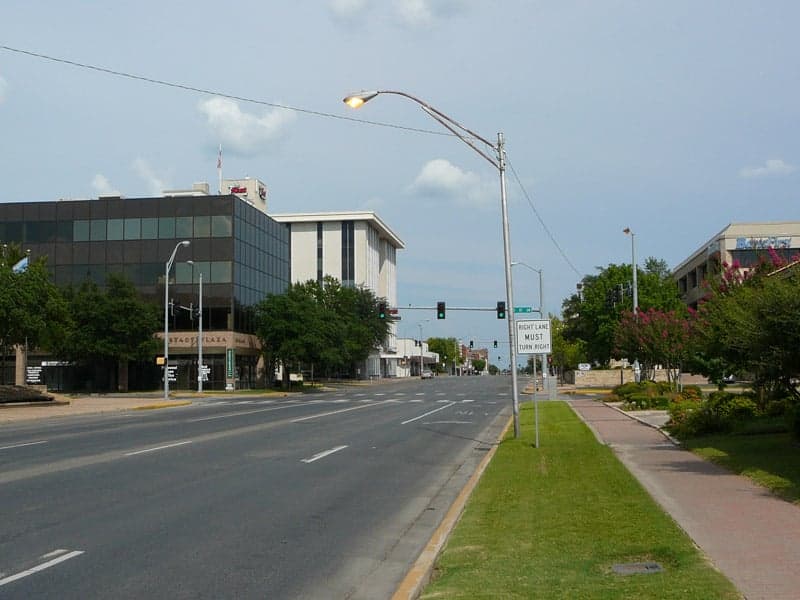
Photo: Wikipedia
Political ClimatePolitical Climate in Ardmore, OK
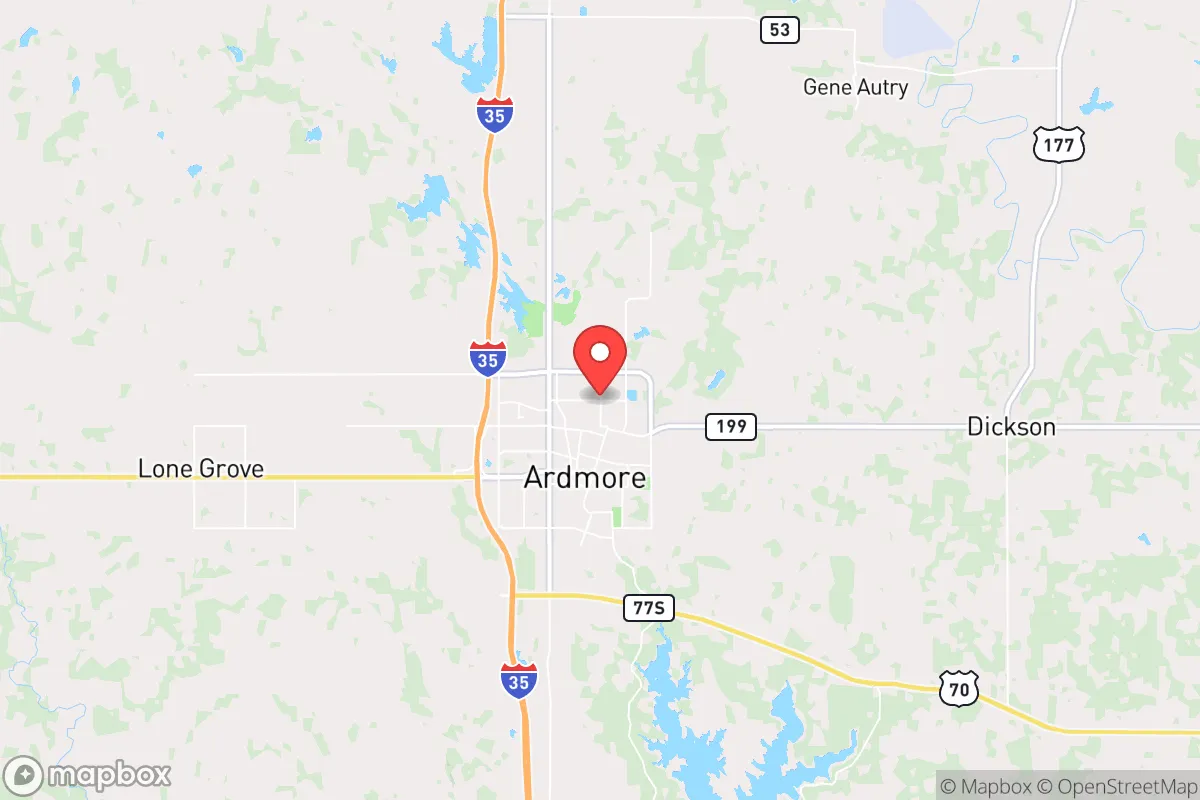
District shown is the primary district for this city’s centroid. Cities may span multiple districts.
Local Political AnalysisPolitical Analysis of Ardmore, OK
Ardmore, Oklahoma, sits solidly in conservative territory, with a Cook PVI of R+17 that reflects a deep-rooted preference for limited government and traditional values. This isn't a recent shift; the area has long voted reliably Republican, and the 2024 election saw Carter County go +30 for the GOP candidate, reinforcing a trend that shows no sign of reversing. If you're looking for a place where folks generally believe in personal responsibility and keeping government out of your business, Ardmore is about as steady as it gets.
How it compares
Drive an hour north to Oklahoma City, and you'll find a more mixed political landscape, with pockets of progressive influence in the urban core and around the university areas. Head south to Dallas or Fort Worth, and you're in a different world entirely—big-city politics that lean left on everything from taxes to property rights. Even nearby towns like Durant or Ada, while still conservative, don't have the same consistent Republican voting record as Ardmore. The contrast is sharpest with Norman, home to the University of Oklahoma, where you'll see more progressive activism and a younger, more transient population pushing for change. Ardmore, by contrast, feels like a place where the old ways—neighbor helping neighbor, minimal interference from the state—still hold strong.
What this means for residents
For someone moving here, the political climate translates into a few concrete realities. Taxes stay low—Oklahoma has no state property tax, and Ardmore's local levies are modest, meaning you keep more of what you earn. Gun rights are respected without the hoops you see in blue states; constitutional carry is the law, and there's no push to change that. School choice is expanding, with charter schools and vouchers gaining traction, so parents have more say in their kids' education. On the flip side, if you're hoping for expansive social programs or aggressive environmental regulations, you'll be disappointed. The county commission and city council tend to prioritize economic development over social engineering, which keeps the place stable but can feel slow to adapt to new ideas. The real concern for long-time residents is the creeping influence of federal mandates—things like EPA water rules or HUD housing guidelines that feel like overreach into local decisions. So far, Ardmore's leaders push back, but it's a constant battle.
Cultural and policy distinctions
One thing that sets Ardmore apart is its strong sense of community self-reliance. You won't see the kind of government-run programs you might in larger cities; instead, churches and civic groups handle a lot of the social safety net. The local Chamber of Commerce is active, and the city's economic development authority focuses on attracting manufacturing and energy jobs without heavy-handed incentives. There's also a noticeable skepticism of national trends—things like critical race theory or gender ideology in schools get a cold shoulder here. The school board and library board have both faced debates over book content and curriculum, and so far, the conservative majority has held the line. Looking ahead, the biggest threat to Ardmore's political character is likely population growth from out-of-state transplants, especially from California or Colorado, who might bring different voting habits. But for now, the area remains a reliable redoubt for those who value freedom from government overreach and a slower pace of life.

State Political ClimatePolitical Climate in Oklahoma
State Political AnalysisPolitical Environment in the State
Oklahoma is a deeply conservative state, with Republicans holding every statewide office and supermajorities in both legislative chambers, but the political landscape is more layered than the raw numbers suggest. The state has shifted rightward over the past 20 years, with Donald Trump winning by 33 points in 2024, up from 36 points in 2020 and 29 points in 2016, driven largely by rural and exurban consolidation. However, Oklahoma City and Tulsa have become increasingly competitive, with urban precincts trending left while the surrounding suburbs and small towns anchor the state’s red identity.
Urban vs. rural divide
The political map of Oklahoma is a study in contrasts. Oklahoma City’s core, particularly around the Plaza District and Midtown, has shifted blue in recent cycles, with precincts in Oklahoma County voting for Joe Biden in 2020 by narrow margins. Tulsa’s downtown and the Kendall-Whittier neighborhood show similar trends, though the city’s outer wards remain reliably red. The real muscle of Oklahoma conservatism lies in the rural and exurban counties: Texas County in the Panhandle voted 86% for Trump in 2024, while Grant County in the north-central plains hit 88%. The suburbs of Edmond, Moore, and Broken Arrow are solidly Republican but have seen slight softening among college-educated voters, particularly women, over issues like school funding and healthcare. The divide is stark: the two major metros produce about 45% of the state’s vote, but the remaining 55% comes from areas where Democrats are virtually extinct at the local level.
Policy environment
Oklahoma’s policy environment is among the most conservative in the nation, with a low-tax, low-regulation posture that attracts businesses and retirees. The state has a flat income tax of 4.75%, which lawmakers are actively working to phase out entirely, and no estate tax. Property taxes are among the lowest in the country, averaging about 0.9% of home value, thanks to a constitutional cap. The regulatory climate is business-friendly, with right-to-work laws and minimal zoning restrictions outside major cities. On education, the state has embraced school choice aggressively: the 2023 Oklahoma Parental Choice Tax Credit Act provides up to $7,500 per child for private school expenses, and charter schools are widespread. Healthcare policy is more mixed—the state expanded Medicaid in 2021 via ballot initiative, but Republican leaders have since imposed work requirements and premiums, creating a patchwork system. Election laws are strict: voter ID is required, early voting is limited to three days, and absentee ballot applications must be notarized unless the voter is military or disabled.
Trajectory & freedom
Oklahoma has moved decisively toward expanding personal freedom in several key areas, particularly gun rights and parental authority. In 2019, the state passed constitutional carry, allowing permitless concealed and open carry for adults 21 and older. The 2022 “Second Amendment Sanctuary State” law prohibits state enforcement of any future federal gun bans or registration schemes. On parental rights, the 2022 “Save Women’s Sports Act” bans transgender athletes from female school sports, and the 2023 “Women’s Bill of Rights” defines sex as biological at birth for legal purposes. Medical freedom saw a setback with the 2024 repeal of the state’s medical marijuana patient protections, though the industry remains robust with over 400,000 active patients. The biggest concern for liberty-minded residents is the state’s heavy reliance on sales taxes and fees, which hit low-income households hardest, and the growing influence of corporate lobbying in Oklahoma City. Property rights are generally strong, with no statewide rent control and limited eminent domain abuse, though oil and gas mineral rights disputes remain a persistent issue.
Civil unrest & political movements
Oklahoma has seen relatively little civil unrest compared to coastal states, but there have been notable flashpoints. The 2020 George Floyd protests in Oklahoma City and Tulsa were largely peaceful, though Tulsa saw some property damage and a heavy police presence. The left-leaning activist group “Tulsa Advocates for Justice” continues to organize around police reform and racial equity, but their influence is limited. On the right, the “Oklahoma Freedom Caucus” has become a powerful force in the legislature, pushing for further tax cuts, school choice expansion, and anti-abortion measures. Immigration politics are heated in the Panhandle, where Guymon and the surrounding meatpacking towns have seen a surge in Hispanic population, leading to local tensions over housing and schools. The state has no sanctuary cities, and a 2024 law requires local law enforcement to cooperate with ICE detainers. Election integrity remains a hot-button issue: the 2020 audit of Tulsa County’s results found no significant irregularities, but grassroots groups like “Oklahoma Voter Integrity Project” continue to push for hand-counting of ballots and stricter chain-of-custody rules.
Projection
Over the next 5-10 years, Oklahoma is likely to remain solidly red, but the urban-rural divide will deepen. In-migration from blue states like California and Texas is accelerating, particularly to the Oklahoma City suburbs of Yukon and Mustang, where new housing developments are booming. These newcomers tend to be more moderate than native Oklahomans, which could soften the state’s hard-right edge on issues like education funding and healthcare. However, the rural counties are depopulating, which will concentrate political power in the metros and their suburbs. The state’s tax-cutting trajectory will likely continue, with the income tax possibly eliminated by 2030, but this will put pressure on services like roads and rural hospitals. The biggest wildcard is the energy transition: as wind and solar expand in western Oklahoma, tensions between traditional oil-and-gas interests and renewable developers could reshape local politics in places like Weatherford and Woodward. For a new resident, expect a state that remains culturally conservative and economically free, but with growing friction between the old rural order and the new suburban reality.
For someone moving to Oklahoma, the bottom line is this: you’ll find a state that respects your right to live as you see fit, with low taxes, strong gun rights, and a government that mostly stays out of your way. The trade-off is that public services are lean, the summers are brutal, and the political conversation can feel like it’s stuck in 1995. If you’re looking for a place where your vote actually counts and your kids won’t be exposed to radical gender ideology in school, Oklahoma delivers. Just know that the cities are slowly changing, and the rural areas are shrinking—so pick your county carefully.
* Values derived from national, state, county, city and local statistics and may differ in a specific area. Last updated: 2026-04-25T13:48:24.000Z
Narrative content on this page is AI-generated and may contain mistakes. Verify any details that matter before acting on them.
ReloMaps may earn a commission from affiliate links at no extra cost to you.

