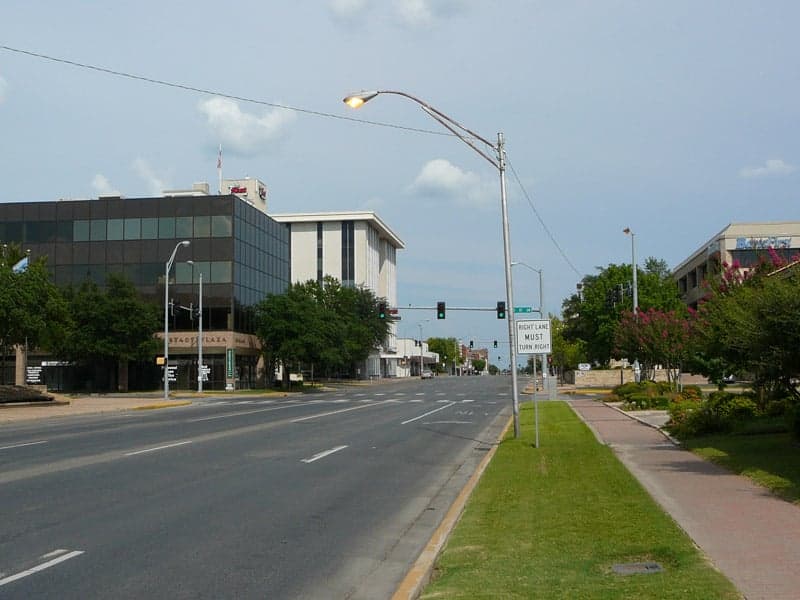
Photo: Wikipedia
Demographics of Ardmore, OK
Affluence Level in Ardmore, OK
A below-average socioeconomic profile. Incomes, home values, and educational attainment trail the U.S., with higher poverty and unemployment.
People of Ardmore, OK
The people of Ardmore, Oklahoma, today number 24,757, forming a community that is predominantly white (61.2%) with a notable Hispanic minority (11.5%) and a smaller Black population (8.3%). The city’s identity is rooted in its history as a railroad and oil town, giving it a practical, working-class character with a lower college attainment rate (22.2%) than the national average. Its foreign-born population is very low at 2.4%, reflecting a community shaped more by domestic migration than international immigration. Ardmore’s residents are concentrated in distinct neighborhoods that trace their origins to the city’s founding and subsequent economic booms.
How the city was settled and grew
Ardmore was founded in 1887 as a stop on the Santa Fe Railway, which drew the first wave of settlers: railroad workers, merchants, and land speculators, mostly of European American descent. The city’s early growth was fueled by the 1890s land runs in the Chickasaw Nation (then Indian Territory), attracting farmers and ranchers. The discovery of the Healdton Oil Field in 1913 triggered a second wave, bringing oil workers and entrepreneurs. The historic Downtown Ardmore district, centered on Main Street, was built by these early settlers and remains the city’s commercial core. The Northeast Ardmore neighborhood, near the old rail yards, became home to many railroad families and later absorbed Black workers who migrated during the oil boom. The Southwest Ardmore area, with its larger lots and older homes, was developed by oil executives and professionals in the 1920s and 1930s.
Modern era (post-1965)
After the 1965 Immigration and Nationality Act, Ardmore saw minimal international immigration, with its foreign-born share remaining below 3%. Instead, the city’s modern demographic shifts came from domestic migration. The expansion of the Ardmore Industrial Airpark and the arrival of manufacturing plants (e.g., Michelin, which opened a tire plant in 1970) drew workers from rural Oklahoma and Texas. The Northwest Ardmore neighborhood, developed in the 1970s and 1980s, became a middle-class area for these new industrial workers and their families. Hispanic population growth, rising from negligible levels to 11.5% today, began in the 1990s as agricultural and construction jobs attracted Mexican-American families. Many settled in the East Ardmore area, near the city’s industrial zones and mobile home parks. The Black population, historically concentrated in Northeast Ardmore near the old rail and oil jobs, has remained stable at 8.3%, with some outmigration to newer subdivisions in South Ardmore. East and Southeast Asian residents (1.2%) and Indian-subcontinent residents (0.7%) are a small but visible presence, often working in healthcare (at Mercy Hospital Ardmore) or as small business owners, with no single ethnic enclave.
The future
Ardmore’s population is projected to grow slowly, driven by continued domestic in-migration from rural Oklahoma and Texas rather than international immigration. The city is likely to remain predominantly white, with the Hispanic share gradually rising toward 15-18% over the next two decades as families grow and new arrivals seek affordable housing. The Black and Asian shares are expected to remain stable, as Ardmore lacks the job diversity or cultural infrastructure to attract larger numbers. The city is not tribalizing into distinct ethnic enclaves; instead, newer subdivisions like Lake Murray Estates (south of town) and Willow Creek (northwest) are drawing a mix of white and Hispanic families, reflecting assimilation rather than segregation. The low college attainment rate (22.2%) suggests the city will continue to attract blue-collar and service-sector workers, with limited growth in high-skilled immigration.
For someone moving to Ardmore now, the city offers a stable, predominantly white community with a growing Hispanic presence, a strong working-class identity, and little ethnic tension. The population is homogenizing slowly, with new residents blending into existing neighborhoods rather than forming distinct enclaves. This makes Ardmore a predictable, low-diversity environment where newcomers can expect a straightforward, neighborly culture rooted in the city’s railroad and oil heritage.

* Values derived from national, state, county, city and local statistics and may differ in a specific area. Last updated: 2026-04-25T13:48:24.000Z
Narrative content on this page is AI-generated and may contain mistakes. Verify any details that matter before acting on them.
ReloMaps may earn a commission from affiliate links at no extra cost to you.

