
Photo: Wikipedia
Personal Sovereignty in Ardmore, OK
Strong independent fundamentals that actively favor personal liberty and low regulation.
What does Personal Sovereignty tell us?
Personal Sovereignty measures your capacity for self-reliance and independence with minimal government friction. Higher scores mean fewer barriers between you and the way you want to live... but it assumes you have the space you need and good neighbors.
What does this tell us?
Personal Sovereignty measures your capacity for self-reliance and independence with minimal government friction. Higher scores mean fewer barriers between you and the way you want to live... but it assumes you have the space you need and good neighbors.
State Policy
Energy independence: Net exporter (180% of energy produced in-state)
Personal Liberty
Homesteading

Personal Liberty Analysis
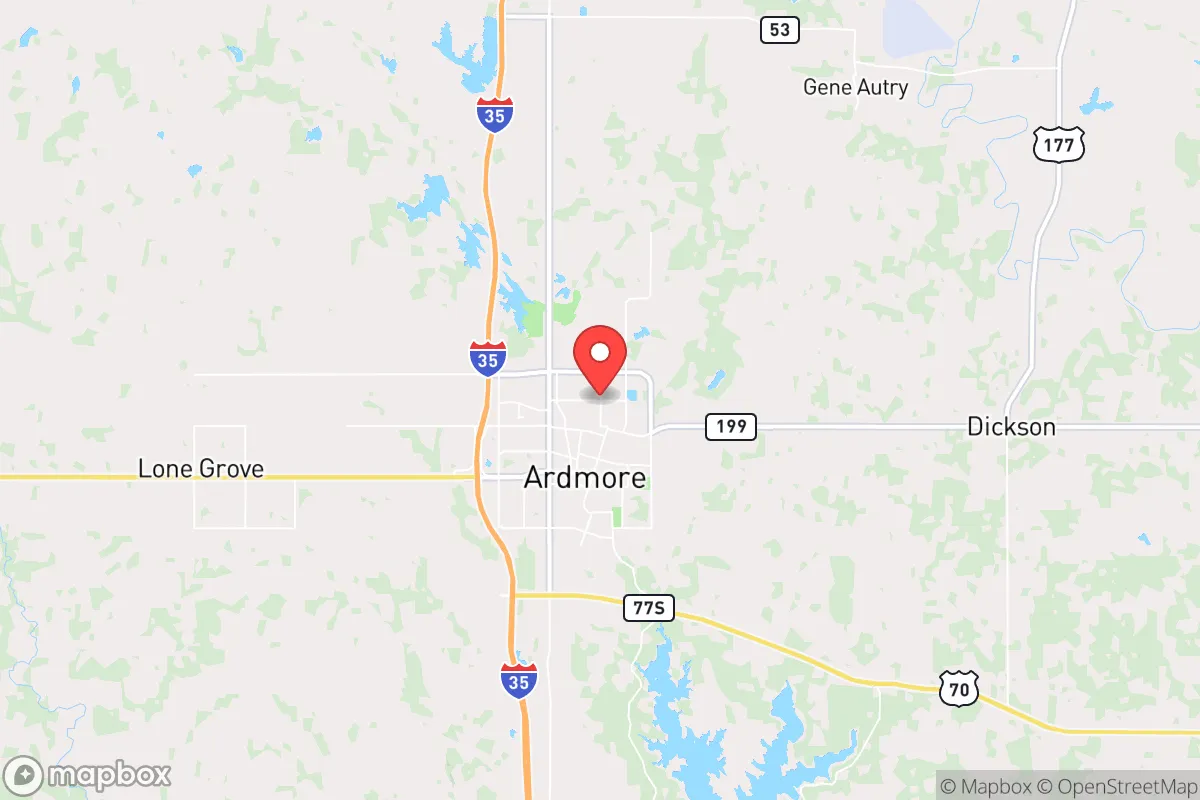
Ardmore, Oklahoma, offers a notably high degree of personal sovereignty compared to much of the country, particularly for those who prioritize minimal government interference in daily life. Nestled in Carter County, this city of roughly 25,000 operates under Oklahoma’s strong preemption laws, which generally prevent local ordinances from exceeding state statutes on firearms, property use, and taxation. For a survivalist or prepper mindset, Ardmore represents a strategic middle ground—close enough to the Dallas-Fort Worth metroplex for supply runs and medical access, yet far enough to avoid the regulatory creep and cultural pressures that often accompany larger urban centers. The state’s constitutional carry law, lack of a personal income tax, and relatively permissive land-use codes create an environment where self-reliance isn’t just tolerated but structurally supported.
Tax burden and regulatory posture: How Ardmore compares to surrounding states
Oklahoma’s tax structure is a major draw for those seeking to keep more of their earnings and reduce government dependency. The state levies a flat income tax of 4.75%, which is lower than neighboring Texas (which has no income tax but higher property taxes) and significantly lower than Arkansas or Kansas. However, Ardmore’s real advantage lies in its property tax rates, which average around 0.85% of assessed value—roughly half the national average and far below Texas’s typical 1.5–2.0%. This means a $200,000 home in Ardmore might carry an annual tax bill of $1,700, versus $3,500+ in a comparable Texas suburb. Sales tax in Ardmore is 8.75% (state + local), which is moderate but offset by the absence of a state-level estate or inheritance tax. Regulatory posture is equally favorable: Oklahoma is a right-to-work state with minimal business licensing hurdles, and Carter County has no county-level zoning overlay for most rural parcels, allowing for workshops, livestock, and alternative energy installations without bureaucratic delays. For a prepper, this translates to fewer inspections, lower carrying costs, and more control over one’s property.
Self-defense and gun law specifics: Constitutional carry and stand your ground
Oklahoma is among the most firearm-friendly states in the nation, and Ardmore fully reflects that. Since November 2019, the state has had permitless constitutional carry for anyone 21 or older who can legally possess a firearm—no license, no training requirement, no government permission slip. Open carry is also legal without a permit. For those who want reciprocity when traveling, Oklahoma issues a concealed carry license (valid for five years) that is recognized by over 30 states. The state’s Stand Your Ground law, codified in 21 O.S. § 1289.25, removes any duty to retreat before using deadly force if you are in a place you have a legal right to be and reasonably believe force is necessary to prevent death or great bodily harm. Castle Doctrine protections extend to vehicles and workplaces, not just homes. Magazine capacity bans, firearm registration, and waiting periods do not exist at the state level. Ardmore’s local law enforcement, the Ardmore Police Department, is generally supportive of Second Amendment rights, though preppers should note that Carter County has a Republican sheriff who has publicly stated he will not enforce any future federal gun control measures he deems unconstitutional. For those concerned about government overreach, this is a jurisdiction where the local legal climate aligns with individual sovereignty.
Self-reliance and homesteading viability: Lot sizes, zoning, and off-grid feasibility
Ardmore and its surrounding unincorporated areas offer strong potential for self-reliant living. Within city limits, standard residential lots range from 0.25 to 0.5 acres, but zoning allows for backyard chickens, small gardens, and even beekeeping with minimal permitting. The real opportunity lies just outside town, in Carter County’s rural zones, where minimum lot sizes for unplatted land are typically 1–5 acres, and many parcels are available for under $5,000 per acre. There is no county-wide zoning ordinance for agricultural or residential use, meaning you can build a workshop, install solar panels, drill a well, or set up rainwater catchment without a lengthy approval process. Off-grid living is legally feasible: Oklahoma law does not require connection to municipal water or sewer on rural parcels, and the state’s net metering policy (though capped) allows solar owners to sell excess power back to the grid. Ardmore’s climate—average 36 inches of rain per year and a growing season of 220+ days—supports substantial food production. For a prepper, the key constraint is water rights: Oklahoma follows a prior appropriation system, so drilling a well requires a permit from the Oklahoma Water Resources Board, but for domestic use (under 5,000 gallons per day), permits are routinely granted. The local soil is clay-heavy, but raised beds and hoop houses are common. Overall, Ardmore’s regulatory environment treats self-reliance as a default rather than an exception.
Personal liberties: Parental rights, medical autonomy, speech, and property
Oklahoma has taken a strong stance on several fronts that matter to those prioritizing personal sovereignty. Parental rights are explicitly protected under state law (10 O.S. § 1-2-101), which affirms that parents have the fundamental right to direct the upbringing, education, and healthcare of their children. Ardmore Public Schools and the surrounding districts generally follow state guidelines that require parental consent for most medical treatments and prohibit instruction on sexual orientation or gender identity in grades K-12 without parental opt-in. Medical autonomy is less robust: Oklahoma has not expanded Medicaid under the ACA, and while the state does not mandate COVID-19 vaccines for adults, employers and healthcare facilities can impose their own requirements. However, the state passed a law in 2022 (SB 1401) prohibiting discrimination based on vaccination status for state services, and Ardmore’s local culture leans heavily toward individual choice. Free speech is protected under the Oklahoma Constitution, which has its own free speech clause that some courts have interpreted more broadly than the First Amendment. There are no local hate speech ordinances or content-based restrictions beyond federal limits. Property rights are reinforced by Oklahoma’s strong eminent domain protections (60 O.S. § 51), which require just compensation and a public purpose, and the state’s right-to-farm law (2 O.S. § 4-1) shields agricultural operations from nuisance lawsuits if they were established before nearby residential development. For a prepper concerned about government overreach, Ardmore’s legal framework provides a buffer against many of the encroachments seen in blue states.
In the broader landscape of personal sovereignty, Ardmore ranks favorably against most of the country. Compared to Texas, it offers lower property taxes and similar gun laws; compared to Colorado or the Pacific Northwest, it has virtually no land-use restrictions, no income tax, and a political culture that views government with skepticism. The trade-offs are real—limited public transit, fewer specialized medical facilities, and a slower pace of life—but for those who value autonomy over convenience, Ardmore provides a legal and cultural environment where self-reliance is the norm, not the exception. For a survivalist or prepper evaluating relocation, this is a location where the state and local governments are more likely to stay out of your way than get in it.

* Values derived from national, state, county, city and local statistics and may differ in a specific area. Last updated: 2026-04-25T13:48:24.000Z
Narrative content on this page is AI-generated and may contain mistakes. Verify any details that matter before acting on them.
ReloMaps may earn a commission from affiliate links at no extra cost to you.

