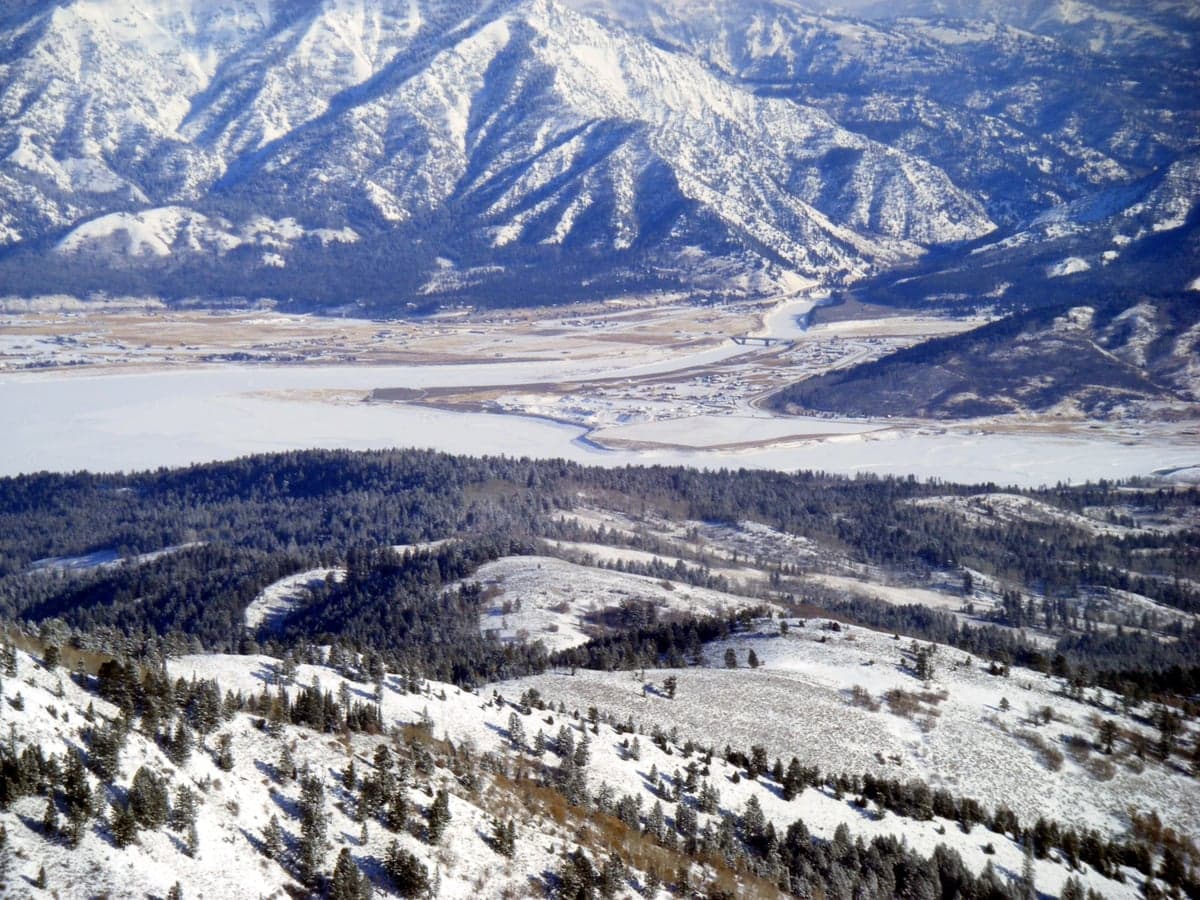
Photo: Wikipedia
Strategic Assessment of Alpine, WY
Strong survivability profile. Good buffer from population centers, with manageable environmental and tactical risks.
What does the Strategic Assessment tell us?
Our Strategic Assessment grades tactical survivability of an area. Major population centers, military targets, fallout zones, natural disasters, and border exposure all drive risk — lower exposure means a more defensible position in a crisis.
This is heavily inspired by Joel Skousen's Strategic Relocation book. Highly recommended you checkout the book ($)What does this tell us?
Our Strategic Assessment grades tactical survivability of an area. Major population centers, military targets, fallout zones, natural disasters, and border exposure all drive risk — lower exposure means a more defensible position in a crisis.
This is heavily inspired by Joel Skousen's Strategic Relocation book. Highly recommended you checkout the book ($)Strategic Pillars

Key Distances
Regional Safe Places
Below is our recommended "safe zones" in Wyoming and the surrounding area based on our strategic heuristics. For most people, it's unrealistic to live in a “safe zone” full-time due to work, family or other personal reasons. They tend to be more rural. However, many of these areas are perfect for second homes and retreat properties that double as a vacation home or even a short-term rental.
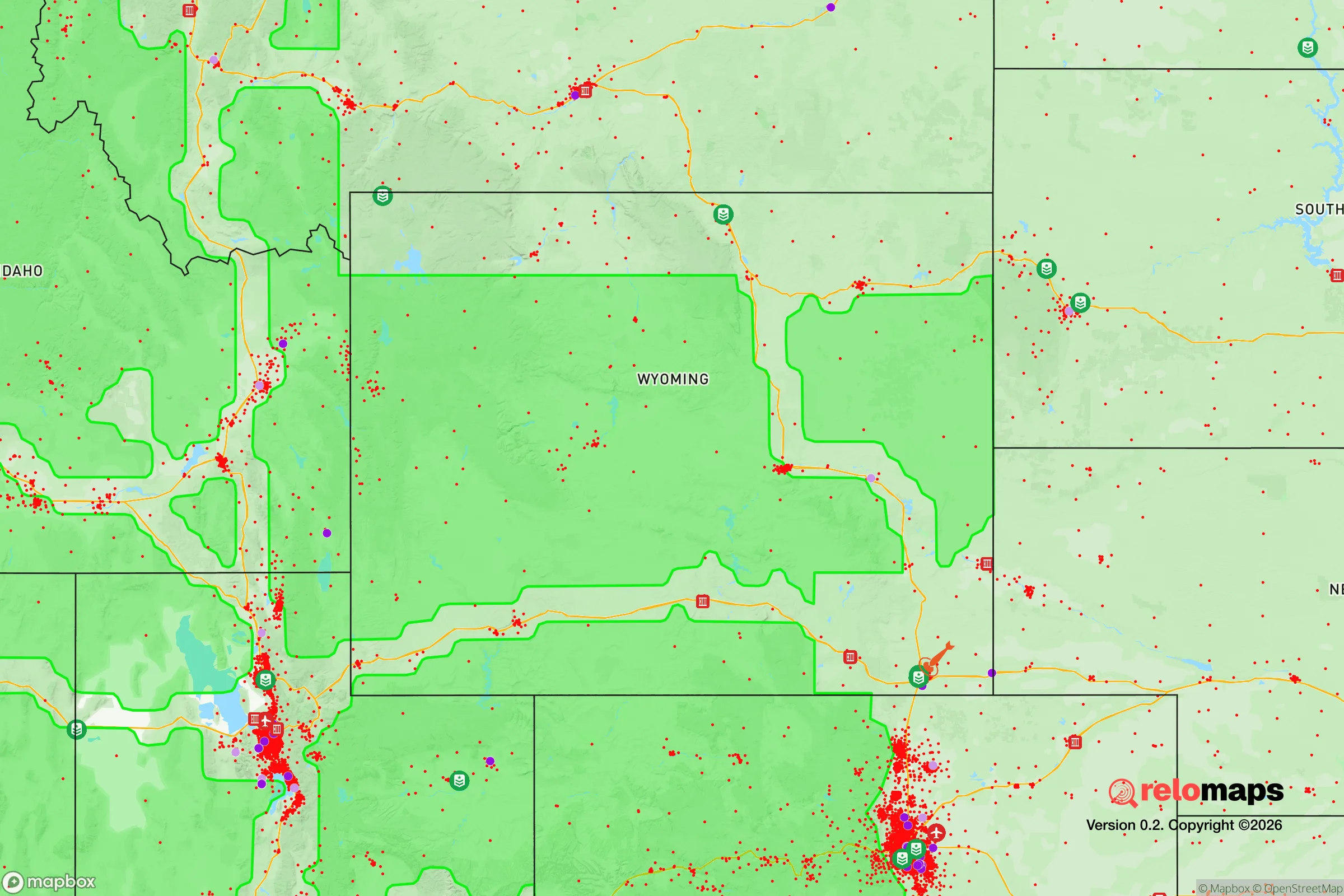
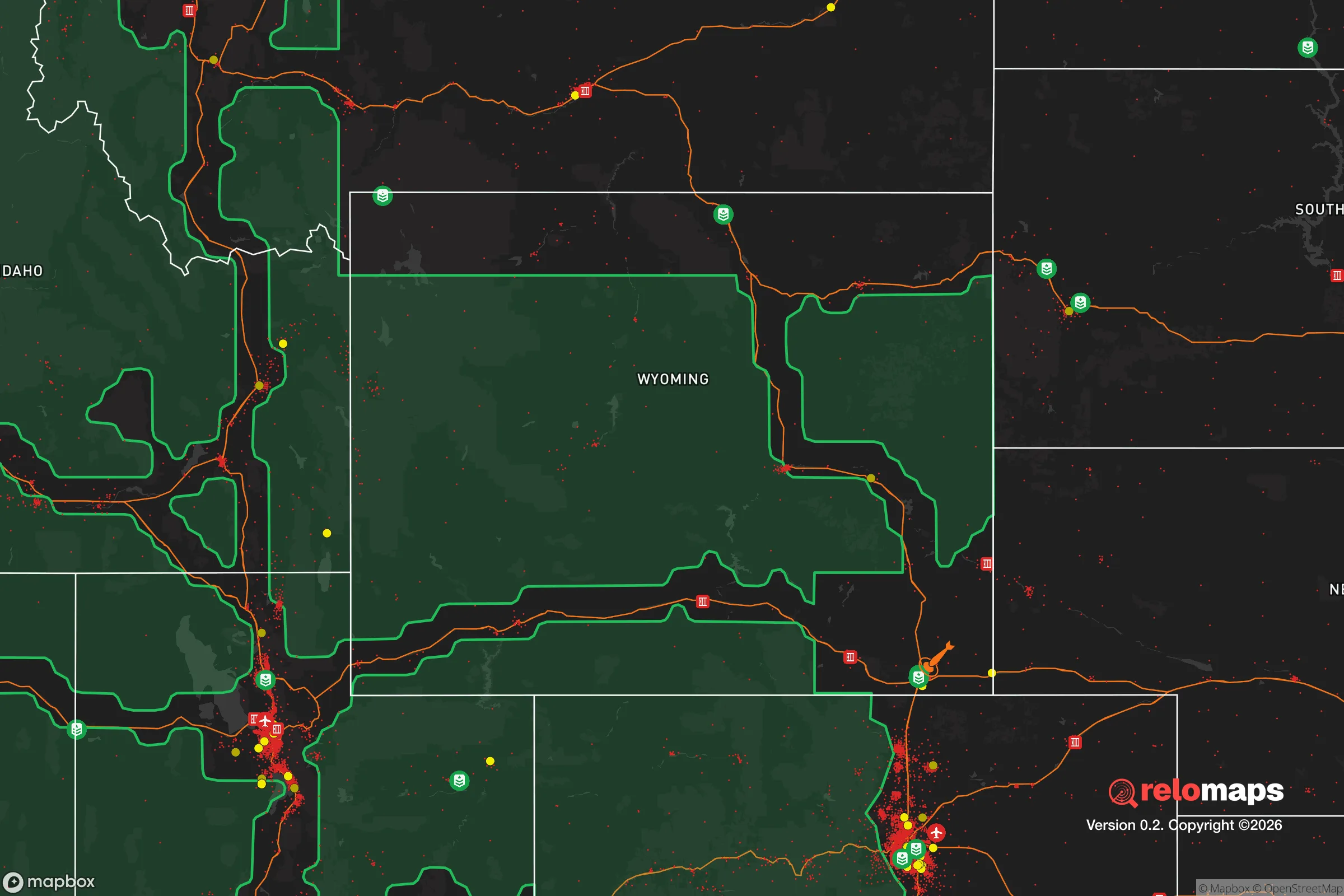


Important Note: For informational purposes only. This does not mean nothing bad ever happens in the green zones. Please use common sense. This is based on public data and modeled with AI. We tried to take a conservative approach but mistakes happen. We update this regularly as new information becomes available.
Solar Generator Recommendations
Backup power matters more here than in safer locations. We've picked three solar generators across budgets and capacity tiers — start with the budget unit if you only need a few essentials, or step up if you want to run a fridge and HVAC for days at a time.

Jackery Portable Power Station Explorer 300
Budget OptionPower on the Go: Weighing only 11 lbs, it's convenient to set up and store with book-sized foldable solar panels

BLUETTI Portable Power Station AC180
Designed for both indoor and outdoor scenarios, AC180 is highly capable as it has a robost capacity and continuous output power.

EF ECOFLOW DELTA Pro Ultra Power Station
Upgraded PickEcoFlow DELTA Pro Ultra is a whole-home energy system designed to grow with your family. Integrated with the Smart Home Panel 2, it scales to meet your evolving energy needs — keeping your home powered, intelligent, and secure through every stage of life.
We earn a commission, at no additional cost to you.
Strategic Assessment Analysis
Alpine offers quiet, stable territory for a relocator prioritizing disaster resilience and self-sufficiency, trading the vulnerabilities of dense urban centers for the security of remoteness. Its high-elevation, arid setting in far western Texas provides a buffer from coastal storms, seismic zones, and the acute fallout risks tied to major metropolitan targets. However, this resilience comes with trade-offs: the area’s isolation, harsh climate, and limited local production mean that being "prepared" here requires a fundamentally different, more logistically rigorous mindset than in a milder, more connected region.
Geographic position and natural advantages for long-term stability
Alpine’s core strategic asset is its location in the high desert of the Trans-Pecos region, roughly 4,500 feet above sea level. This elevation and aridity naturally mitigate several threats that plague lower, wetter, or more densely populated areas. The region is far removed from active seismic faults that threaten the West Coast, and its inland position eliminates storm surge and hurricane-force winds as a primary concern. The flat terrain of Tornado Alley dissipates well before reaching the mountainous terrain of the Big Bend area, reducing the frequency and intensity of those events. The population density of the surrounding Brewster County — at just over 1 person per square mile — represents a significant advantage. In a major grid-down scenario, the sheer lack of nearby human targets means Alpine is unlikely to see the mass movement of refugees or face the immediate secondary effects of an incident in a major city like Houston, Dallas, or San Antonio. The distances to those cities (roughly 300–500 miles) provide a genuine buffer against blast, fallout, and panic-driven migration in the first critical days.
Risks, exposures, and proximity to fallout-relevant landmarks
While remote, Alpine is not risk-proof. The primary natural hazards are drought, wildfire, and flash flooding. The region is in a near-permanent state of drought stress; annual precipitation is under 15 inches, and the local water table is a finite, shared resource. Wildfire risk is real, particularly in the grassy and brush-covered foothills around the city, and a prolonged dry spell combined with a wind event could threaten structures on the outskirts. Flash flooding, paradoxically, is a threat during monsoon season in the narrow arroyos and low-lying areas. From a man-made risk perspective, the nearest major fallout-significant target is the Permian Basin oil and gas infrastructure around Midland-Odessa, roughly 130 miles north. This is far enough to avoid blast effects but close enough to be a concern if prevailing winds carry fallout south. The U.S.-Mexico border runs just 40 miles south of Alpine, which can introduce issues of cross-border cartel activity and illegal traffic, particularly in remote areas. This is a law enforcement and security concern, not a weapons-of-war issue, but it represents a persistent, low-level threat to security and supply chain reliability that a relocator must account for.
Practical resilience for a relocator: food, water, energy, and defensibility
For someone moving to Alpine to build a prepared life, the practical realities demand upfront capital and a shift in expectations. Water is the single greatest vulnerability. Alpine’s municipal supply comes from deep wells in the Edwards-Trinity aquifer, but in a prolonged grid failure, well pumps fail. A relocator should plan for a secondary water source: rainwater catchment (though rainfall is scarce) or a private well on a larger property. Storage capacity of 1,000 gallons or more per person is a reasonable baseline. The growing season is short and the soil is poor, making large-scale home food production a challenge. Local food supply is thin — the town has one full-service grocery store and a few smaller markets. For long-term resilience, relocators should consider a strong focus on stored staples (grains, legumes, freeze-dried goods) and develop skills in arid-adapted gardening (raised beds, shade cloth, drip irrigation). Hunting is possible on public lands for mule deer and javelina, but it is not a reliable primary food source.
Energy security is a strong point. The region enjoys over 300 days of sunshine annually, making solar photovoltaic + battery storage a viable primary or backup system. Passive solar design for heating is effective given the clear winter skies; cooling is the bigger electrical load in summer. Firewood for heating is available from mesquite and oak in the area, but it is a labor-intensive resource. The local power grid is relatively fragile due to long transmission lines; outages from wind, ice, or equipment failure are common, so off-grid or backup generation is not a luxury here — it is a necessity.
Defensibility and community are mixed. The town itself is small (fewer than 6,000 residents) and largely unpoliced in a crisis sense — the Brewster County Sheriff’s Office has limited resources. Owning property outside of town on a few acres provides natural defensibility, as neighbors are few and lines of sight are long. However, the community culture leans independent and armed, which can be a positive for mutual aid or a friction point for outsiders. Building trust will be a multi-year effort. There are a handful of prepper-adjacent groups and church networks, but the area does not have a formalized preparedness community infrastructure like you might find in rural Idaho or Montana. You will largely be on your own.
The overall strategic picture for Alpine as a relocation destination
Alpine is a solid choice for a relocator who understands that resilience looks different in the desert than it does in the woods. You trade the risk of storms and dense population for the risks of aridity, isolation, and limited local resources. The location provides excellent strategic depth from the immediate fallout zones of major cities and the Permian Basin, but that buffer is not absolute. For a single individual or family willing to invest $15,000–$30,000 in water storage, solar power, and a deep pantry, Alpine offers a viable long-term base. The key is to arrive with your systems in place or a clear plan to build them, because the local economy and infrastructure will not support a last-minute pivot to self-sufficiency. It is a land of big skies, hard realities, and genuine freedom — but only for those who respect its limits.

* Values derived from national, state, county, city and local statistics and may differ in a specific area. Last updated: 2026-06-25T05:18:39.000Z
Narrative content on this page is AI-generated and may contain mistakes. Verify any details that matter before acting on them.
ReloMaps may earn a commission from affiliate links at no extra cost to you.

