Photo: Wikipedia
Demographics of Alpine, WY
Affluence Level in Alpine, WY
An upper-middle-class area. Household wealth, education levels, and homeownership run ahead of national benchmarks.
People of Alpine, WY
The people of Alpine, Wyoming, today number just 978, forming a tight-knit, predominantly white community with a low density that reflects the town's deep roots in the Rocky Mountain West. With 90.0% of the population identifying as white and a foreign-born rate of only 1.4%, Alpine retains a distinctly homogeneous character, shaped more by domestic in-migration than international diversity. The town’s 35.5% college-educated rate suggests a modestly skilled workforce, while the small Hispanic (3.7%) and East/Southeast Asian (1.1%) populations add limited but notable texture. Newcomers will find a place that values self-reliance, outdoor recreation, and a quiet pace of life — a community where generational familiarity and recent transplants from the Intermountain West coexist.
How the city was settled and grew
Alpine’s human story begins not with a founding charter but with the westward push of homesteaders and railroad laborers in the late 19th century. The area was originally inhabited by the Shoshone and Bannock peoples, but white settlement accelerated after the completion of the Union Pacific’s Oregon Short Line through the Star Valley region in the 1880s. The town was formally platted in 1906, with the first wave of settlers — largely ranchers, Mormon farmers from Utah, and railroad workers — taking up land along the Salt River and Greys River corridors. These families built the core of what is now Old Town Alpine, the historic district along Highway 89 where many original wood-frame homes and a handful of late-1800s commercial buildings still stand. A secondary cluster, the River Bend area (near the confluence of the Salt and Greys rivers), became home to the Swiss and German immigrants who arrived in the 1910s and 1920s to work the timber and irrigation projects. By 1950, Alpine’s population hovered around 300, with nearly all families engaged in ranching, logging, or small-scale retail that served the surrounding ranches.
Modern era (post-1965)
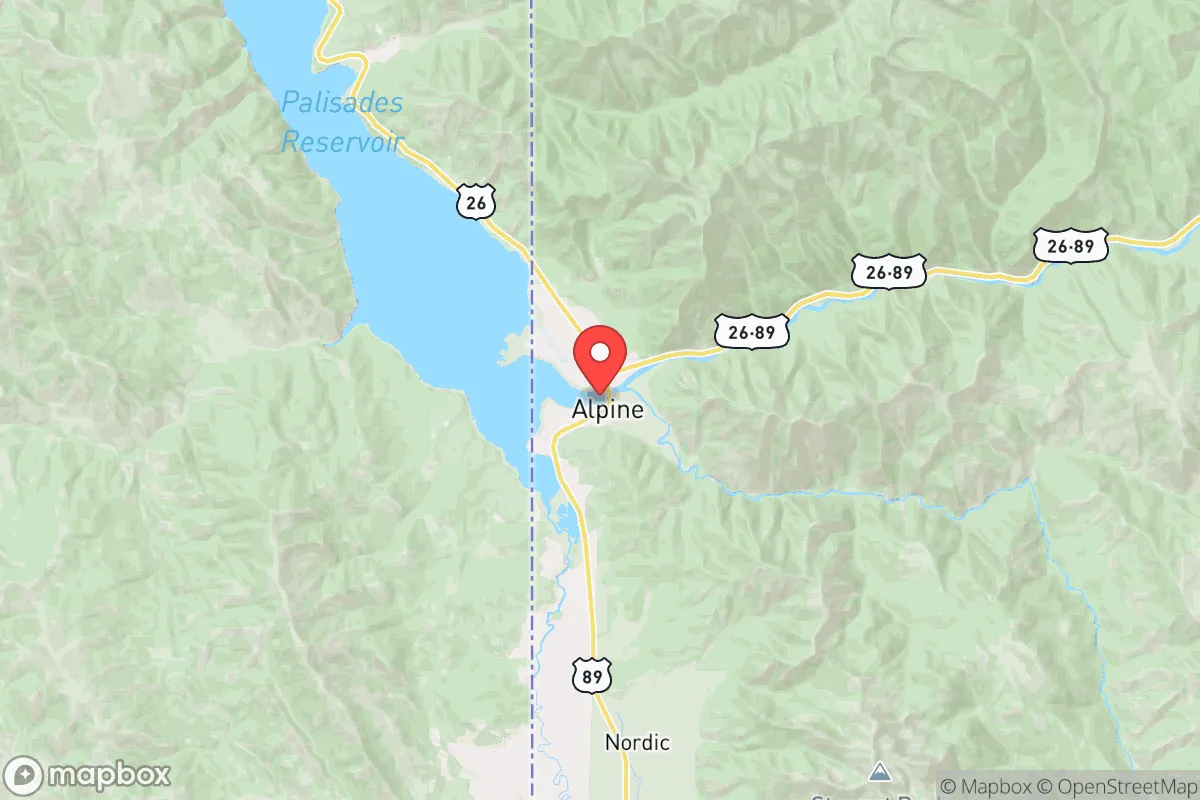
The modern transformation of Alpine began in earnest after the 1960s, driven not by foreign immigration but by a steady trickle of domestic migrants seeking a slower, more rural alternative to the growing boomtowns of Jackson (45 minutes north) and Idaho Falls (90 minutes west). The 1970s saw the development of Alpine Heights, a subdivision of larger lot homes on the bench above the river, which attracted second-home buyers from Utah and Colorado and early telecommuters. The real inflection point came after the 1990s, when recreational tourism — especially snowmobiling, fly fishing, and hunting — began to reshape the local economy. Shady Creek Estates, a gated community developed in the early 2000s along the Greys River corridor, absorbed many of the out-of-state retirees and seasonal residents who now make up a significant share of the year-round population. The racial composition remained overwhelmingly white throughout this period; Alpine’s Black population is 0.0%, and the Hispanic share (3.7%) reflects mostly short-term service workers in the hospitality sector, not settled families. The East/Southeast Asian presence (1.1%) is small and has no distinct neighborhood concentration, likely scattered across the newer subdivisions. Today, North Alpine, the area near the junction of Highways 26 and 89, serves as the town’s commercial and service hub, where convenience stores, a gas station, and a real estate office serve both locals and through traffic.
The future
Alpine’s population is projected to grow modestly over the next decade, driven by a continuation of the same domestic in-migration that has defined its modern era — remote workers and retirees from Utah and Colorado, plus a trickle of Jackson-area “spillover” residents priced out of Teton County. The town’s demographic profile is unlikely to become significantly more diverse. The foreign-born rate (1.4% overall) is well below the national average, and there are no employers or housing patterns that attract large immigrant communities. The 1.1% East/Southeast Asian population may increase slightly if nearby Alpine Nordic and regional ski-adjacent industries recruit skilled workers, but growth will likely remain single-family and owner-occupied. New development is concentrated in two areas: the East River Flat, a stretch of land near the border with Lincoln County where a handful of new single-family homes have gone up since 2020, and the Wyoming Range Acres subdivision (just south of town), which is attracting younger families seeking proximity to the Bridger-Teton National Forest. The cultural identity will likely remain that of a working-class-to-upper-middle-class recreation town — whiter, older, and more conservative than the broader Intermountain West trend, with a growing emphasis on tourism services over traditional ranching.
Bottom line: Alpine is becoming a moderately upscale, predominantly white enclave of recreation-oriented households, with little population churn or diversification on the horizon. For someone moving in now, this means a stable, predictable community where neighbors are likely to share similar backgrounds and values, and where the primary demographic change will be an increase in out-of-state license plates rather than any meaningful shift in racial or ethnic makeup.

* Values derived from national, state, county, city and local statistics and may differ in a specific area. Last updated: 2026-06-25T05:18:39.000Z
Narrative content on this page is AI-generated and may contain mistakes. Verify any details that matter before acting on them.
ReloMaps may earn a commission from affiliate links at no extra cost to you.

