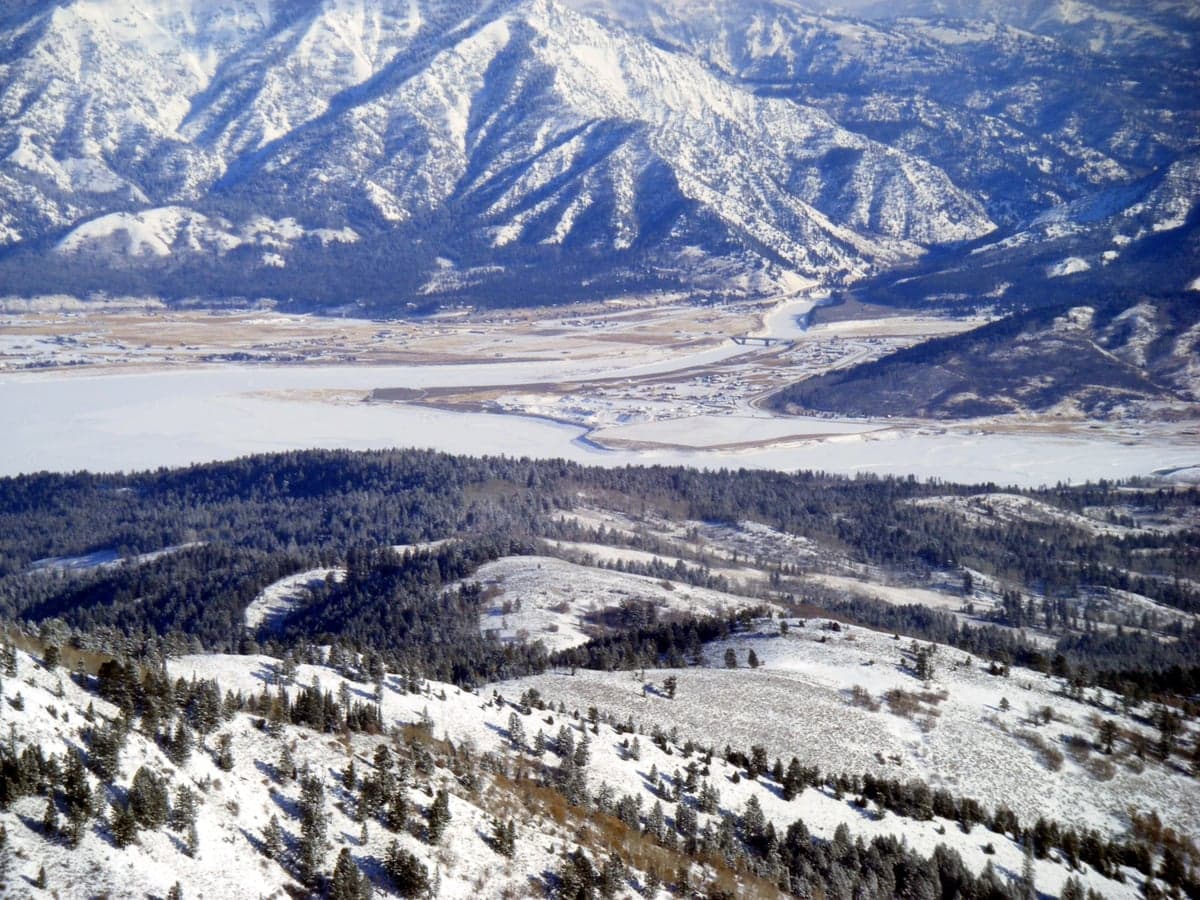
Photo: Wikipedia
Personal Sovereignty in Alpine, WY
Viable for self-reliance. Generally workable, though some barriers may limit total independence.
What does Personal Sovereignty tell us?
Personal Sovereignty measures your capacity for self-reliance and independence with minimal government friction. Higher scores mean fewer barriers between you and the way you want to live... but it assumes you have the space you need and good neighbors.
What does this tell us?
Personal Sovereignty measures your capacity for self-reliance and independence with minimal government friction. Higher scores mean fewer barriers between you and the way you want to live... but it assumes you have the space you need and good neighbors.
State Policy
Energy independence: Net exporter (800% of energy produced in-state)
Personal Liberty
Homesteading

Personal Liberty Analysis
Alpine, Wyoming, offers a personal sovereignty environment shaped by the state’s deeply ingrained libertarian ethos and the practical demands of life in the remote Star Valley region. With no state income tax, a right-to-work legal framework, and a county government that generally favors minimal interference, individuals and families here experience a level of autonomy that is uncommon even by Western standards. The combination of Wyoming’s constitutional protections for gun rights, parental authority, and property use, paired with the town’s small population of roughly 1,200, creates a place where self-reliance is not just a preference but a daily necessity for those who choose to live there.
What the tax and regulatory burden looks like for residents
Wyoming’s tax structure is among the most favorable in the nation for those prioritizing personal financial sovereignty. There is no state income tax on wages, salaries, or capital gains, and no state-level tax on retirement income, which directly appeals to single individuals and families looking to keep more of what they earn. Lincoln County, where Alpine is situated, levies a sales tax rate of 6%—combining the state’s 4% rate with a 2% county option—but this is applied only to tangible goods and a limited set of services, not to groceries or prescription drugs. Property taxes are assessed at a relatively low effective rate of about 0.64% of market value, thanks to the state’s reliance on mineral extraction revenues. The regulatory posture from the town and county is light-touch: there is no zoning ordinance in unincorporated parts of Lincoln County, and Alpine’s own municipal code is minimal, focused mainly on public safety and infrastructure rather than dictating land use or business operations. Building permits are required for new construction, but the process is straightforward and fees are modest compared to states with more bureaucratic oversight. For a self-employed individual, remote worker, or small business owner, the absence of state income tax and the limited regulatory friction create a clear advantage over most other locations in the Mountain West.
How self-defense and gun laws protect personal autonomy
Wyoming is a constitutional carry state, meaning that no permit is required to carry a concealed firearm for any law-abiding adult 21 years or older, both inside and outside Alpine. This is codified in state statute and is not subject to local preemption challenges, so Lincoln County and the town of Alpine cannot enact any ordinances that would restrict this right. The state also recognizes permits from all other states, which is relevant for those who travel frequently or live near the Idaho border—Idaho is roughly 10 minutes from Alpine and also has constitutional carry, creating a contiguous freedom-of-movement corridor for armed citizens. Stand-your-ground laws are fully in effect: there is no duty to retreat before using deadly force in self-defense, whether in one’s home, vehicle, or any place where the individual is lawfully present. Additionally, Wyoming’s firearm preemption statute explicitly prohibits any local government from regulating the ownership, possession, or transportation of firearms, which means a resident’s right to keep and bear arms is uniform across the entire state, not fragmented by city or county ordinances as is common in coastal states. For a family or individual who views self-defense as a fundamental aspect of personal sovereignty, this legal framework is among the most robust in the country.
Self-reliance and homesteading viability: lot sizes, zoning, and off-grid feasibility
Alpine’s geography and local regulations make it a viable location for those pursuing a self-reliant or off-grid lifestyle, though there are practical considerations. Many residential lots in the Alpine area are 1 to 5 acres, especially outside the town’s immediate commercial core, and in unincorporated Lincoln County there is no county-wide zoning, meaning residents are generally free to build detached structures, keep livestock, or operate small-scale agricultural enterprises without seeking variances or special permits. The town of Alpine itself has some basic subdivision regulations, but they are oriented toward health and safety (e.g., septic setbacks, well permitting) rather than aesthetic or prescriptive land-use controls. Off-grid living is legally feasible—Wyoming law allows for owner-built homes without licensed contractors, and there are no state mandates requiring connection to municipal water or sewer systems, provided that a well is drilled and a septic system is installed to county health standards. Solar panels, wind turbines, and propane systems are common in the valley, and the county building department issues permits for alternative energy installations without the red tape found in more developed areas. However, the climate is a genuine constraint: Alpine sits at 5,600 feet elevation with long, snowy winters and a short growing season, so any serious homesteading attempt must account for the need to store feed, manage deep snow, and rely on robust heating systems. The town’s limited retail infrastructure means that residents often drive to Jackson (45 minutes) or Idaho Falls (1.5 hours) for supplies, reinforcing that self-reliance here is not just a legal freedom but a logistical reality.
Personal liberties: parental rights, medical autonomy, speech, and property
Wyoming’s legal environment is notable for its protection of individual and parental rights across several domains. Parental rights in education are strongly protected: state law does not mandate any form of comprehensive sex education, and parents have the explicit right to opt their children out of any health or family life instruction. Homeschooling is legal with minimal reporting requirements—parents need only submit a basic curriculum plan to the local school district each year, and there are no standardized testing requirements or home visits from state officials. On medical autonomy, Wyoming does not have a general vaccine mandate law for adults or children, and there are no state restrictions on interstate purchase of raw milk, supplements, or alternative health products. The state also does not participate in many federal health surveillance programs that infringe on privacy, though residents should note that telemedicine with out-of-state providers can be complicated due to licensing laws. Free speech is protected by both the Wyoming and U.S. Constitutions, and the state has no hate speech laws or pervasive public nuisance ordinances that chill expressive activity. Property rights are secured by Wyoming’s strict eminent domain standards, which limit the taking of private land primarily to actual public use (roads, utilities) rather than economic development purposes, which is a meaningful distinction from states that allow private property to be seized for private projects. For a relocation-oriented audience, this combination of rights—parental, medical, expressive, and propriety—creates a legal atmosphere where the state is largely a background presence rather than an active manager of personal decisions.
In the broader context of Mountain West states, Alpine, Wyoming, ranks near the top for personal sovereignty due to the absence of state income tax, constitutional carry, permissive land-use regulations, and strong protections for individual rights. Compared to neighboring Idaho, which has similar gun laws but imposes a sales tax on groceries and has more extensive municipal codes in places like Boise, Alpine’s regulatory environment is notably lighter. Relative to Colorado, where state-level mandates on energy, education, and healthcare are more prevalent, Wyoming’s approach is decidedly hands-off. For the individual or family who values autonomy over convenience—willing to accept the trade-offs of remote living, harsh winters, and limited services—Alpine offers a legal and practical foundation for a self-directed life that is difficult to replicate elsewhere in the Lower 48.

* Values derived from national, state, county, city and local statistics and may differ in a specific area. Last updated: 2026-06-25T05:18:39.000Z
Narrative content on this page is AI-generated and may contain mistakes. Verify any details that matter before acting on them.
ReloMaps may earn a commission from affiliate links at no extra cost to you.

