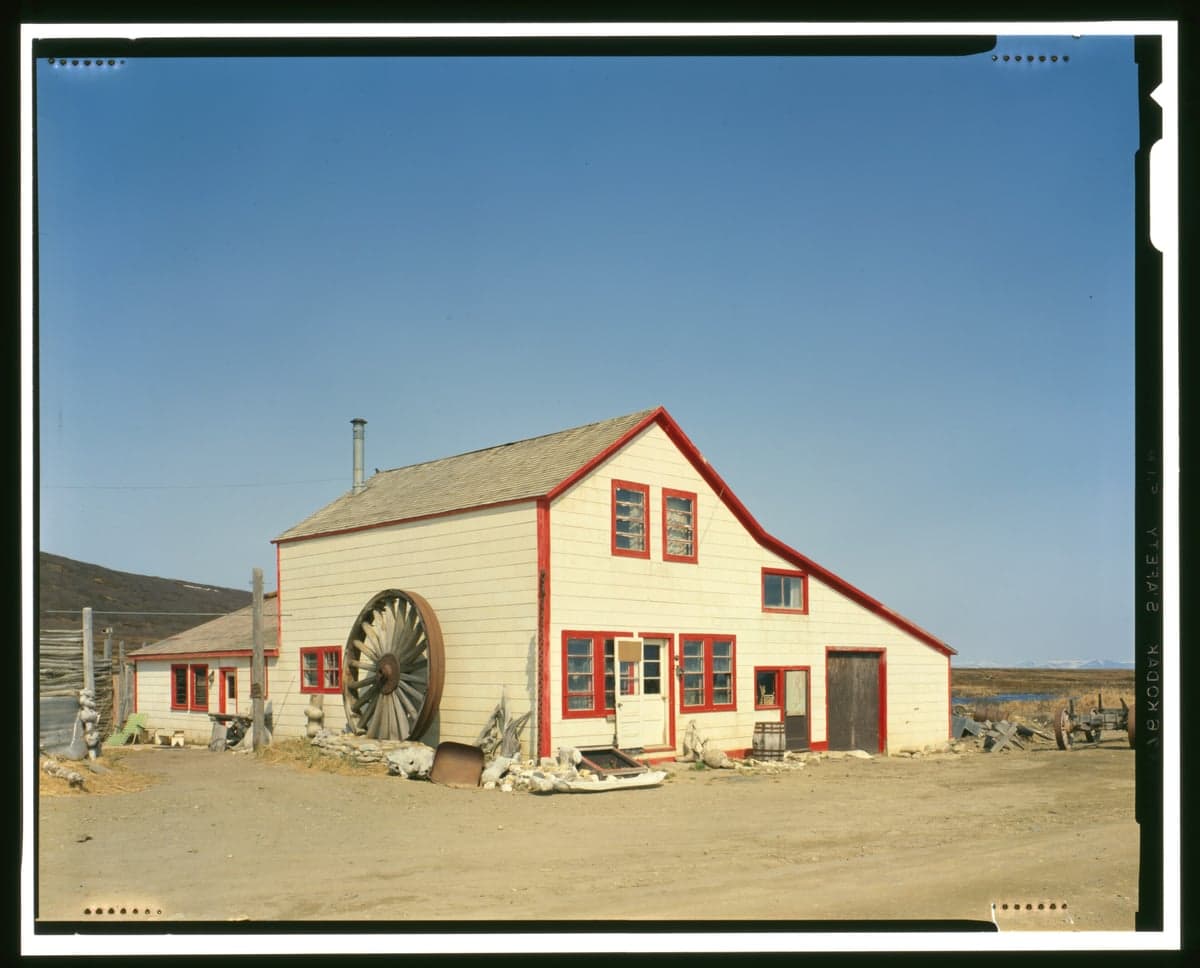
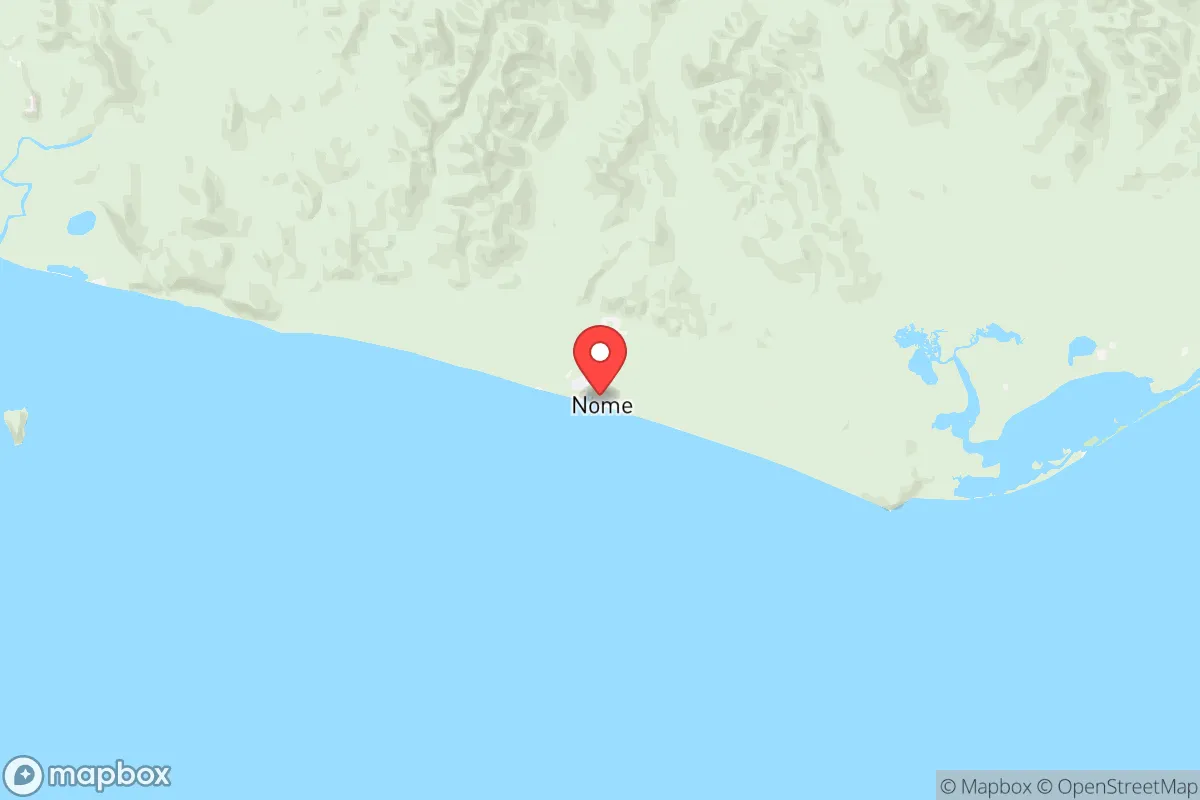
Photo: Wikipedia
Political ClimatePolitical Climate in Nome County
Showing state-level results — no local-only data available.
Local Political AnalysisPolitical Analysis of Nome County
Nome County, Alaska, leans solidly Republican, carrying a Cook Partisan Voting Index (PVI) of R+6—identical to the statewide Alaska PVI of R+6. This means the county is about six points more Republican than the national average, a tilt that has held steady through recent election cycles. However, the political reality on the ground is more nuanced than a single number suggests, with significant variation between the hub city of Nome and the smaller, more remote villages that dot the Bering Sea coast.
How it compares
At first glance, Nome County and Alaska as a whole appear politically identical, both sitting at R+6. But the comparison masks a key difference: Nome County is far more isolated and subsistence-dependent than the Anchorage or Fairbanks areas that drive much of the state's overall PVI. Within the county, the city of Nome itself is the most politically moderate area, often swinging between candidates. In the 2022 U.S. Senate race, Nome precincts gave Republican incumbent Lisa Murkowski a narrow edge over Democrat Pat Chesbro, while the outlying villages like Teller and Shishmaref voted more heavily for the Republican challenger, Kelly Tshibaka. The real contrast comes in the smaller communities: Unalakleet and Savoonga tend to lean more Democratic, driven by strong tribal governance and a focus on subsistence rights, while Golovin and Elim are reliably red, with local politics centered on resource extraction and marine mammal harvest quotas. The county's overall R+6 rating is a compromise between Nome's swing-voter tendencies and the deep-red lean of the interior villages.
What this means for residents
For conservative residents, the R+6 lean means their values around self-reliance, subsistence hunting, and limited government intervention are broadly reflected in local and state representation. The county's state house district has been held by a Republican since 2014, and the local borough assembly tends to favor pro-development candidates on issues like mining and coastal erosion mitigation. For liberal residents, the political climate is more challenging but not hostile. Nome itself provides a blue-ish pocket where progressive candidates can win local school board and city council seats, especially on platforms focused on climate adaptation and Indigenous sovereignty. The practical effect of the R+6 lean is that statewide ballot measures—like the 2024 ranked-choice voting repeal—tend to pass in Nome County by margins similar to the rest of Alaska, but with a slight lag in rural precincts where mail-in voting is less common. Both sides find common ground on subsistence issues, which transcend party lines in a region where food security depends on access to salmon, seal, and caribou.
Culturally, Nome County stands apart from the rest of Alaska in its blend of Iñupiat and Yup'ik traditions with a frontier gold-rush history. The county's politics are heavily shaped by the Alaska Native Claims Settlement Act (ANCSA) and the Alaska National Interest Lands Conservation Act (ANILCA), which create a unique policy landscape around land use and subsistence priorities. Unlike the more partisan battles in Anchorage over oil taxes or education funding, Nome County's political debates often center on local issues like ice road maintenance, village sanitation, and the Bering Sea crab fishery. The county's R+6 rating is less a statement of partisan loyalty and more a reflection of a pragmatic, survival-oriented electorate that votes for whoever promises to keep the barge coming and the school open. For anyone moving here, the key takeaway is that national political labels matter less than local connections—your vote counts most when it's cast for someone who knows the difference between a snowmachine and a snowmobile.

State Political ClimatePolitical Climate in Alaska
State Political AnalysisPolitical Environment in the State
Alaska is a fascinating political outlier: a state with a strong libertarian streak, a Cook PVI of R+8, and a voting history that has swung from solidly Republican to electing an independent governor and a Democratic U.S. House member in recent cycles. Over the last 20 years, the state has shifted from a reliably red stronghold to a more volatile, independent-minded place where the old GOP establishment has been challenged by both a populist right and a pragmatic center. For a conservative-leaning relocator, the reality is that Alaska is less about party loyalty and more about a deep-seated distrust of government, a fierce defense of individual liberties, and a unique set of local issues—like the Permanent Fund Dividend (PFD) and resource extraction—that often trump national partisan battles.
Urban vs. rural divide
The political map of Alaska is a textbook case of the urban-rural split, but with a twist. The Anchorage bowl (Anchorage proper and its suburbs like Eagle River and Chugiak) is the state's political engine, and it's been trending more competitive. Anchorage itself is a swing area: the more liberal, diverse neighborhoods in midtown and downtown lean Democratic, while the conservative strongholds in South Anchorage, Eagle River, and the Mat-Su Borough (Wasilla, Palmer) are deeply red. The Mat-Su Valley is the heart of Alaska's conservative movement—think Sarah Palin country—and it reliably delivers huge margins for Republicans. Fairbanks, the second-largest city, is more mixed: the university and military presence create a moderate-to-liberal base, but the surrounding interior is deeply conservative. Juneau, the capital, is a blue island in a red state, driven by government employment and a strong environmentalist culture. The rural areas—the Bush, the Aleutians, and the Southeast panhandle—are harder to pigeonhole: many Native villages lean Democratic due to tribal ties and federal funding, but they also hold socially conservative views. The real divide isn't just city vs. country; it's between the resource-dependent, libertarian-leaning areas (the Slope, the Mat-Su) and the government-dependent, more liberal areas (Juneau, parts of Anchorage).
Policy environment
Alaska's policy environment is defined by two things: no state income tax and no state sales tax (though local sales taxes exist in some municipalities). This is a huge draw for conservatives and libertarians. The state's budget is heavily reliant on oil revenue and the Permanent Fund, which also funds the annual PFD—a direct cash payment to every resident that is almost sacred in state politics. The regulatory posture is generally pro-development, especially for oil, gas, and mining, though environmental regulations from the federal government (ANWR, the Tongass) are a constant flashpoint. Education policy is a mixed bag: the state has a strong public school system in urban areas, but rural schools struggle with funding and teacher retention. There is no school choice program like vouchers, though charter schools exist. Healthcare is a major issue: Alaska has the highest healthcare costs in the nation, and the state expanded Medicaid under the ACA. Election laws are relatively open: Alaska has a top-four primary system and ranked-choice voting for general elections, which was passed by ballot initiative in 2020. This has been controversial among conservatives, as it has allowed moderate Republicans and independents to win over more partisan candidates.
Recent policy direction
The last few years have seen Alaska zigzag on key liberty issues. On gun rights, Alaska remains one of the most permissive states: no permit required for concealed carry, no magazine limits, and a strong preemption law that prevents local governments from passing their own restrictions. In 2023, the legislature passed a bill to allow school staff to carry firearms on campus. On parental rights and education, the state has seen battles over critical race theory and transgender policies, but no major legislation has passed. The state's medical and bodily autonomy landscape is unique: abortion remains legal and accessible, with no major restrictions, but the state has also passed laws protecting medical freedom for vaccine mandates. On property rights, Alaska is generally strong, with no state-level property tax and a homestead exemption, but federal land ownership (over 60% of the state) creates constant tension. The taxation environment remains favorable, but the state has debated a state income tax multiple times in the last decade due to budget deficits, though none have passed. The voting and ballot access issue is the most contentious: ranked-choice voting was upheld by the courts in 2024, but there is an active movement to repeal it, with a ballot initiative likely in 2026. For a relocator, the bottom line is that Alaska is a state where individual liberties are broadly protected, but the political fights are real and often center on how to fund the government without taxes.
Civil unrest & political movements
Alaska has a history of civil unrest that is more about resource politics than culture wars. The most visible flashpoints have been around the Permanent Fund Dividend: in 2019, Governor Mike Dunleavy faced a recall effort after he vetoed funding for the PFD, and the state saw large protests in Anchorage and Juneau. The oil and gas industry is another constant source of tension: the debate over drilling in ANWR has drawn activists from both sides, with pro-development rallies in the North Slope and environmental protests in Anchorage. Immigration politics are less prominent than in the Lower 48, but there is a small but vocal movement around border security and sanctuary policies—Anchorage has a "welcoming city" ordinance that limits cooperation with federal immigration enforcement, which has been a target for conservative activists. Election integrity has been a hot topic since the 2020 election, with some conservative groups questioning the ranked-choice voting system and pushing for audits. The state also has a small but active secessionist movement (the Alaska Independence Party), though it has little mainstream support. For a new resident, the political climate is less about street protests and more about the constant, low-grade tension between the state's libertarian ethos and the realities of a government-dependent economy.
Projection
Over the next 5-10 years, Alaska's political trajectory will be shaped by two forces: demographic change and economic diversification. The state's population is aging and slowly declining, with young people leaving for the Lower 48. In-migration is mostly from conservative-leaning areas of the Pacific Northwest and California, which could reinforce the state's red lean, but also from military and federal workers who tend to be more moderate. The Mat-Su Borough will continue to grow and become an even stronger conservative base, while Anchorage will likely remain a swing area, with the potential to flip more Democratic if the city continues to diversify. The ranked-choice voting system is the wild card: if it survives the repeal effort, it will continue to produce moderate, coalition-based governance; if it is repealed, the state could swing back to more partisan, primary-driven politics. The fiscal situation is the biggest uncertainty: if oil revenues continue to decline, the state will eventually have to either cut services, implement a tax, or draw down the Permanent Fund, any of which would be politically explosive. For a relocator, the Alaska of 2035 will likely be more politically polarized than today, but still defined by its independent streak and its unique set of local issues.
For a new resident, the practical takeaway is that Alaska rewards self-reliance and a tolerance for political unpredictability. Conservatives will find a state that respects gun rights, low taxes, and individual freedom, but they'll also have to accept ranked-choice voting, a strong public sector, and a healthcare system that is expensive and government-involved. Liberals will find a state that protects abortion access and has a strong environmental movement, but they'll have to live with a pro-development, resource-extraction economy and a deeply conservative rural population. The bottom line: Alaska is not a red state in the way Texas or Alabama is—it's a state where the political battles are fought over local issues, not national ones, and where the ultimate value is personal freedom, even if that means living with a little chaos.
* Values derived from national, state, county, city and local statistics and may differ in a specific area. Last updated: 2026-06-16T20:01:33.000Z
Narrative content on this page is AI-generated and may contain mistakes. Verify any details that matter before acting on them.
ReloMaps may earn a commission from affiliate links at no extra cost to you.

