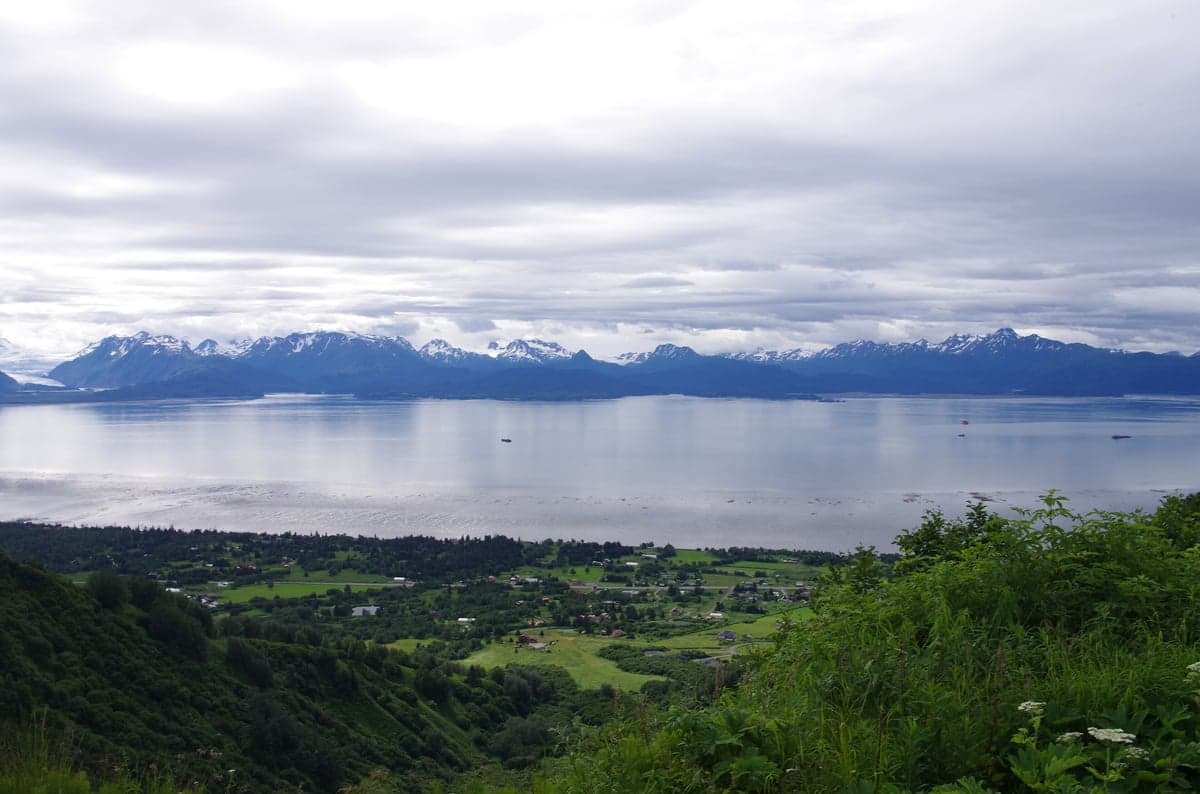
Photo: Wikipedia
Political ClimatePolitical Climate in Kenai Peninsula County
Showing state-level results — no local-only data available.
Local Political AnalysisPolitical Analysis of Kenai Peninsula County
Kenai Peninsula County is a reliably Republican stronghold, mirroring the state of Alaska's overall political lean with a Cook PVI of R+6. However, the county's politics are far from monolithic, with a distinct coastal-versus-inland split that creates a more nuanced picture than the statewide average suggests. The real story is how the peninsula's unique economy—fishing, oil, and tourism—shapes a brand of conservatism that is often more libertarian than the national GOP, and how that plays out in local elections.
How it compares
While both Kenai Peninsula County and Alaska share the same R+6 PVI, the county's internal dynamics are more polarized. The city of Homer, with its strong artist and fishing community, consistently votes bluer than the rest of the peninsula, often swinging Democratic in state legislative races. In contrast, Soldotna and Kenai are solidly red, driven by oil and gas workers and a strong evangelical presence. The real swing precincts are in the Nikiski and Sterling areas, where independent-minded voters—many working in the fisheries or as small business owners—can tip a close race. Statewide, Alaska's politics are dominated by the "Sourdough" independent streak, but on the peninsula, that independence is more likely to manifest as a vote for a conservative third-party candidate than a moderate Democrat. The county's Republican lean is more consistent than in the Mat-Su Borough, but less extreme than in the Fairbanks North Star Borough.
What this means for residents
For conservative residents, the political climate is comfortable. Local government, school boards, and the borough assembly are reliably conservative, and the area's strong gun rights culture is protected by state preemption laws. For liberal residents, the reality is more about finding community in specific pockets. Homer offers a progressive enclave with a thriving arts scene and a vocal environmental movement, but its influence is limited to local issues. The practical effect is that most political battles are fought over resource development—specifically oil drilling in Cook Inlet and the proposed Pebble Mine—rather than social issues. Both sides agree on the importance of the fishing industry, which creates odd alliances. The county's tax structure is also a point of agreement: there is no sales tax in most borough areas, and property taxes are low, which appeals to fiscal conservatives and libertarians alike.
Culturally, the Kenai Peninsula is defined by its independence from Anchorage. Residents often feel overlooked by the state government in Juneau, which fuels a strong "local control" sentiment. This manifests in everything from opposition to state-mandated education standards to a preference for local fish processing over outside corporate interests. The area's policy distinctions are most visible in its approach to land use: the Kenai National Wildlife Refuge and state parks cover vast swaths of the county, creating a constant tension between conservation and development. This isn't a red-versus-blue fight; it's a deeply local argument about what kind of place the peninsula should be. Looking ahead, the county's politics will likely remain R+6, but the growing population of remote workers and retirees from outside Alaska could slowly shift the Homer and Seward areas toward purple, while the core oil-and-gas communities stay deep red. For now, it's a place where a Republican can win a countywide race by 15 points, but a local school bond measure might fail by 2. That's the Kenai Peninsula in a nutshell.

State Political ClimatePolitical Climate in Alaska
State Political AnalysisPolitical Environment in the State
Alaska has long been a Republican-leaning state with a strong libertarian streak, carrying a Cook PVI of R+6, but its politics are far more independent and unpredictable than that label suggests. Over the past 20 years, the state has shifted from reliably conservative to a volatile mix where maverick Republicans, moderate Democrats, and third-party candidates all compete seriously, driven by a deep distrust of centralized power and a fierce attachment to individual freedoms. The dominant coalition is a pragmatic, resource-focused conservatism that prioritizes oil revenue, subsistence rights, and local control, but recent cycles have seen a growing urban-liberal bloc in Anchorage and Juneau pushing back against the old guard.
Urban vs. rural divide
The political map of Alaska is a stark contrast between a few concentrated urban centers and the vast, sparsely populated Bush and Interior regions. Anchorage, home to about 40% of the state’s population, is the swing district that decides most statewide races; its liberal-leaning midtown and downtown precincts are balanced by conservative suburbs like Eagle River and Chugiak. Juneau, the capital, is reliably Democratic, driven by state government employees and a strong environmentalist presence, while Fairbanks leans Republican but has a significant military and university population that keeps it competitive. The Mat-Su Borough, anchored by Wasilla and Palmer, is the state’s conservative heartland—deep red, pro-development, and culturally aligned with the Lower 48’s rural West. Rural villages in the Bush, like Barrow (Utqiaġvik) and Nome, vote overwhelmingly Democratic due to strong tribal governance and reliance on federal programs, but they often split on resource extraction issues. The divide isn’t just partisan; it’s about lifestyle—urbanites in Anchorage care about education funding and climate policy, while rural residents prioritize fuel costs, hunting rights, and subsistence access.
Policy environment
Alaska’s policy environment is defined by its lack of a state income tax or statewide sales tax, funded almost entirely by oil revenue and the Permanent Fund Dividend (PFD). This creates a unique fiscal politics: the PFD check, typically $1,000–$2,000 per person annually, is a sacred cow that both parties defend, but debates over its size drive budget fights. The state has a constitutional budget reserve and a spending cap, but no broad-based tax, making it one of the most tax-friendly states in the nation. Regulatory posture is generally light, especially for oil, mining, and fishing, though environmental permitting can be slow due to federal overlay on federal lands (60% of the state). Education policy is locally controlled, with no statewide school choice program, but charter schools and correspondence programs are common. Healthcare is a mixed bag: Alaska expanded Medicaid under the ACA in 2015, but rural access remains poor, and the state has high rates of uninsured residents. Election laws are relatively open—same-day voter registration, no-excuse absentee voting, and a top-four primary system (adopted in 2020) that allows independents to vote in all primaries. This system, championed by the late Republican Senator Ted Stevens’ legacy, has produced centrist winners like Senator Lisa Murkowski and Governor Mike Dunleavy.
Recent policy direction
Recent legislation shows Alaska zigzagging between libertarian impulses and pragmatic compromises. On gun rights, Alaska is a constitutional carry state with no permit required for concealed carry, and it passed a 2013 law prohibiting state enforcement of future federal gun bans—one of the strongest Second Amendment protections in the nation. Parental and education rights saw a 2023 law allowing parents to opt children out of any curriculum they find objectionable, though it stopped short of a full “Don’t Say Gay” style ban. Speech and privacy are broadly protected, with no state-level surveillance programs beyond standard law enforcement, though the state’s small population means close-knit communities can feel intrusive. Medical and bodily autonomy is a flashpoint: abortion remains legal up to viability (codified in state law in 1997), but a 2024 ballot initiative to enshrine it further failed narrowly, and the state has no trigger law. Property rights are strong, with no statewide zoning and a “right to farm” law protecting agricultural uses, but federal land ownership (national parks, refuges) creates constant tension. Taxation remains the big story: the 2023 budget battle saw Governor Dunleavy propose a state income tax to close a deficit, but it was rejected, and the state instead drew down savings. Voting access expanded with the top-four primary system, but a 2024 bill to require photo ID for absentee ballots failed, keeping Alaska’s election system relatively open compared to many red states.
Civil unrest & political movements
Civil unrest in Alaska is rare but intense when it flares. The most visible recent movement was the “Save Our Salmon” protests in 2020–2022, where environmental activists and tribal groups blocked roads and occupied state buildings in Anchorage and Juneau to oppose the Pebble Mine project in Bristol Bay—a fight that pitted resource extraction against subsistence fishing. On the right, the Alaska Independence Party, which once elected Governor Wally Hickel, still advocates for a state referendum on secession, though it’s a fringe movement with no real traction. Immigration politics are muted because Alaska has a tiny foreign-born population (under 8%), but there’s a strong anti-federal sentiment around land management, with “Bundy-style” standoffs over grazing rights in the Interior. Election integrity controversies are minimal—Alaska’s ranked-choice voting system (used in 2022) drew lawsuits from conservatives, but courts upheld it, and turnout remained high. The most visible flashpoint for newcomers is the PFD debate: every year, protests erupt in Anchorage over the dividend amount, with left-leaning groups arguing for smaller checks to fund services and right-leaning groups demanding the full statutory formula. It’s a uniquely Alaskan political drama that defines daily life.
Projection
Over the next 5–10 years, Alaska’s political trajectory points toward continued volatility and a slow drift toward the center, driven by demographic shifts and fiscal reality. In-migration is modest but tilts younger and more liberal, especially to Anchorage and Juneau, while out-migration of older conservatives to the Lower 48 is steady. The state’s reliance on oil revenue is declining as production drops, forcing a reckoning with either a state income tax or deep cuts to services—neither of which is popular. The urban-rural divide will likely widen, with Anchorage and Juneau becoming more Democratic and the Bush staying Democratic but with lower turnout, while the Mat-Su and Fairbanks remain red. The wildcard is the Permanent Fund: if the dividend is cut further to fund government, expect a populist backlash that could elect a third-party governor. Someone moving in now should expect a decade of budget fights, a slow move toward some form of taxation, and a political culture that remains fiercely independent but increasingly polarized between resource-development conservatives and environmentalist liberals.
For a new resident, the bottom line is that Alaska offers a unique blend of low taxes, strong gun rights, and local control, but it comes with a volatile political scene where nothing is guaranteed. Conservatives will find a welcoming environment in the Mat-Su or Fairbanks, with a government that mostly stays out of their lives, but they’ll need to accept that Anchorage and Juneau will push back on resource extraction and social issues. Liberals will find a foothold in the cities, with a functional safety net and strong environmental protections, but they’ll have to navigate a state where rural subsistence rights and oil money still dominate. The key takeaway: Alaska rewards self-reliance and political engagement—your vote genuinely matters here, and the state’s small population means you can have a real impact on local politics, whether you’re in Wasilla or Sitka.
* Values derived from national, state, county, city and local statistics and may differ in a specific area. Last updated: 2026-06-15T11:53:51.000Z
Narrative content on this page is AI-generated and may contain mistakes. Verify any details that matter before acting on them.
ReloMaps may earn a commission from affiliate links at no extra cost to you.

