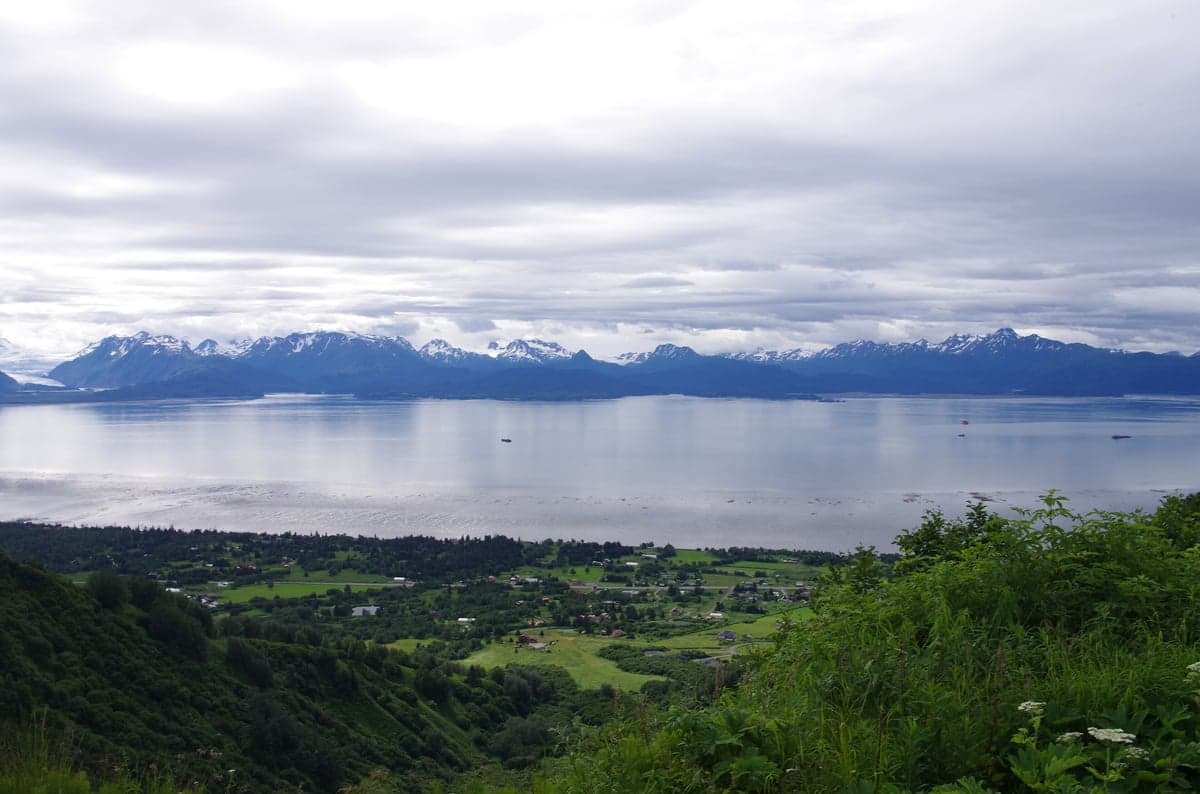
Photo: Wikipedia
Personal Sovereignty in Kenai Peninsula County
Strong independent fundamentals that actively favor personal liberty and low regulation.
What does Personal Sovereignty tell us?
Personal Sovereignty measures your capacity for self-reliance and independence with minimal government friction. Higher scores mean fewer barriers between you and the way you want to live... but it assumes you have the space you need and good neighbors.
What does this tell us?
Personal Sovereignty measures your capacity for self-reliance and independence with minimal government friction. Higher scores mean fewer barriers between you and the way you want to live... but it assumes you have the space you need and good neighbors.
State Policy
Energy independence: Net exporter (350% of energy produced in-state)
Personal Liberty
Homesteading

Personal Liberty Analysis
Kenai Peninsula Borough offers one of the strongest personal sovereignty environments in Alaska, combining the state’s famously light regulatory touch with a local culture that prizes self-reliance and independence. Unlike the more centralized governance found in Anchorage or Juneau, the borough’s dispersed population centers—from Homer and Soldotna to Seward and the remote communities of Cooper Landing and Ninilchik—operate under a county-level structure that generally defers to individual choice on property use, self-defense, and daily life. For a conservative-leaning individual or family seeking maximum autonomy, the Kenai Peninsula represents a deliberate step away from the regulatory density of the Lower 48, though the trade-offs involve harsh winters, limited services, and a reliance on personal preparedness that not every newcomer is ready for.
Tax burden and regulatory posture in Kenai Peninsula Borough
Alaska’s absence of a state income tax and state sales tax is the foundation of the Kenai Peninsula’s low-tax environment, and the borough itself keeps its own tax burden modest. The borough levies a 2.5% sales tax on most goods and services, with individual cities like Soldotna adding an additional 3% and Homer adding 2.5%, bringing combined rates to around 5.5% in those hubs. Property taxes are among the lowest in the nation, with the borough’s mill rate at roughly 8.5 mills (about $8.50 per $1,000 of assessed value), and many rural properties outside city limits—especially in areas like Sterling, Kasilof, and Ninilchik—qualify for exemptions that reduce the bill further. The regulatory posture is equally light: there is no state-level building code enforced outside of a few incorporated cities, no mandatory vehicle emissions testing, and no county-wide zoning in unincorporated areas. This means a landowner in Cooper Landing can build a cabin, park an RV, or set up a workshop without the permitting gauntlet common in the Lower 48. The trade-off is that services like road maintenance, snow plowing, and emergency response are sparse in remote areas, placing the burden of infrastructure on the individual.
Self-defense and gun law specifics on the Kenai Peninsula
Alaska is a constitutional carry state, and Kenai Peninsula Borough reflects that ethos fully. No permit is required to carry a concealed firearm for anyone 21 or older who can legally possess a gun, and open carry is unrestricted. The borough has no local ordinances restricting firearm ownership, magazine capacity, or ammunition types, meaning residents in Homer, Soldotna, Seward, and all unincorporated areas enjoy the same broad rights as the rest of the state. Stand-your-ground laws apply with no duty to retreat in any place where a person has a legal right to be, and the state’s castle doctrine extends to vehicles and occupied structures. For hunters and sport shooters, the peninsula’s vast public lands—including the Kenai National Wildlife Refuge and Chugach National Forest—provide year-round access with minimal regulation beyond standard state hunting licenses. The gun culture here is practical and ingrained; most households own at least one firearm, and local gun shops and shooting ranges in Soldotna and Homer are well-supported. Newcomers from restrictive states will find the legal environment refreshingly simple, though responsible storage and bear defense (a .44 Magnum or 12-gauge slug is common advice) are practical necessities, not just rights.
Self-reliance and homesteading viability across the borough
The Kenai Peninsula is one of Alaska’s most viable regions for off-grid living and homesteading, but viability varies sharply by location. In unincorporated areas like Ninilchik, Kasilof, and the western side of the peninsula near Anchor Point, parcels of 5 to 40 acres are common, with prices ranging from $5,000 to $20,000 per acre depending on road access and proximity to tidewater. Zoning is virtually nonexistent in these areas: no minimum square footage for dwellings, no restrictions on alternative energy systems (solar panels, wind turbines, micro-hydro), and no prohibition on composting toilets or rainwater collection. Off-grid feasibility is high, though the climate demands serious planning—winter temperatures routinely hit -20°F, and the growing season is only 90 to 110 days, limiting gardening to cold-hardy crops like potatoes, kale, and root vegetables. In contrast, the more densely populated city limits of Soldotna and Homer impose some building codes and lot size minimums (typically 7,500 to 10,000 square feet), making true homesteading harder. Seward, hemmed in by mountains and the ocean, has limited land availability and higher prices, pushing most homesteaders toward the central and southern parts of the borough. For those willing to haul water, use propane, and maintain a wood stove, the Kenai Peninsula offers one of the last accessible frontiers for self-reliant living in the United States.
Personal liberties: parental rights, medical autonomy, speech, and property
Alaska’s state constitution provides strong protections for individual liberties, and Kenai Peninsula Borough generally follows suit. Parental rights are robust: the state has no mandatory vaccination laws for school attendance (parents can opt out for any reason), and homeschooling is lightly regulated, requiring only an annual notification to the local school district. Medical autonomy is similarly broad—there is no state mandate for health insurance, no individual mandate, and no restrictions on alternative or complementary medicine, though access to specialists is limited to Soldotna’s Central Peninsula Hospital and Homer’s South Peninsula Hospital. Speech and assembly rights are fully protected, with no local hate speech ordinances or permit requirements for public gatherings outside of a few city parks. Property rights are the crown jewel: Alaska’s right-to-farm laws protect agricultural activities from nuisance lawsuits, and the borough does not impose rent control, short-term rental bans, or restrictive covenants on unincorporated land. The main constraint is the Alaska National Interest Lands Conservation Act (ANILCA), which limits development on federal lands that cover roughly 60% of the borough, but private landholders face few government intrusions. For a family that values the freedom to raise children without state interference, choose medical treatments, speak openly, and use their land as they see fit, the Kenai Peninsula ranks among the most liberty-respecting regions in the country.
Overall, the Kenai Peninsula Borough delivers a level of personal sovereignty that is rare even by Alaskan standards, combining low taxes, minimal regulation, strong gun rights, and genuine homesteading opportunities in a single, accessible package. Compared to the more urbanized Anchorage Municipality or the heavily federalized Interior, the peninsula offers a middle ground—close enough to services in Soldotna and Homer to avoid total isolation, yet remote enough in places like Ninilchik and Cooper Landing to escape the creeping regulatory reach that defines much of the Lower 48. For the conservative-leaning individual or family who prioritizes autonomy over convenience, the Kenai Peninsula is not just a place to live; it is a deliberate choice to opt out of the administrative state and embrace a life where personal responsibility is the primary law.

* Values derived from national, state, county, city and local statistics and may differ in a specific area. Last updated: 2026-06-15T11:53:51.000Z
Narrative content on this page is AI-generated and may contain mistakes. Verify any details that matter before acting on them.
ReloMaps may earn a commission from affiliate links at no extra cost to you.

