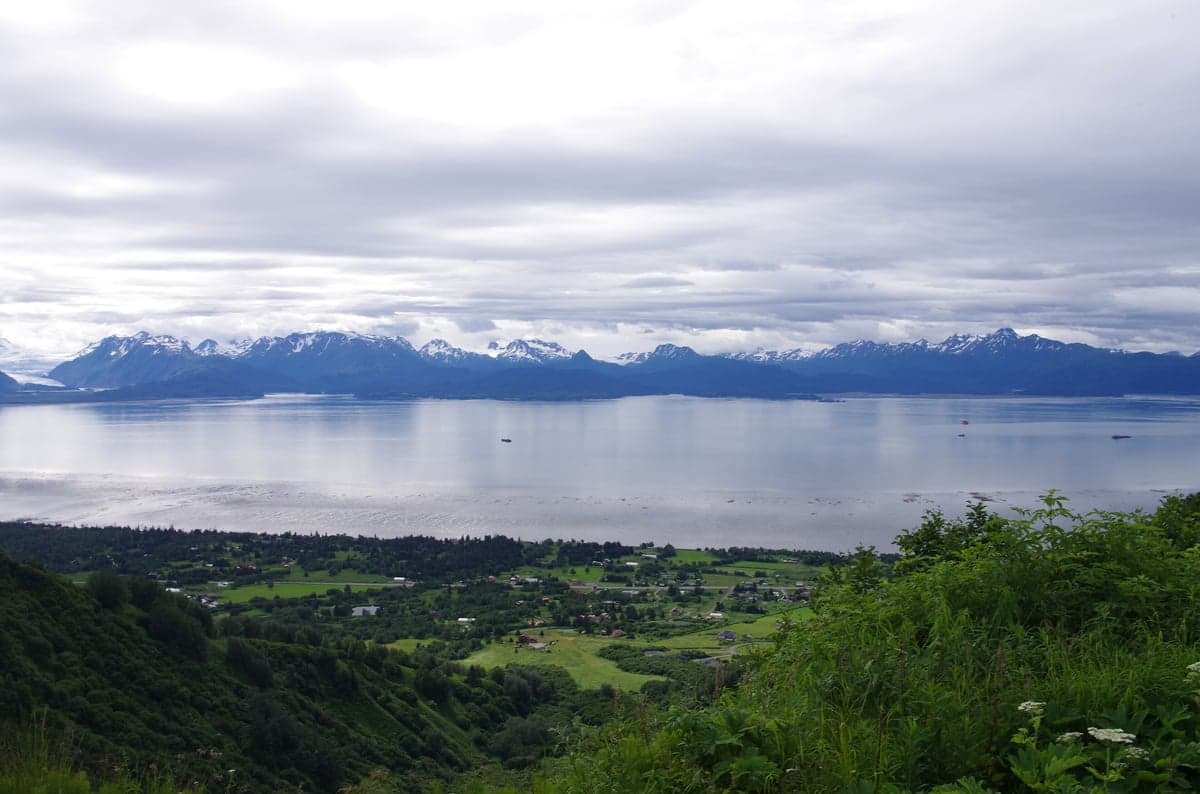
Photo: Wikipedia
Demographics of Kenai Peninsula County
Affluence Level in Kenai Peninsula County
A middle-class area roughly in line with national averages across income, home values, education, and employment.
People of Kenai Peninsula County
The people of Kenai Peninsula County, Alaska, today number roughly 59,843, forming a predominantly white (77.9%) and sparsely populated region where a strong frontier identity meets a growing service economy. With only 1.3% foreign-born residents and a modest 29.4% college-educated rate, the population is notably less diverse than the national average, yet it carries a distinct character shaped by Alaska Native heritage, Russian colonial history, and waves of resource-driven migration. The county’s identity is anchored in small cities like Homer, Kenai, and Soldotna, where fishing, oil, and tourism define daily life, while newer arrivals are drawn to Seward and Sterling for their access to wilderness and relative affordability.
Settlement & growth (pre-1960)
Long before European contact, the Kenai Peninsula was home to the Dena’ina Athabascans, who inhabited the western and northern shores, and the Alutiiq (Sugpiaq) people along the southern coast and Prince William Sound. These groups lived in semi-permanent villages, relying on salmon runs, marine mammals, and trade networks that connected the interior to the Gulf of Alaska. Russian colonization began in the late 18th century, with fur traders establishing outposts at Fort Alexander (near present-day Kenai) and Nikolaevsk in the 1790s. The Russian-American Company brought a mix of Russian promyshlenniki (fur hunters), Creoles (mixed Russian-Alaska Native people), and Orthodox missionaries, leaving a lasting cultural and religious imprint still visible in communities like Ninilchik, where Russian Old Believers later settled.
The United States purchased Alaska in 1867, but significant American settlement on the Kenai Peninsula did not begin until the early 20th century. The first major wave came with the gold rushes of the 1890s and 1900s, drawing prospectors to Hope and Sunrise on Turnagain Arm, though these booms were short-lived. A more enduring influx followed the construction of the Alaska Railroad in the 1910s and 1920s, which connected Seward to Anchorage and Fairbanks, turning Seward into a critical port and transportation hub. Homesteaders—many of Scandinavian, German, and Scots-Irish descent—arrived under the Homestead Act, clearing land for farms and ranches in the Kenai River valley around Soldotna and Sterling. Commercial fishing also expanded, drawing cannery workers and fishermen to Homer and Seldovia, where a mix of Scandinavians, Finns, and a small number of Japanese and Filipino laborers created the peninsula’s first non-white enclaves.
World War II brought a temporary military buildup, with bases and airfields constructed in Kenai and Seward, but the population remained small—fewer than 10,000 residents as late as 1950. The real turning point came in 1957 with the discovery of oil at Swanson River on the Kenai National Wildlife Refuge, which triggered a boom that transformed the peninsula from a remote outpost into an energy-producing region. Oil workers, engineers, and support staff poured in from Texas, Oklahoma, and the Lower 48, settling primarily in Kenai and Soldotna, where new housing subdivisions and schools sprang up almost overnight.
Modern era (post-1965)
The 1965 Hart-Cellar Act had minimal direct impact on Kenai Peninsula County, given its already low foreign-born population (1.3% today). Instead, the post-1965 demographic story is one of domestic migration, driven by the oil industry and, later, by lifestyle seekers. The 1968 discovery of the massive Prudhoe Bay oil field on the North Slope created a secondary boom for the Kenai Peninsula, as the region became a hub for oil and gas processing, with refineries and liquefied natural gas (LNG) plants in Kenai and Nikiski. This attracted a wave of workers from the Lower 48—predominantly white, often from the Gulf Coast and Plains states—who brought a conservative, blue-collar ethos that still defines much of the area’s political culture.
Suburbanization accelerated in the 1970s and 1980s, with Soldotna emerging as the commercial and administrative center, while Sterling and Kalifornsky grew as bedroom communities for workers commuting to Kenai and Nikiski. The Alaska Native Claims Settlement Act (ANCSA) of 1971 also reshaped the region, creating village corporations like Kenai Native Association and Cook Inlet Region, Inc. (CIRI), which gave Dena’ina and Alutiiq shareholders economic stakes in development. Today, Alaska Natives make up a significant minority, concentrated in Kenai, Ninilchik, and Seldovia, though their share of the population has declined as non-Native in-migration continues.
Since the 1990s, the county has seen a steady influx of retirees and remote workers drawn to the peninsula’s natural beauty and lower cost of living compared to Anchorage. Homer has become a magnet for artists, writers, and environmentalists, giving it a more liberal, countercultural vibe that contrasts with the conservative oil towns. Hispanic residents, while still a small share (4.3%), have grown modestly, working in fishing, hospitality, and construction, with small clusters in Homer and Seward. East/Southeast Asian communities (1.8%) are primarily Filipino and Vietnamese, many with roots in the fishing industry, and are most visible in Kenai and Homer. The Black population (0.5%) and Indian subcontinent population (0.0%) remain negligible, reflecting the region’s limited draw for non-white immigrants.
The future
Kenai Peninsula County’s population is projected to grow slowly, if at all, with the state’s overall demographic stagnation and out-migration from Alaska to the Lower 48 tempering any boom. The county is becoming slightly more diverse, driven by modest Hispanic and Asian growth, but it will remain overwhelmingly white for the foreseeable future. The biggest demographic shift is likely to be age-related: the population is aging, with retirees moving in and younger families leaving for job opportunities elsewhere, particularly in Anchorage or the Lower 48. New residential development is concentrating in Soldotna and Sterling, where services and schools are strongest, while remote work is enabling a small but growing number of newcomers to settle in Homer and Seward without relying on local employment.
Culturally, the county is becoming more polarized between the conservative, resource-extraction communities of the Kenai River valley and the more liberal, tourism-and-arts enclaves of the southern coast. This tension is likely to intensify as climate change affects salmon runs and winter tourism, potentially reshaping the economy and the types of people who choose to live here. The Alaska Native population, while small, is gaining political and economic influence through land corporations and tribal governments, particularly in Kenai and Ninilchik.
For someone moving in now, Kenai Peninsula County offers a place where frontier self-reliance still matters, where the pace of life is slow, and where community ties are strong but insular. It is not a region of rapid change or diversity, but one of stability and deep connection to the land—a place for those who value solitude, outdoor recreation, and a conservative, hands-on lifestyle over urban amenities or cultural variety.

* Values derived from national, state, county, city and local statistics and may differ in a specific area. Last updated: 2026-06-15T11:53:51.000Z
Narrative content on this page is AI-generated and may contain mistakes. Verify any details that matter before acting on them.
ReloMaps may earn a commission from affiliate links at no extra cost to you.

