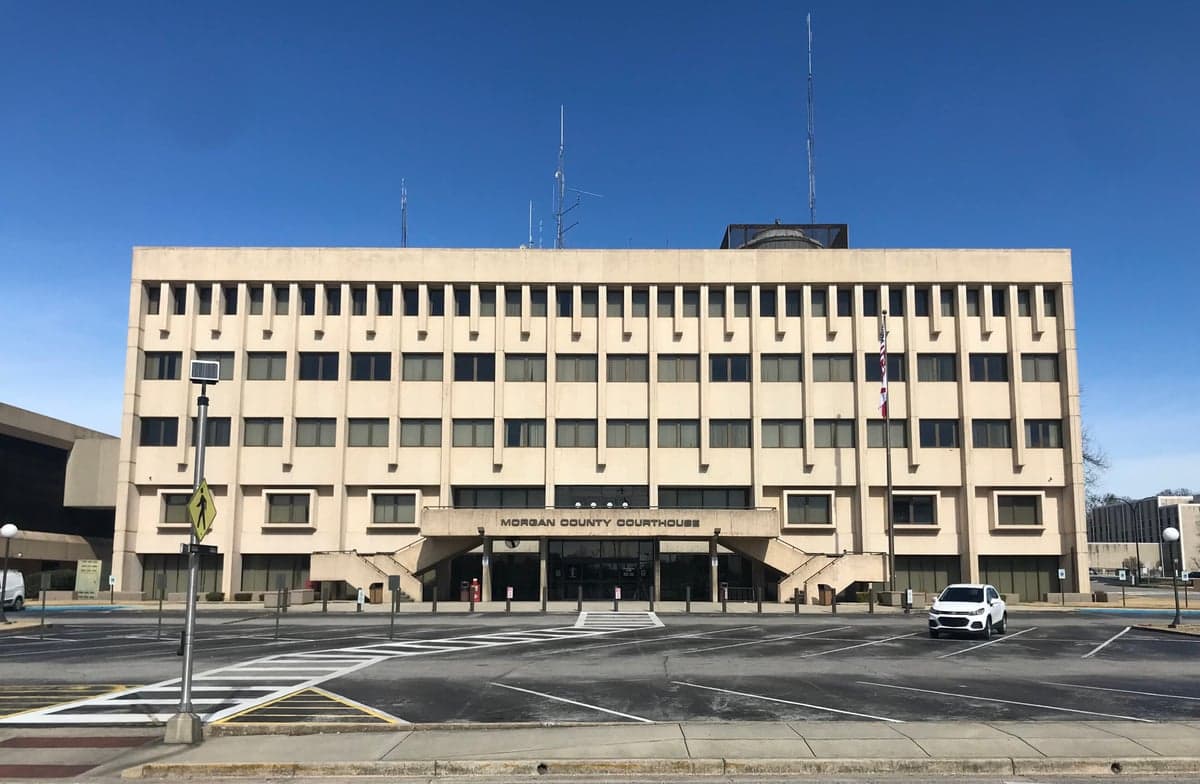
Photo: Wikipedia
Political ClimatePolitical Climate in Morgan County
Showing district-level results — no local-only data available.
Local Political AnalysisPolitical Analysis of Morgan County
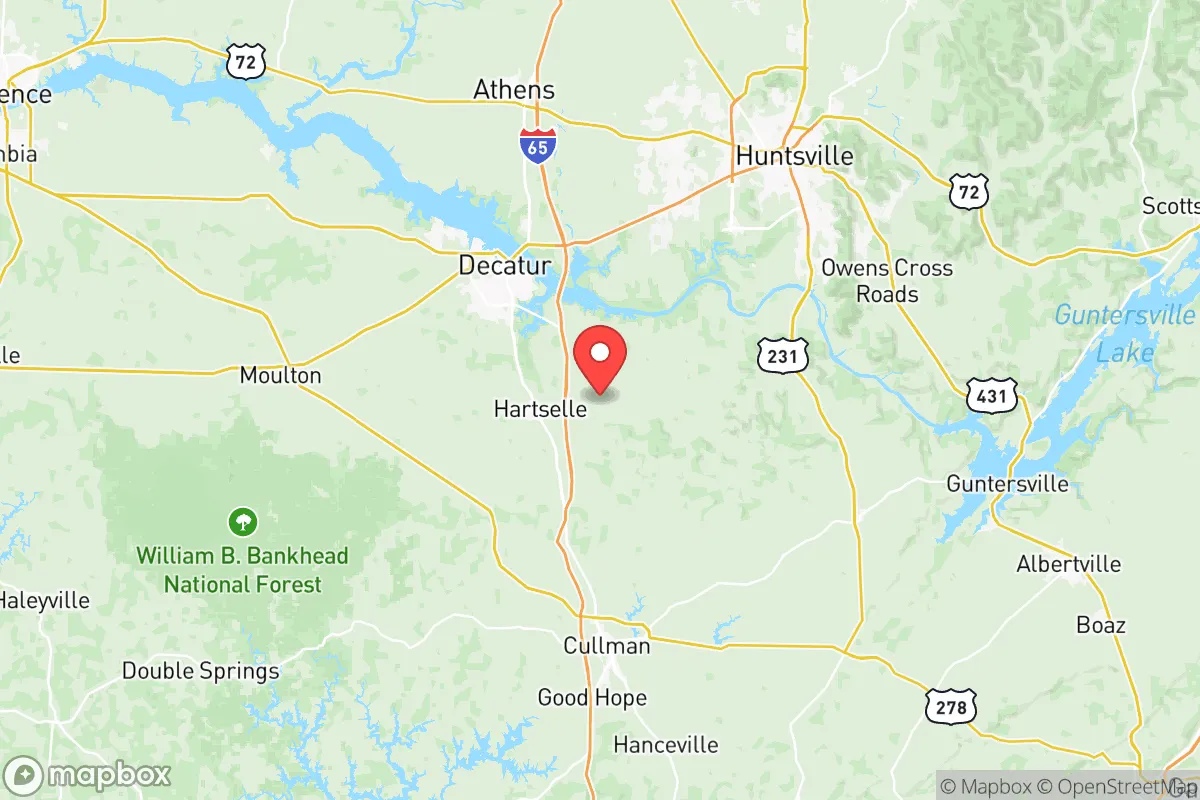
Morgan County, Alabama, is a solidly Republican area with a Cook Partisan Voting Index (PVI) of R+15, meaning it votes about 15 points more Republican than the national average. This isn't a new development; the county has been reliably red for decades, but the intensity of that lean has deepened since the 2010s, mirroring statewide trends. While the county as a whole is conservative, there are notable pockets of variation—Decatur, the county seat, has a more mixed political character, while smaller towns like Hartselle and Falkville are among the most reliably Republican precincts in the state.
How it compares
Comparing Morgan County to the rest of Alabama is a bit like comparing a fast-moving river to the ocean—they're both moving the same direction, but the county's pace is a little different. The state of Alabama as a whole is also deeply Republican, with a PVI of R+15 as well, so Morgan County is essentially a perfect microcosm of the state's political center of gravity. However, the county's internal dynamics are more nuanced than the statewide average suggests. In Decatur, particularly in precincts near the city's historic core and around the Alabama A&M satellite campus, you'll find precincts that occasionally vote Democratic in local races, especially for school board or city council. In contrast, Hartselle and the rural areas around Lacey's Spring and Somerville are among the most conservative in the entire state, often delivering 80%+ margins for Republican candidates. The swing precincts—the ones that decide close local races—tend to be in the suburban fringes of Decatur, like the areas around Priceville and along the Highway 67 corridor, where voters are reliably Republican but more open to moderate candidates in local elections.
What this means for residents
For conservative residents, Morgan County offers a deeply comfortable political environment. Local government, from the county commission to most city councils, is dominated by Republicans, and conservative values are reflected in everything from school board policies to zoning decisions. You'll find that most churches, civic clubs, and even the local Chamber of Commerce operate with a broadly conservative ethos. For liberal residents, the reality is more challenging but not isolating. Decatur provides a small but active Democratic base, and there are local advocacy groups focused on issues like public education funding and environmental protection (particularly around the Tennessee River). However, liberal residents often feel they need to be more strategic about where they voice their opinions—a "Decatur vs. Hartselle" dynamic is real, and political conversations in a Hartselle coffee shop will be very different from those in a Decatur brewpub. The key takeaway is that while the county is overwhelmingly red, the urban-rural split within it creates distinct social spaces for both political tribes.
One cultural distinction worth noting is how Morgan County's politics intersect with its economic identity. The area has a strong manufacturing base—companies like Nucor Steel and 3M are major employers—and this has fostered a pragmatic, "get the job done" political culture that sometimes overrides pure ideology. For example, local Republican officials have been known to support infrastructure projects or workforce development programs that might be seen as too "big government" in more conservative parts of the state. This practical streak means that while the county votes red, it's not a place where political purity tests dominate local governance. Looking ahead, the county's trajectory is likely to remain deeply Republican, but the growing suburbanization around Decatur and Priceville could gradually moderate the tone, if not the partisan outcome, of local politics.

State Political ClimatePolitical Climate in Alabama
State Political AnalysisPolitical Environment in the State
Alabama is a deeply conservative state, with Republicans holding every statewide elected office and supermajorities in both legislative chambers, a dominance that has solidified over the past 20 years. The state has voted for the Republican presidential candidate by margins of 25 points or more in every election since 2008, with Donald Trump carrying it by 26 points in 2024. This wasn't always the case — Alabama was a reliably Democratic state for most of the 20th century, but the realignment around civil rights and the rise of the Religious Right flipped it decisively, and the shift has only accelerated as the rural base has grown more Republican and the Black Belt has become the state's only reliably Democratic stronghold.
Urban vs. rural divide
The political map of Alabama breaks down along stark geographic lines. The state's largest city, Birmingham, and its surrounding Jefferson County are a Democratic anchor, delivering margins of 60-65% for Democratic candidates, driven by a large Black population and a growing professional class. Montgomery and the Black Belt counties stretching across the state's midsection — places like Selma, Greene County, and Macon County (home to Tuskegee) — are also heavily Democratic, often voting 70-80% for Democrats. On the other side, the fast-growing suburbs of Huntsville and Madison in the north are deeply Republican, with Madison County routinely giving Republicans 65-70% of the vote. The rural counties in the southern part of the state, like Baldwin County (home to Gulf Shores and Orange Beach) and Mobile County, are also solidly red, though Mobile itself is more competitive. The key takeaway: the urban cores of Birmingham, Montgomery, and to a lesser extent Mobile are blue islands in a sea of red, while the rest of the state — from the Tennessee Valley to the Wiregrass — is overwhelmingly Republican.
Policy environment
Alabama's policy environment reflects its conservative lean. The state has one of the lowest tax burdens in the country, with no state-level property tax to speak of (the average effective rate is around 0.4%) and a flat income tax rate of 5%. Sales taxes are high, however, often exceeding 10% in many municipalities when state and local rates are combined. The regulatory posture is business-friendly, with right-to-work laws and minimal zoning restrictions in most areas. Education policy is a mixed bag: the state has a school choice program (the Alabama Accountability Act) that provides tax credits for private school tuition, but public school funding remains among the lowest in the nation, and the state's NAEP scores consistently rank near the bottom. Healthcare is a major concern — Alabama did not expand Medicaid under the Affordable Care Act, leaving roughly 300,000 residents in the coverage gap, and rural hospital closures have been a persistent problem. Election laws are among the more restrictive in the country, with strict voter ID requirements, limited early voting (no in-person early voting before 2022, and even now it's only available in certain counties), and a ban on curbside voting that was passed in 2021.
Recent policy direction
Over the past five years, Alabama has moved aggressively on several fronts. On gun rights, the state passed constitutional carry in 2022, allowing permitless carry of concealed handguns, and has preempted local gun ordinances, meaning cities like Birmingham cannot enact their own restrictions. On education and parental rights, the legislature passed the Alabama Parents' Bill of Rights in 2022, requiring schools to notify parents of any changes to a student's health or well-being, and in 2024 passed a law banning the teaching of "divisive concepts" related to race and gender in K-12 classrooms. On abortion, Alabama has one of the most restrictive laws in the nation — the Human Life Protection Act of 2019 bans abortion at all stages of pregnancy with no exceptions for rape or incest, only for the life of the mother. On voting and ballot access, the state passed a law in 2021 banning curbside voting and limiting absentee ballot assistance, and in 2023 enacted a law requiring photo ID for absentee ballots. On property rights, Alabama is a strong "right to farm" state, with laws protecting agricultural operations from nuisance lawsuits. On privacy and surveillance, the state has no comprehensive data privacy law, though it passed a limited law in 2023 regulating the use of facial recognition technology by law enforcement. On medical and bodily autonomy, the state has banned gender-affirming care for minors (2022) and has no shield laws for out-of-state abortion providers.
Civil unrest & political movements
Alabama has a long and complicated history with civil rights, and that legacy still shapes its political landscape. The Selma to Montgomery marches of 1965 are a living memory, and the Edmund Pettus Bridge remains a pilgrimage site for voting rights activists. In recent years, the state has seen organized movements on both sides. On the left, the Alabama Poor People's Campaign has been active on Medicaid expansion and economic justice, and Black Lives Matter protests in Birmingham and Montgomery in 2020 were large and sustained, though they did not lead to significant policy changes. On the right, the Alabama Citizens for Life and the Eagle Forum are influential, and the state has seen a rise in "election integrity" activism since 2020, with groups like the Alabama Voter Integrity Project pushing for stricter laws. Immigration politics are less of a flashpoint here than in border states, but the state did pass a strict immigration law in 2011 (HB 56) that was largely gutted by the courts, and there is ongoing debate about sanctuary policies — no Alabama city has declared itself a sanctuary city, and the state has a law prohibiting such designations. Secession and nullification rhetoric is mostly fringe, though there is a small "Alabama Republic" movement that surfaces occasionally. The most visible flashpoint for a new resident would likely be the ongoing debate over Confederate monuments — Birmingham removed its Confederate monument in 2020, while Montgomery has kept its in place, and the issue remains contentious in smaller towns.
Projection
Over the next 5-10 years, Alabama is likely to remain deeply Republican, but demographic shifts are slowly changing the map. The Huntsville metro area is booming, driven by the defense and aerospace industries, and is attracting a younger, more educated population that is still conservative but less culturally rigid than the rural base. The Black Belt is losing population, which weakens the Democratic base, while the Gulf Coast (Baldwin County) is growing rapidly with retirees and remote workers, reinforcing the Republican lean. In-migration is mostly from other conservative states, so the political balance is unlikely to shift dramatically. What a new resident should expect: continued Republican dominance at the state level, with occasional Democratic wins in local races in Birmingham and Montgomery. The policy direction will likely continue on its current trajectory — more school choice, no Medicaid expansion, tighter election laws, and continued restrictions on abortion and transgender rights. The wild card is the state's aging infrastructure and struggling rural hospitals, which could force a reckoning on healthcare policy if the crisis deepens.
For a new resident, the bottom line is straightforward: if you are conservative, Alabama is a state where your values are reflected in law and policy, and you will find a welcoming environment for business, gun ownership, and religious practice. If you are liberal, you will find like-minded communities in Birmingham, Montgomery, and Huntsville's more diverse neighborhoods, but you will be living in a state where your political views are in the minority and where state policy will often run counter to your preferences. The practical takeaway is that Alabama offers a low-cost, low-regulation lifestyle with a strong sense of community, but the trade-offs are limited public services, a strained healthcare system, and a political environment that is unlikely to change anytime soon.
* Values derived from national, state, county, city and local statistics and may differ in a specific area. Last updated: 2026-07-06T09:23:55.000Z
Narrative content on this page is AI-generated and may contain mistakes. Verify any details that matter before acting on them.
ReloMaps may earn a commission from affiliate links at no extra cost to you.

