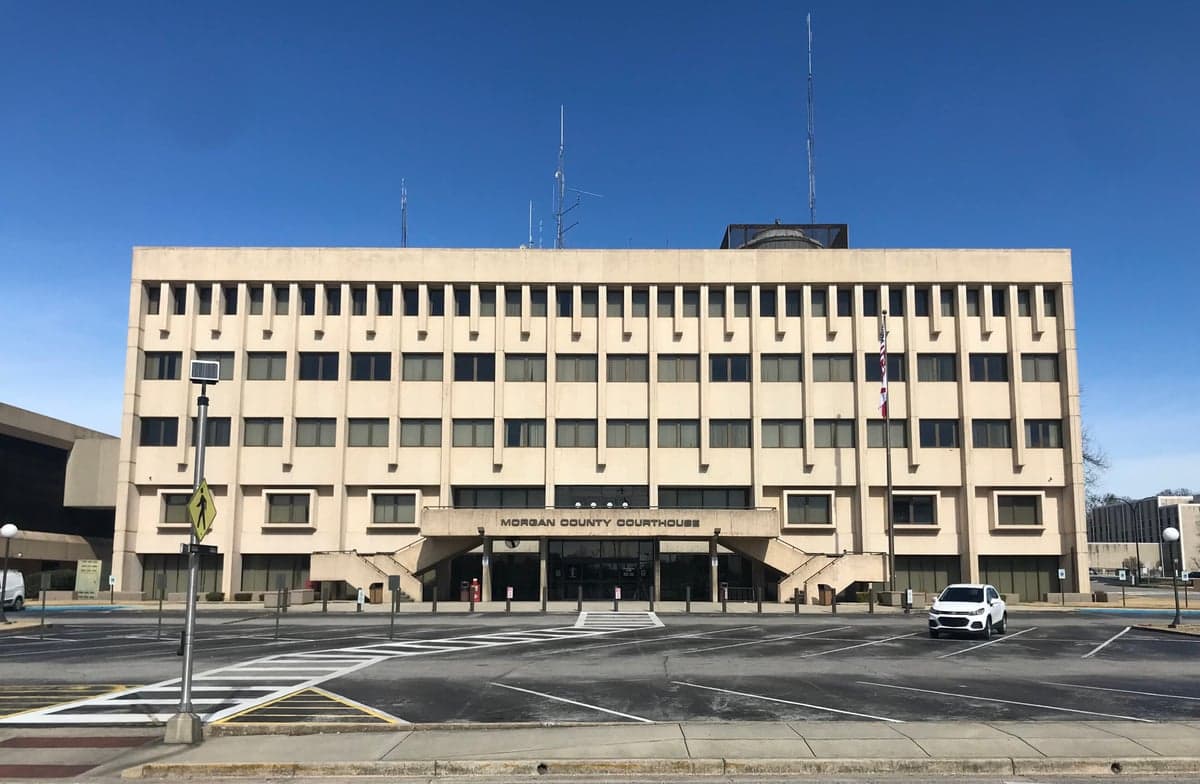
Photo: Wikipedia
Demographics of Morgan County
Affluence Level in Morgan County
A middle-class area roughly in line with national averages across income, home values, education, and employment.
People of Morgan County
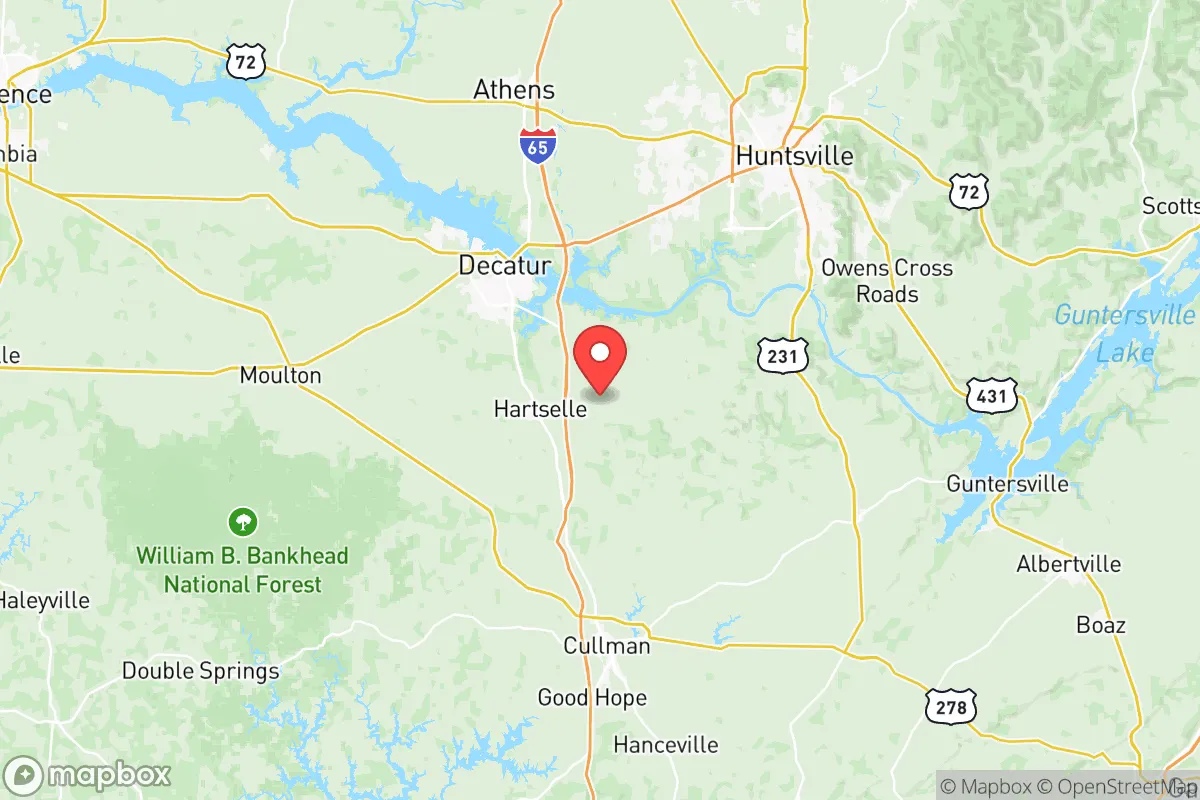
The people of Morgan County, Alabama, today number 123,742 and are predominantly white (72.8%) with significant Black (12.5%) and Hispanic (10.2%) minorities, creating a community that blends Deep South tradition with a growing industrial and logistics workforce. The county’s identity is rooted in its role as a manufacturing and transportation hub along the Tennessee River, anchored by the cities of Decatur and Hartselle, where a pragmatic, family-oriented culture prevails. With a foreign-born population of just 3.9% and a college attainment rate of 23.2%, Morgan County remains a place where native-born residents and a modest but growing immigrant population coexist in a landscape shaped by agriculture, railroads, and modern industry.
Settlement & growth (pre-1960)
Before American settlement, the area now known as Morgan County was part of the vast homeland of the Cherokee and Chickasaw nations, who used the Tennessee River valley for hunting and trade. European contact came sporadically through Spanish and French explorers in the 16th and 17th centuries, but no permanent colonial settlements were established. The land was ceded by the Cherokee in the 1806 Treaty of Washington, opening it to Anglo-American settlement.
The first major wave of settlers arrived between 1810 and 1830, primarily Scots-Irish and English yeoman farmers moving south and west from Virginia, North Carolina, and Tennessee. They were drawn by the promise of fertile bottomlands along the Tennessee River and the Flint Creek watershed. These early families founded the county seat of Somerville in 1818 and later established the river town of Decatur in 1820 as a cotton-shipping port. By the 1830s, the county’s economy was firmly based on cotton cultivation, worked by an enslaved Black population that grew rapidly. The 1860 census recorded that enslaved people made up roughly 35% of the county’s population, concentrated on plantations near the river.
After the Civil War and Reconstruction, the county’s demographic story shifted with the arrival of the railroads. The Louisville and Nashville Railroad built a major depot and repair yard in Decatur in the 1870s, attracting a wave of white and Black laborers from the rural countryside. The town of Hartselle was founded in 1870 as a railroad stop and grew into a center for timber and cotton trading. A smaller but notable group of German and Irish immigrants arrived during this period to work on railroad construction and in the new cotton mills, settling in Decatur’s west end and in the mill village of Falkville.
The 20th century brought industrialization. The Tennessee Valley Authority (TVA) built Wheeler Dam in the 1930s, electrifying the county and attracting chemical and fertilizer plants. During World War II, the U.S. Army established the Huntsville Arsenal and Redstone Arsenal just east of the county line, drawing thousands of workers to Decatur and the surrounding area. This period saw an influx of white and Black workers from rural Alabama and Tennessee, as well as a small number of Northern engineers and managers. By 1960, Morgan County’s population had grown to roughly 60,000, with Decatur as the dominant city and Hartselle emerging as a quieter, more conservative bedroom community.
Modern era (post-1965)
The 1965 Hart-Cellar Act had a limited direct impact on Morgan County compared to coastal or Sun Belt boom regions. The foreign-born share remains low at 3.9%, but the composition has shifted. The most significant change has been the growth of the Hispanic population, which rose from under 1% in 1990 to 10.2% today. This wave began in the late 1990s and accelerated after 2005, driven by demand for labor in poultry processing plants in Priceville and Trinity, as well as in construction and landscaping across the county. Mexican and Central American immigrants, primarily from Guatemala and Honduras, have formed small but visible communities in Decatur’s southwest neighborhoods and in mobile home parks along Highway 31.
Domestic migration has been a more powerful force. Since the 1970s, Morgan County has experienced steady growth from the Rust Belt and other parts of the South, attracted by the expansion of the Browns Ferry Nuclear Plant (completed 1974) and the rise of the automotive supply chain. The opening of the Decatur Industrial Park in the 1980s drew companies like 3M, Nucor Steel, and later, the Mazda-Toyota joint venture (now operating in nearby Huntsville). This brought a wave of white-collar engineers and managers from Michigan, Ohio, and Indiana, many of whom settled in the newer subdivisions of Hartselle and Priceville. The Black population, which had been concentrated in Decatur’s historic neighborhoods like Old Town and the West Decatur area, has remained stable at 12.5%, with some suburbanization to newer developments in the county’s southern reaches.
Suburbanization has reshaped the county’s geography. Hartselle has grown from a small railroad town of 8,000 in 1980 to over 14,000 today, attracting families seeking lower taxes and better schools. Priceville, once a rural crossroads, has exploded from 1,500 residents in 1990 to over 7,000, becoming a commuter suburb for both Decatur and Huntsville. The county’s Asian population remains tiny at 0.5%, consisting mostly of East and Southeast Asian families (Chinese, Korean, Vietnamese) employed in engineering and research roles at the nearby Redstone Arsenal, with no distinct ethnic enclave. The Indian subcontinent population is statistically negligible at 0.0%.
The future
Morgan County is projected to become slightly more diverse over the next 10-20 years, but the pace will be gradual. The Hispanic share is expected to rise to 12-14% by 2040, driven by continued demand in manufacturing and food processing, with new arrivals likely settling in Decatur’s existing Hispanic neighborhoods and spreading into Falkville and Eva as affordable housing expands. The white population share will decline slowly as the native-born population ages and younger families move to newer suburbs in Limestone and Madison counties. The Black population is expected to remain stable at 11-13%, with some outmigration of younger professionals to Huntsville and Atlanta.
The county’s cultural identity is evolving from a traditional, rural-Southern character toward a more suburban, industry-focused one. The influx of Northern and Midwestern transplants has softened some regional accents and introduced new political and social perspectives, though the county remains reliably conservative. New residential development is concentrating in Priceville and along the Interstate 65 corridor, where large subdivisions are replacing farmland. The historic core of Decatur is seeing modest reinvestment, but the city’s population growth has lagged behind the county’s suburban fringe.
For someone moving in now, Morgan County offers a stable, family-oriented environment with a growing industrial base and affordable housing, but with limited ethnic diversity compared to the national average. The population is becoming more suburban and slightly more Hispanic, but the overall character remains that of a white-majority, native-born community where newcomers are expected to integrate into existing social and civic structures. The county is not becoming a melting pot in the classic sense, but rather a place where a modest, steady diversification is unfolding alongside a strong sense of local identity rooted in the Tennessee River valley’s industrial and agricultural heritage.

* Values derived from national, state, county, city and local statistics and may differ in a specific area. Last updated: 2026-07-06T09:23:55.000Z
Narrative content on this page is AI-generated and may contain mistakes. Verify any details that matter before acting on them.
ReloMaps may earn a commission from affiliate links at no extra cost to you.

