
Photo: Wikipedia
Personal Sovereignty in Colbert County
Viable for self-reliance. Generally workable, though some barriers may limit total independence.
What does Personal Sovereignty tell us?
Personal Sovereignty measures your capacity for self-reliance and independence with minimal government friction. Higher scores mean fewer barriers between you and the way you want to live... but it assumes you have the space you need and good neighbors.
What does this tell us?
Personal Sovereignty measures your capacity for self-reliance and independence with minimal government friction. Higher scores mean fewer barriers between you and the way you want to live... but it assumes you have the space you need and good neighbors.
State Policy
Energy independence: Importer (45% of energy produced in-state)
Personal Liberty
Homesteading

Personal Liberty Analysis
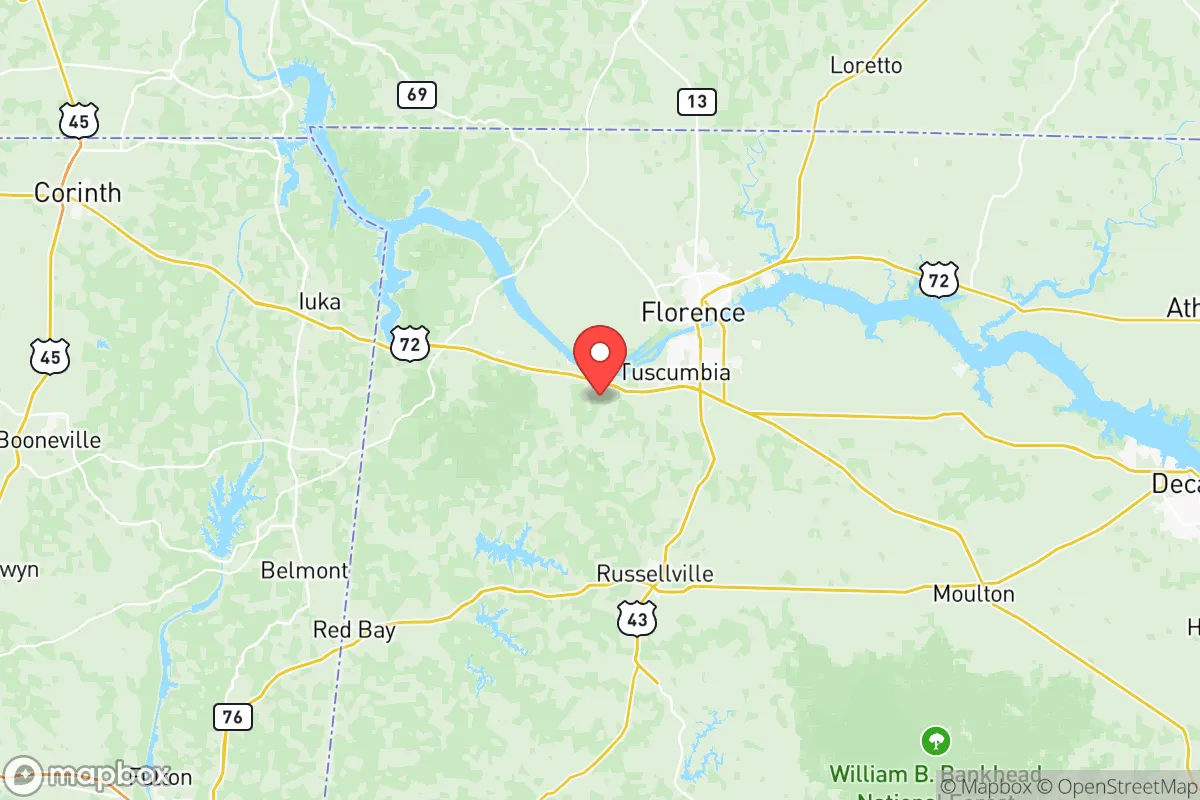
Colbert County, Alabama, offers a notably high degree of personal sovereignty, grounded in Alabama’s strong constitutional protections for gun rights, low tax burden, and a regulatory environment that generally favors individual autonomy over government oversight. For residents in cities like Muscle Shoals, Sheffield, Tuscumbia, and the more rural stretches near Cherokee and Leighton, the day-to-day experience of freedom is tangible — from minimal zoning restrictions in unincorporated areas to a legal culture that presumes personal responsibility. This analysis examines the specific pillars of autonomy that matter most to freedom-oriented individuals and families considering relocation.
Tax burden and regulatory posture: how Alabama’s light touch shapes daily life
Alabama’s state-level tax structure is among the most favorable in the nation for those prioritizing financial sovereignty. There is no state-level property tax on automobiles, boats, or business inventory, and the state’s combined average property tax rate of roughly 0.40% of assessed value is one of the lowest in the country. In Colbert County, the effective property tax rate typically falls between 0.35% and 0.45%, meaning a $200,000 home carries an annual tax bill of roughly $700 to $900. The state income tax is a flat 5%, but with a standard deduction of $4,000 for single filers and $7,500 for married couples filing jointly, many households see a reduced effective rate. Sales tax in the county is 9% (4% state, 2% county, 3% city in Muscle Shoals and Sheffield), which is moderate for the region but worth noting for daily purchases. The regulatory posture in Colbert County is distinctly light-touch. There is no county-wide zoning in unincorporated areas, which means property owners in rural zones near Leighton or Cherokee can build, fence, or operate small-scale enterprises without navigating a thicket of permits. The city of Muscle Shoals has zoning ordinances, but they are generally straightforward and business-friendly, with no overlay districts or complex design review boards. Occupational licensing is minimal compared to states like California or New York, and home-based businesses — from auto repair to catering — operate with few barriers as long as they don’t create public nuisances.
Self-defense and gun law specifics: what Alabama’s permitless carry means for residents
Alabama is a constitutional carry state, meaning that as of 2022, any adult who can legally possess a firearm may carry it openly or concealed without a permit. Colbert County Sheriff’s Office issues permits for reciprocity purposes, but there is no legal requirement to obtain one for in-state carry. The state’s self-defense laws are robust: Alabama’s Stand Your Ground statute, codified in § 13A-3-23, removes any duty to retreat before using deadly force if the person is in a place where they have a legal right to be and reasonably believes force is necessary to prevent death, great bodily harm, or a forcible felony. Castle Doctrine protections extend to occupied vehicles and workplaces, not just dwellings. There are no state-level magazine capacity restrictions, no firearm registration, and no waiting periods for purchase. The NRA-ILF rates Alabama’s gun laws as among the most permissive in the country, and local enforcement in Colbert County reflects that culture. Sheriff’s deputies in the county are known to be supportive of gun rights, and there are no local ordinances in Muscle Shoals, Sheffield, Tuscumbia, or unincorporated areas that restrict carry beyond state law. For residents who prioritize self-defense as a personal responsibility, Colbert County presents no legal friction.
Self-reliance and homesteading viability: lot sizes, zoning, and off-grid feasibility
For those seeking a self-reliant lifestyle — gardening, livestock, alternative energy, or even full off-grid living — Colbert County offers substantial opportunity, particularly outside the city limits. In unincorporated areas, there are no minimum lot size requirements for agricultural use, and properties of 1 to 5 acres are common and affordable. A 3-acre parcel near Cherokee or Leighton can be purchased for $15,000 to $30,000, while larger tracts of 10 to 40 acres run $50,000 to $120,000 depending on proximity to the Tennessee River. Zoning is essentially absent in these areas: residents can keep chickens, goats, cattle, or horses without special permits, and there are no restrictions on rainwater collection, composting toilets, or solar panel installation. The Tennessee Valley Authority (TVA) provides grid electricity, but going off-grid is legal and straightforward — no county ordinance prohibits solar with battery storage or propane backup systems. Within the city limits of Muscle Shoals and Sheffield, lot sizes shrink to standard residential parcels of 0.25 to 0.5 acres, and city zoning does impose some limits on livestock (typically no pigs or roosters, and limits on the number of chickens). However, even in these cities, vegetable gardens, fruit trees, and small workshops are generally permitted without permits. Water rights in Alabama follow the reasonable use doctrine, meaning landowners with a water source on their property can use it for domestic and agricultural purposes without a permit. For the homesteader, Colbert County’s regulatory environment is permissive enough to allow a high degree of self-sufficiency without legal friction.
Personal liberties: parental rights, medical autonomy, speech, and property
Alabama has a strong legal framework for parental rights. The Alabama Parental Rights Act, codified in § 26-16-1, affirms that parents have the fundamental right to direct the upbringing, education, and healthcare of their children. This includes the right to opt children out of public school curricula or activities that conflict with religious or moral beliefs, and the right to homeschool without extensive state oversight — parents need only file a notice of intent and maintain a portfolio of work. Medical autonomy is more mixed: Alabama has not expanded Medicaid, which limits low-income access, but for those with private insurance or cash-pay options, the state does not mandate COVID-19 vaccines or impose broad medical mandates. The state’s 2019 law banning most abortions (the Human Life Protection Act) aligns with the values of many conservative-leaning residents, though it also limits medical choice for those who disagree. Free speech protections are robust, with no state-level hate speech laws or social media content moderation mandates that restrict private expression. Property rights are strongly protected: Alabama is a “property rights” state under the Alabama Constitution, and eminent domain is rarely used for private economic development. There is no state-level rent control, and short-term rental regulations in Colbert County are minimal — unincorporated areas have no restrictions, while Muscle Shoals requires a simple business license for Airbnb operations. For the individual who values personal liberty across multiple domains, Colbert County’s legal environment is consistently permissive.
Overall, Colbert County ranks among the more sovereignty-friendly areas in the Southeast, comparable to neighboring Lauderdale County or rural counties in Tennessee’s southern tier. The combination of constitutional carry, low property taxes, minimal zoning, strong parental rights, and affordable land creates an environment where personal responsibility is the default expectation rather than a bureaucratic hurdle. For the family or individual who wants to live with minimal government interference — whether that means carrying a firearm, building a homestead, homeschooling children, or operating a business from home — Colbert County delivers a level of autonomy that is increasingly rare in urbanized America.

* Values derived from national, state, county, city and local statistics and may differ in a specific area. Last updated: 2026-06-15T23:06:04.000Z
Narrative content on this page is AI-generated and may contain mistakes. Verify any details that matter before acting on them.
ReloMaps may earn a commission from affiliate links at no extra cost to you.

