Photo: Wikipedia
Demographics of Colbert County
Affluence Level in Colbert County
A below-average socioeconomic profile. Incomes, home values, and educational attainment trail the U.S., with higher poverty and unemployment.
People of Colbert County
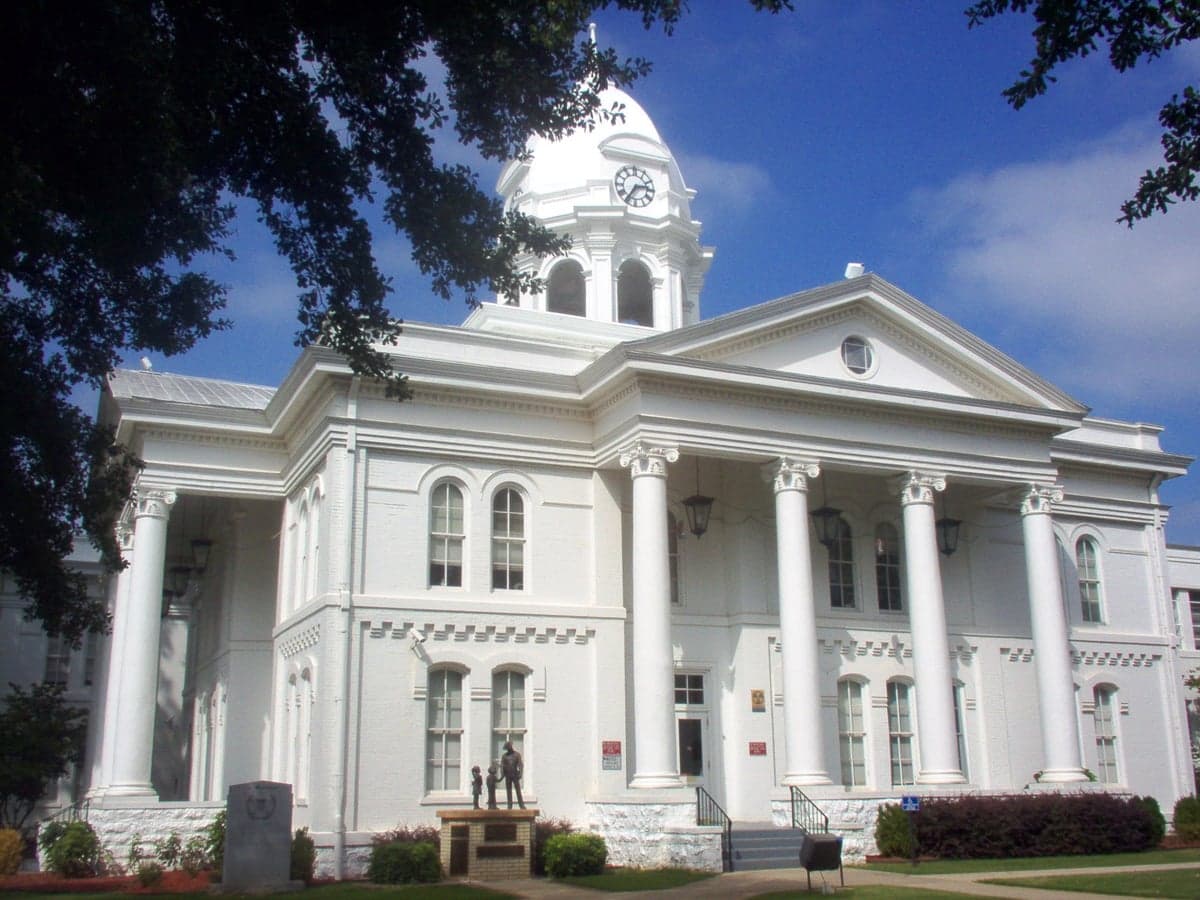
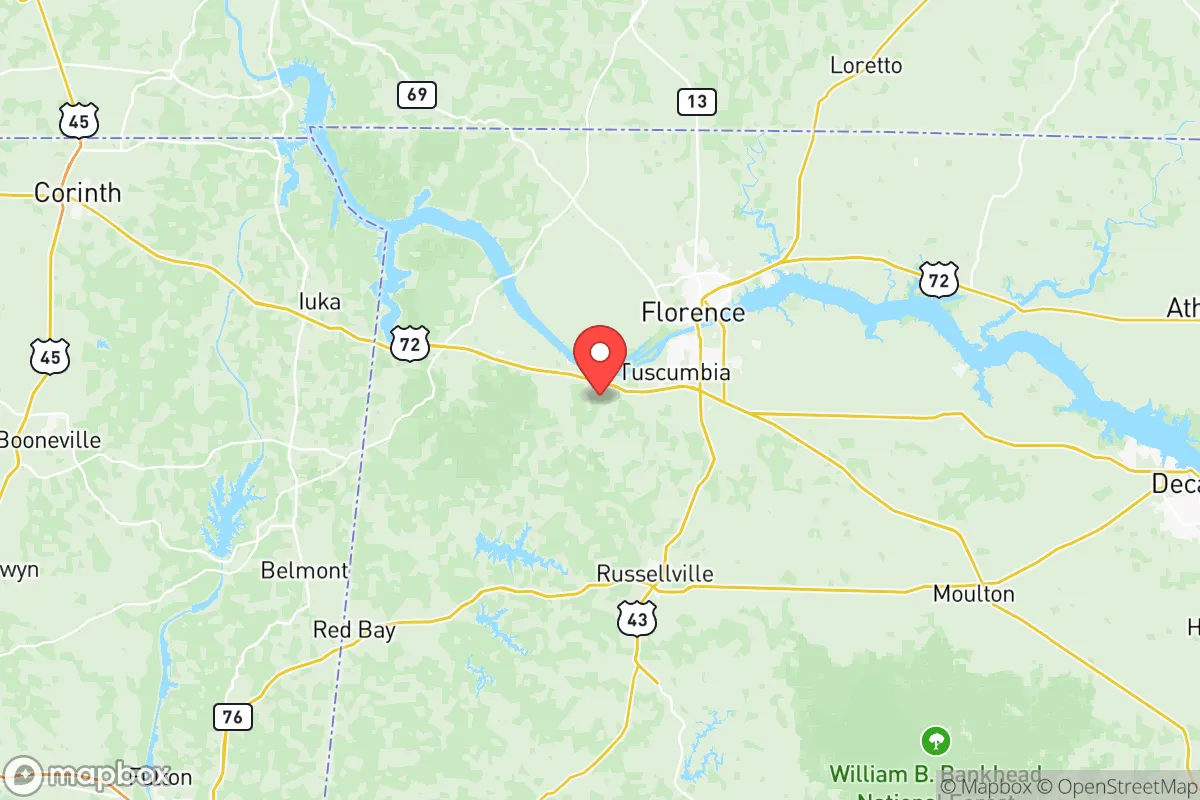
Colbert County, Alabama, is home to 57,648 residents, a population that is 77.4% white and 15.8% Black, with a very small foreign-born share of just 0.9%. The county’s character is rooted in its Tennessee River border, its history as a manufacturing and agricultural hub, and a cultural identity shaped by Deep South traditions, including a strong conservative lean. Distinctive markers include the county seat of Tuscumbia, the river town of Muscle Shoals, and the historic railroad city of Sheffield, which together form a tri-cities area that anchors the local economy and community life.
Settlement & growth (pre-1960)
Before European settlement, the area now known as Colbert County was part of the ancestral homeland of the Chickasaw Nation. The Chickasaw established villages along the Tennessee River, using the fertile bottomlands for agriculture and the river for trade. European contact began in the 16th century with Spanish expeditions, but sustained interaction came later with French and British traders in the 1700s. The region was ceded by the Chickasaw in the 1830s through the Treaty of Pontotoc Creek, opening the land to American settlers.
The first major wave of American settlers arrived in the 1830s and 1840s, primarily Scots-Irish and English families from Virginia, North Carolina, and Tennessee. They were drawn by cheap land grants and the promise of cotton cultivation along the Tennessee River. These early settlers founded the towns of Tuscumbia (incorporated 1820) and Sheffield (founded 1815, but not incorporated until 1885). Tuscumbia quickly became a regional center for cotton trade and river commerce. The construction of the Tuscumbia, Courtland & Decatur Railroad in the 1830s, one of the earliest railroads in the United States, connected the area to the river and spurred growth.
After the Civil War and Reconstruction, the economy shifted. The 1880s saw the rise of the iron and coal industries in north Alabama, and Sheffield was platted in 1885 as a planned industrial city by the Sheffield Land, Iron & Coal Company. This drew a new wave of domestic migrants, including white laborers from the Appalachian foothills and Black families seeking work in the mines and furnaces. The town of Muscle Shoals grew rapidly after 1918, when the federal government built Wilson Dam and the Muscle Shoals nitrate plants for World War I munitions. This project brought in engineers, construction workers, and their families from across the country, creating a more diverse, skilled workforce than the surrounding agricultural areas.
By the mid-20th century, the population was overwhelmingly native-born and rural, with a small but established Black community concentrated in Tuscumbia and Muscle Shoals. The county’s economy was anchored by agriculture (cotton, corn, livestock), the Tennessee Valley Authority (TVA) dams and power plants, and light manufacturing. The 1950 Census recorded a population of 39,170, reflecting steady growth from the pre-war era.
Modern era (post-1965)
The 1965 Hart-Cellar Act had minimal direct impact on Colbert County, as the foreign-born population remains just 0.9% today. Unlike major metropolitan areas, the county did not see significant new immigrant waves from Asia, Latin America, or the Middle East. Instead, the post-1965 demographic story is one of domestic migration and suburbanization within the tri-cities area.
The most notable shift has been the growth of Muscle Shoals as a residential and commercial hub. From the 1970s onward, Muscle Shoals attracted families and retirees from rural Colbert County and neighboring counties, drawn by better schools, newer housing developments, and the expansion of manufacturing employers like the Reynolds Metals aluminum plant (now part of Constellium) and the North American Lighting auto parts factory. This suburbanization pulled population away from older town centers like Tuscumbia and Sheffield, which saw slower growth or slight declines.
The Black population, which was 15.8% in the 2020 Census, has remained relatively stable as a share of the county since the 1970s, though there has been some out-migration of younger Black residents to larger cities like Huntsville and Birmingham for education and employment. Hispanic residents, now 3.3% of the population, began arriving in the 1990s and 2000s, primarily as laborers in poultry processing plants (such as the Wayne Farms facility in nearby Decatur) and in construction. This community is small but growing, with families settling in Tuscumbia and Muscle Shoals. The East/Southeast Asian population (0.2%) and Indian subcontinent population (0.2%) are tiny, mostly professionals employed at the University of North Alabama in Florence or at local hospitals.
Domestic migration from the Rust Belt—particularly Ohio, Michigan, and Illinois—has been a modest but steady trend since the 1990s, driven by retirees seeking lower costs and warmer winters, as well as remote workers and manufacturing employees relocating for jobs at the TVA facilities or the expanding aerospace supply chain in the Shoals region. The county’s college-educated share is 20.3%, below the national average of roughly 34%, reflecting the area’s industrial and agricultural employment base.
The future
Colbert County’s population is projected to remain stable or grow very slowly over the next 10–20 years, as the broader Shoals region benefits from the expansion of the University of North Alabama and the continued growth of Huntsville’s aerospace and defense economy, which is about 60 miles east. The county is likely to become slightly more diverse, with the Hispanic share increasing to perhaps 5–7% by 2040, driven by continued labor demand in manufacturing and agriculture. The Black population share is expected to remain near current levels, with some younger families returning from larger cities as remote work allows them to live in lower-cost areas.
New residential development is concentrating in Muscle Shoals and along the U.S. 72 corridor, which connects the county to Florence and Huntsville. The older downtowns of Tuscumbia and Sheffield are seeing reinvestment, including the restoration of historic buildings and new riverfront amenities, which may attract a modest influx of creative-class workers and retirees. The county’s cultural identity remains strongly Southern and conservative, but the growing Hispanic community and the return of some Black families from urban areas are slowly broadening the social fabric.
For someone moving in now, Colbert County offers a stable, affordable, and family-oriented environment with a strong sense of local history. The population is not rapidly diversifying, but it is not static either—the tri-cities area is gradually becoming more suburban and slightly more varied in its ethnic makeup, while retaining its Deep South character and manufacturing-based economy.

* Values derived from national, state, county, city and local statistics and may differ in a specific area. Last updated: 2026-06-15T23:06:04.000Z
Narrative content on this page is AI-generated and may contain mistakes. Verify any details that matter before acting on them.
ReloMaps may earn a commission from affiliate links at no extra cost to you.

