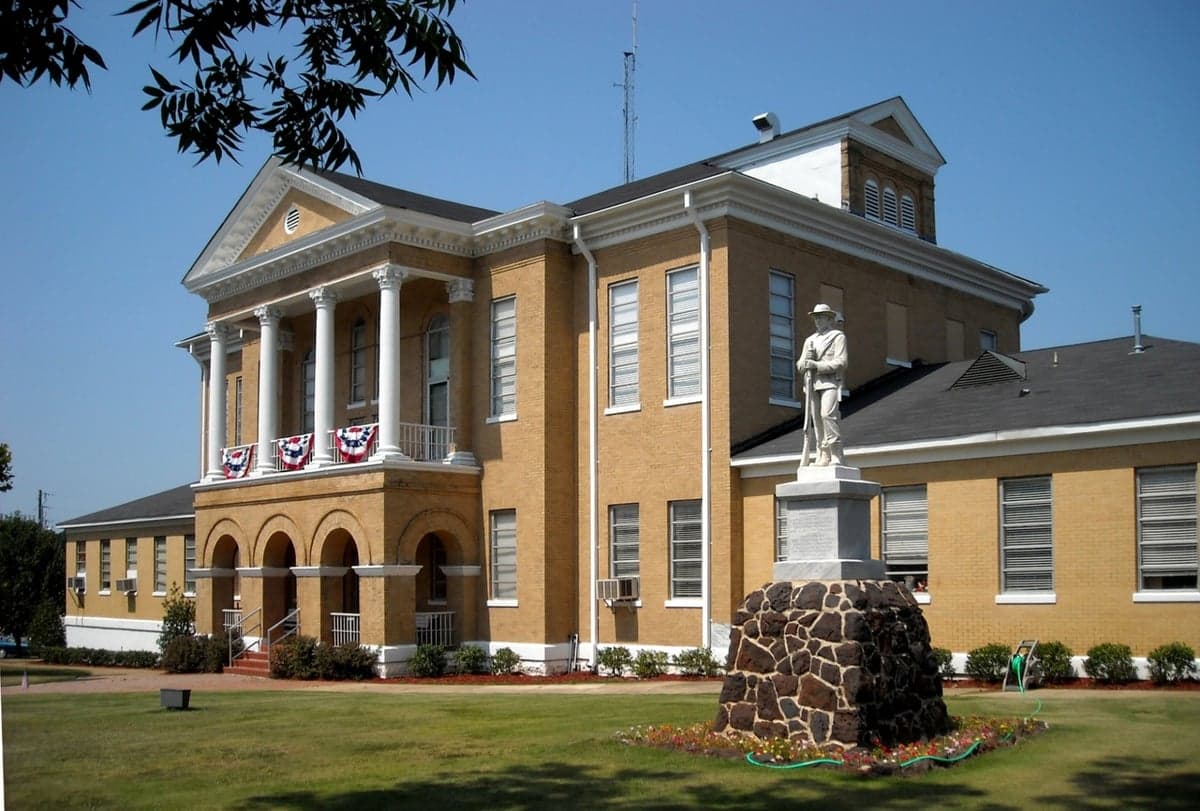
Photo: Wikipedia
Political ClimatePolitical Climate in Choctaw County
Showing district-level results — no local-only data available.
Local Political AnalysisPolitical Analysis of Choctaw County
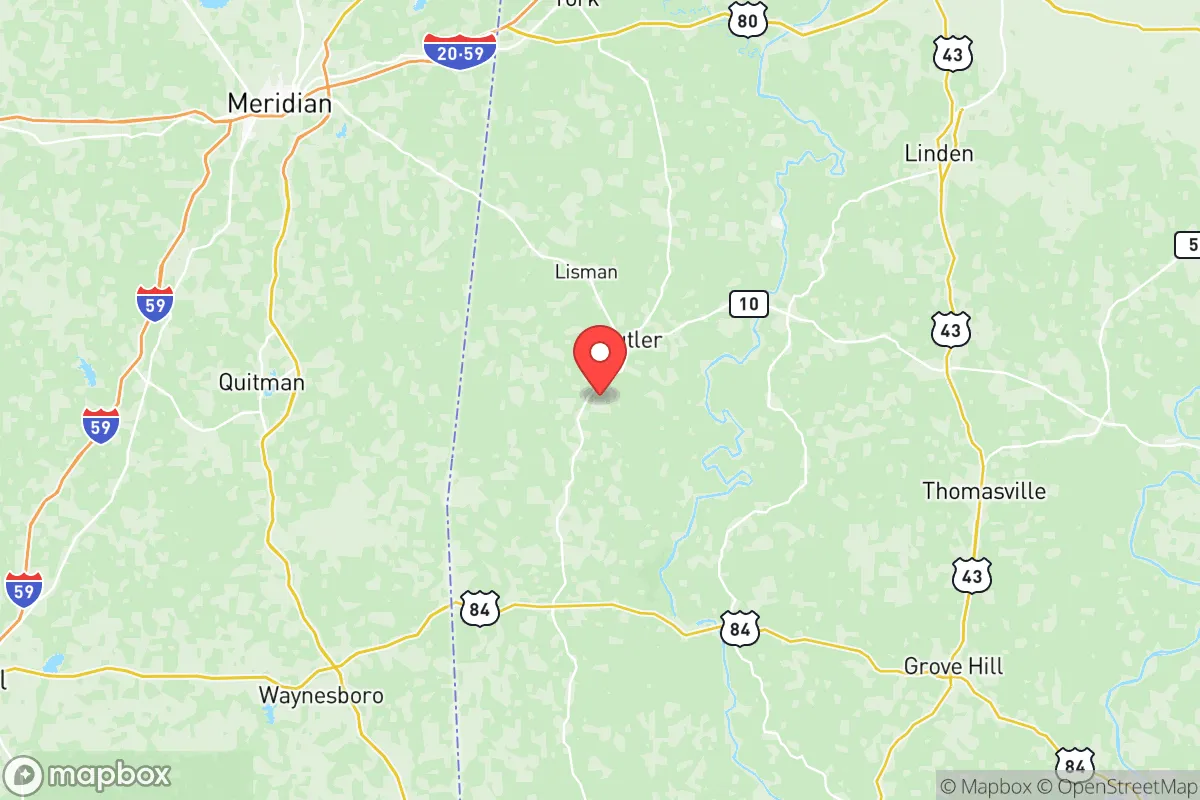
Choctaw County is one of the few reliably Democratic-leaning counties in deep-red Alabama, carrying a Cook PVI of D+13 that stands in stark contrast to the state’s overall conservative tilt. The county has voted for the Democratic presidential nominee in every election this century, though the margins have tightened considerably since the Obama years. If you’re looking at the map, the blue comes almost entirely from the Black Belt corridor running through the county’s southern half, anchored by the towns of Butler, Gilbertown, and Lisman, while the whiter, more rural northern precincts around Toxey and Silas lean just as reliably Republican.
How it compares to the rest of Alabama
Alabama as a whole is one of the most Republican states in the country, with Donald Trump carrying it by roughly 25 points in 2024 and every statewide office held by a Republican. Choctaw County is the outlier, voting for Joe Biden by a double-digit margin in 2020 and remaining one of only a handful of counties (alongside Bullock, Greene, and Lowndes) that Democrats can still count on. The difference comes down to demographics: Choctaw County is roughly 45% Black, and those voters — concentrated in Butler, the county seat, and the surrounding plantation-era communities — vote overwhelmingly Democratic. The white vote in the county is actually more Republican than the state average, but it’s simply outnumbered. That split creates a fascinating dynamic where a county that feels culturally Southern and rural still sends Democrats to the state legislature, a rarity in modern Alabama politics.
What this means for residents
For conservative residents, living in a D+13 county means their votes are effectively canceled out in most statewide and presidential races, but it doesn’t leave them without representation — the county’s state House and Senate seats are held by Republicans, and local offices like sheriff and probate judge often go to whichever candidate can pull a few crossover votes. For liberal residents, the county’s lean means they’re not completely isolated, but they still live under a state government that has banned abortion, restricted voting access, and refused to expand Medicaid. The practical effect is that local politics here are less about partisan warfare and more about personal relationships — in a county of just over 12,000 people, you’re likely to know the person on the other side of the ballot. Turnout is the real story: Democratic margins in Choctaw have shrunk from 30-plus points in 2008 to around 13 points in 2020, driven by out-migration of younger Black residents and a slow but steady influx of retirees from Mobile and Meridian, Mississippi.
Cultural and policy distinctions
Choctaw County’s political identity is inseparable from its economic reality. The county is one of the poorest in Alabama, with a median household income around $38,000 and a poverty rate near 25%, and that shapes policy priorities in ways that cut across party lines. Residents on both sides tend to support timber and agriculture interests — the county is heavily forested and home to several sawmills — and there’s broad bipartisan support for the local poultry industry and the Choctaw County School System, which is the largest employer in the county. The biggest cultural distinction is the presence of the Mississippi Choctaw reservation just across the state line, which brings a Native American voting bloc and a casino economy that spills into the county. Looking ahead, the county’s Democratic lean is likely to persist but keep eroding — the Black population is aging and shrinking, and without a major economic draw, younger voters are leaving. The 2026 midterms will be a telling test: if the Democratic margin drops below 10 points, Choctaw will start looking more like a swing county than a safe blue one, which would be a historic shift for this corner of the Black Belt.

State Political ClimatePolitical Climate in Alabama
State Political AnalysisPolitical Environment in the State
Alabama is a deeply Republican state, with the GOP holding every statewide office, a supermajority in both legislative chambers, and a 2024 presidential margin of roughly +30 points for Donald Trump. The state’s political identity has hardened over the last 15 years, shifting from a reliably Democratic stronghold in local races to a near-monolith for the GOP, driven by a realignment over race, religion, and rural economic anxiety. For a relocator, this means you’re moving into a place where conservative governance is the default, but the texture of that conservatism varies sharply depending on whether you land in Birmingham, Huntsville, or the Wiregrass.
Urban vs. rural divide
The political map of Alabama is a classic urban-rural split, but with a twist: the state’s largest cities are islands of blue in a sea of red. Jefferson County (Birmingham) and Montgomery County are the Democratic anchors, consistently voting 65-75% for Democratic presidential candidates. Huntsville (Madison County) is the fascinating outlier — a fast-growing, high-education tech hub that has trended purple, voting for Trump by only single digits in 2020 and 2024, a stark contrast to the rural counties surrounding it. The rural Black Belt, stretching from the Mississippi line through Selma to Montgomery, is overwhelmingly Democratic and African American, but it’s also depopulating. Meanwhile, the suburban rings around Birmingham — Shelby County, Hoover, and Vestavia Hills — are the engine of the state’s Republican majority, voting 70-80% GOP. The Wiregrass region around Dothan and the northeast corner near Gadsden are as red as anywhere in America, with margins often exceeding 50 points. The practical takeaway: if you live in Mountain Brook or Auburn, you’ll rarely meet a Democrat; if you live in downtown Birmingham, you’ll rarely meet a Republican.
Policy environment
Alabama’s policy posture is defined by low taxes, minimal regulation, and a strong cultural conservatism. There is no state income tax on Social Security benefits, and the state’s combined state and local sales tax burden is among the highest in the nation, often exceeding 10% in cities like Birmingham and Mobile — a regressive trade-off that funds a lean government. Property taxes are exceptionally low, roughly half the national average, which keeps housing affordable but starves schools. The regulatory climate is business-friendly, with no state-level minimum wage (the federal $7.25 applies) and a right-to-work law that has kept unionization rates below 10%. Education policy is a flashpoint: the state funds a school choice program via the CHOOSE Act, which provides tax credits for private school tuition, and it has banned critical race theory and certain LGBTQ-related instruction in public schools. Healthcare is a mixed bag — Alabama did not expand Medicaid under the ACA, leaving a coverage gap of roughly 300,000 working poor, but it has some of the nation’s strongest rural hospital networks in Huntsville and Dothan. Election laws are strict: voter ID is required, early voting was only introduced in 2024, and absentee voting requires a notarized application or a qualifying excuse.
Recent policy direction
The last five years have seen Alabama lean further into a specific brand of conservative governance. On guns, the state passed constitutional carry in 2022, allowing permitless carry of handguns, and it has a strong Stand Your Ground law. On parental rights, the 2022 “Don’t Say Gay” style law (the Parental Rights in Education Act) restricts classroom discussion of sexual orientation in early grades, and the state has aggressively restricted transgender medical care for minors, with a 2022 law making it a felony for doctors to provide puberty blockers or hormones. On abortion, Alabama’s 2019 near-total ban, which has no exceptions for rape or incest, took full effect after Dobbs and is the strictest in the nation. Property rights are strongly protected, with a 2021 law limiting the use of eminent domain for private development. On privacy, the state has moved to protect firearm owners’ data from credit card tracking and has resisted federal surveillance programs. The ballot access picture is mixed: the 2024 introduction of early voting was a modest expansion, but the state has also purged voter rolls aggressively, citing noncitizen registration concerns. The direction is clear: Alabama is codifying a maximalist version of social conservatism while keeping taxes low and courts friendly to business.
Civil unrest & political movements
Alabama’s political movements are less about street protest and more about institutional capture. The state’s most visible flashpoint in recent years was the 2024 U.S. Senate race, where Democrat Doug Jones’s 2017 upset win over Roy Moore was reversed decisively by Katie Britt, a mainstream conservative — a sign that the old “scandal politics” era is over. On the ground, you’ll see active, organized conservative groups like the Alabama Policy Institute and Eagle Forum chapters pushing school choice and election integrity, while progressive activism is concentrated in Birmingham’s urban core, where groups like the Alabama Coalition for Immigrant Justice advocate for sanctuary policies — though no Alabama city has formally adopted sanctuary status. Immigration politics are hot: the state passed HB 56 in 2011, once the nation’s strictest immigration law, and while courts gutted parts of it, the legislature has continued to push measures requiring E-Verify and penalizing undocumented presence. Secession rhetoric is mostly a historical artifact, but you’ll hear occasional “state sovereignty” language from rural county commissions, particularly over federal land management in the Bankhead National Forest. Election integrity controversies have been muted compared to Georgia or Arizona, but the 2024 voter roll purge drew federal lawsuits. A new resident would notice the political energy is less about protests and more about church bulletin announcements, county GOP meetings, and school board races.
Projection
Over the next decade, Alabama’s politics will likely stay Republican, but the composition of that majority is shifting. Huntsville’s growth is the wildcard — the city added 60,000 residents in the last decade, many of them out-of-state engineers and defense contractors who are fiscally conservative but socially moderate. If that trend continues, Madison County could become a genuine swing county by 2032, pulling the state’s congressional map slightly toward the center. Meanwhile, the Black Belt’s population decline will shrink the Democratic base, making statewide Democratic wins nearly impossible. In-migration from California and the Northeast is minimal, so the cultural conservatism of the legislature is unlikely to soften. Expect continued fights over school choice expansion, further Medicaid restriction debates, and a push for a state constitutional amendment to clarify gun rights. The most realistic projection: Alabama in 2035 will look much like it does today, but with a more educated, slightly more suburban electorate in the north that could make the Republican primary the only race that matters.
For a new resident, the bottom line is this: Alabama offers a predictable, low-tax, culturally conservative environment where your politics will rarely be challenged in daily life, especially outside Birmingham and Montgomery. If you’re conservative, you’ll find a state government that shares your priorities on guns, education, and taxes. If you’re liberal, you’ll find a small but resilient community in the urban cores, but you should expect to be in the minority in most public forums. The state’s trajectory is stable, not volatile — what you see now is likely what you’ll get in a decade, with Huntsville as the only place where the political weather might genuinely change.
* Values derived from national, state, county, city and local statistics and may differ in a specific area. Last updated: 2026-11-04T03:59:27.000Z
Narrative content on this page is AI-generated and may contain mistakes. Verify any details that matter before acting on them.
ReloMaps may earn a commission from affiliate links at no extra cost to you.

