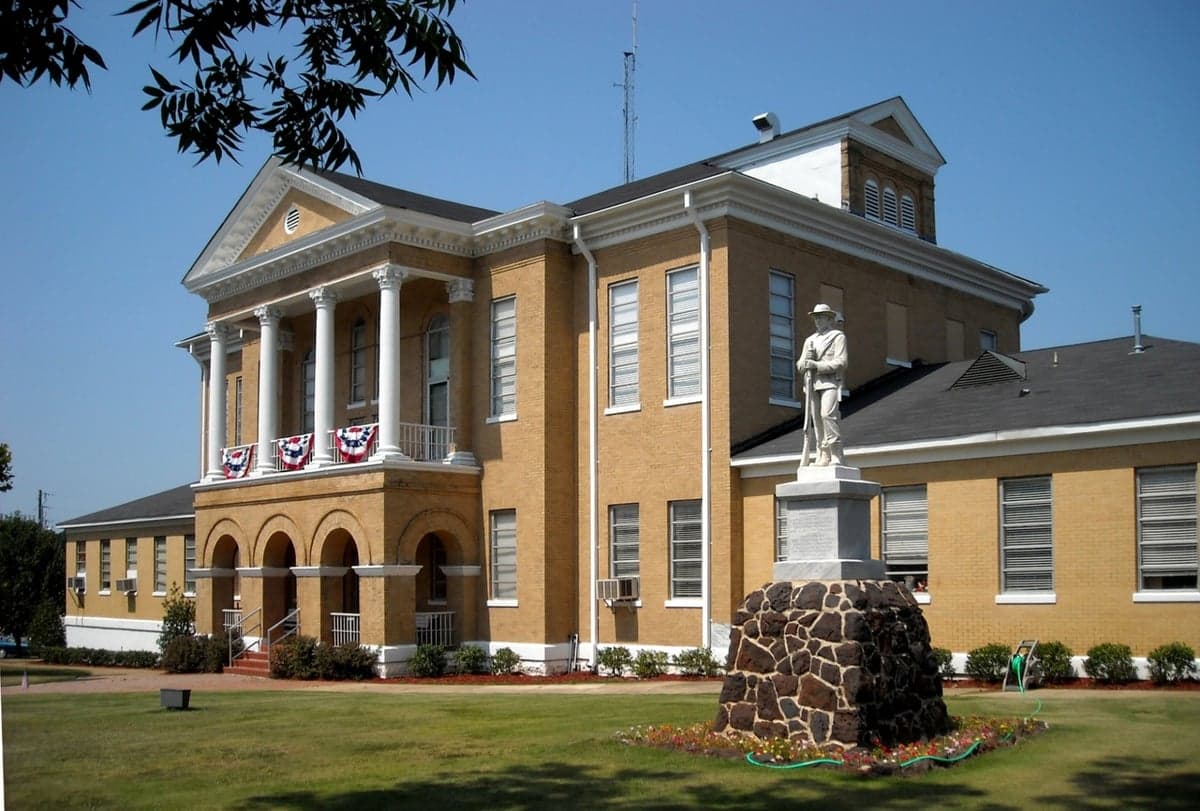
Photo: Wikipedia
Demographics of Choctaw County
Affluence Level in Choctaw County
A below-average socioeconomic profile. Incomes, home values, and educational attainment trail the U.S., with higher poverty and unemployment.
People of Choctaw County
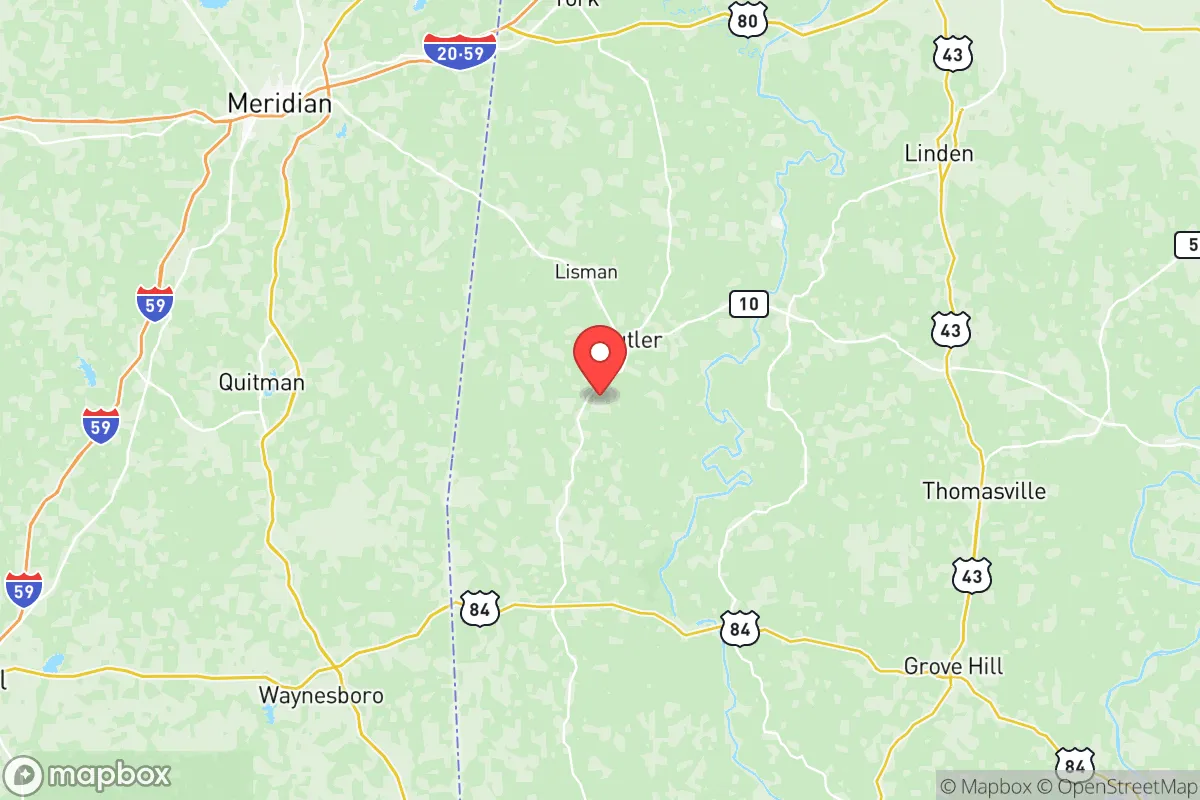
Choctaw County, Alabama, is home to roughly 12,525 residents, a population that is 56.6% White and 38.1% Black, with a foreign-born share of just 0.3% — one of the lowest in the nation. This is a deeply rural, historically rooted corner of the state’s Black Belt, where the population has been shaped more by out-migration than immigration for over a century. The county’s identity is defined by its timber and agricultural heritage, its small towns like Butler and Gilbertown, and a demographic stability that is rare in an increasingly mobile America.
Settlement & growth (pre-1960)
Before American settlement, the area that is now Choctaw County was the domain of the Choctaw Nation, a Muskogean-speaking people who controlled much of present-day west-central Alabama and east-central Mississippi. The Choctaw were among the "Five Civilized Tribes," and their forced removal via the Treaty of Dancing Rabbit Creek in 1830 — part of the broader Trail of Tears — opened the region to White settlement. The county itself was created in 1847, carved from Sumter and Washington counties, and named in honor of the Choctaw people who had been displaced just a generation earlier.
The first wave of American settlers arrived in the 1830s and 1840s, primarily Scots-Irish and English yeoman farmers moving south and west from the Carolinas, Georgia, and Virginia. They were drawn not by large plantations but by the promise of cheap, fertile bottomland along the Tombigbee River and its tributaries. The county seat, Butler, was established in 1848 and quickly became the commercial hub, with cotton gins, grist mills, and general stores serving the surrounding farmsteads. Smaller communities like Gilbertown and Lisman grew as trading posts along the wagon roads that connected the county to the river ports at Mobile and Demopolis.
By 1860, enslaved African Americans made up a substantial portion of the county’s population, working the cotton fields that dominated the local economy. After emancipation, many freedmen remained in the area as sharecroppers and tenant farmers, forming the foundation of the county’s Black communities. The post-Reconstruction era saw the establishment of all-Black settlements and churches, particularly around Mount Sterling and Jachin, where descendants of those freed families still live today. The 1870s and 1880s also brought a small but notable influx of German and Irish laborers who worked on the railroads that began threading through the county, though their numbers remained modest compared to the dominant Anglo and Black populations.
The early 20th century brought economic transformation. The timber industry, which had been a secondary activity, exploded after 1900 as the virgin longleaf pine forests were harvested for lumber and turpentine. Sawmills sprang up in Pennington and Silas, attracting both Black and White workers from across the region. The discovery of oil in the 1940s near Gilbertown — one of Alabama’s first commercial oil fields — added a new economic layer, though it employed relatively few people. The county’s population peaked around 20,000 in 1940, but the mechanization of agriculture and the decline of the timber industry triggered a steady out-migration that would continue for decades.
Modern era (post-1965)
The 1965 Hart-Cellar Act, which transformed U.S. immigration policy, had virtually no effect on Choctaw County. With a foreign-born population of just 0.3% — roughly 38 people — the county remains one of the least ethnically diverse places in America by immigrant standards. The demographic story of the modern era is not one of new arrivals but of continued domestic out-migration, particularly among Black residents who left for Southern cities like Birmingham, Atlanta, and Mobile, or further north to Chicago and Detroit during the tail end of the Great Migration.
Since 1970, the county has lost roughly 40% of its population, a decline that has accelerated in recent decades. The 2020 Census recorded 12,525 residents, down from 13,859 in 2010 and 15,922 in 2000. The racial composition has remained remarkably stable during this period — the Black share has hovered around 38% for decades, and the White share around 57% — because both groups have left at similar rates. The Hispanic population, at 1.1%, is a very recent and small addition, largely concentrated in and around Butler and Gilbertown, where a handful of Latino workers have been employed in poultry processing and timber operations. East/Southeast Asian residents are essentially absent (0.0%), and the Indian-subcontinent population is negligible at 0.2%.
Suburbanization has not reshaped Choctaw County in the way it has transformed other parts of Alabama. There are no bedroom communities feeding a nearby metropolis; the county’s largest town, Butler, has fewer than 2,000 residents. Instead, the modern era has been characterized by consolidation — small communities like Jachin and Mount Sterling have dwindled to clusters of homes and churches, while Butler and Gilbertown have absorbed what little commercial activity remains. The county’s economy now revolves around timber, small-scale agriculture, and a significant prison industry — the Choctaw County Jail and the nearby state-run facilities employ a meaningful share of the local workforce.
The future
Choctaw County’s population is projected to continue its slow decline, with the University of Alabama’s Center for Business and Economic Research estimating a further 5-8% drop by 2040. The county is aging — the median age is now over 45, well above the national average — and younger residents continue to leave for educational and employment opportunities in Tuscaloosa, Meridian, and the Gulf Coast. The racial composition is likely to remain stable, as both White and Black populations are aging in place with minimal in-migration from any group.
The small Hispanic population may grow modestly, particularly if regional poultry and timber industries expand, but there is no indication that Choctaw County will see the kind of immigrant-driven diversification that is reshaping other parts of the South. The county’s cultural identity — rooted in rural Protestantism, hunting and fishing traditions, and a strong sense of local place — is likely to persist, though it will be increasingly shaped by retirees and remote workers seeking low-cost, low-density living. The expansion of broadband access in rural Alabama, funded by state and federal grants, could bring a small but meaningful influx of remote workers to areas around Butler and Pennington over the next decade.
For those considering a move to Choctaw County, the bottom line is this: this is a place of deep historical continuity, where the descendants of 19th-century settlers and freed slaves still share the same communities their ancestors built. It is not a place of demographic dynamism — the population is shrinking, aging, and overwhelmingly native-born. But for families and individuals seeking a quiet, affordable, and genuinely rural lifestyle with a strong sense of community, the county offers a stability that few fast-growing regions can match. The people of Choctaw County are, in many ways, the same people who have always been here — and they are likely to remain so for generations to come.

* Values derived from national, state, county, city and local statistics and may differ in a specific area. Last updated: 2026-11-04T03:59:27.000Z
Narrative content on this page is AI-generated and may contain mistakes. Verify any details that matter before acting on them.
ReloMaps may earn a commission from affiliate links at no extra cost to you.

