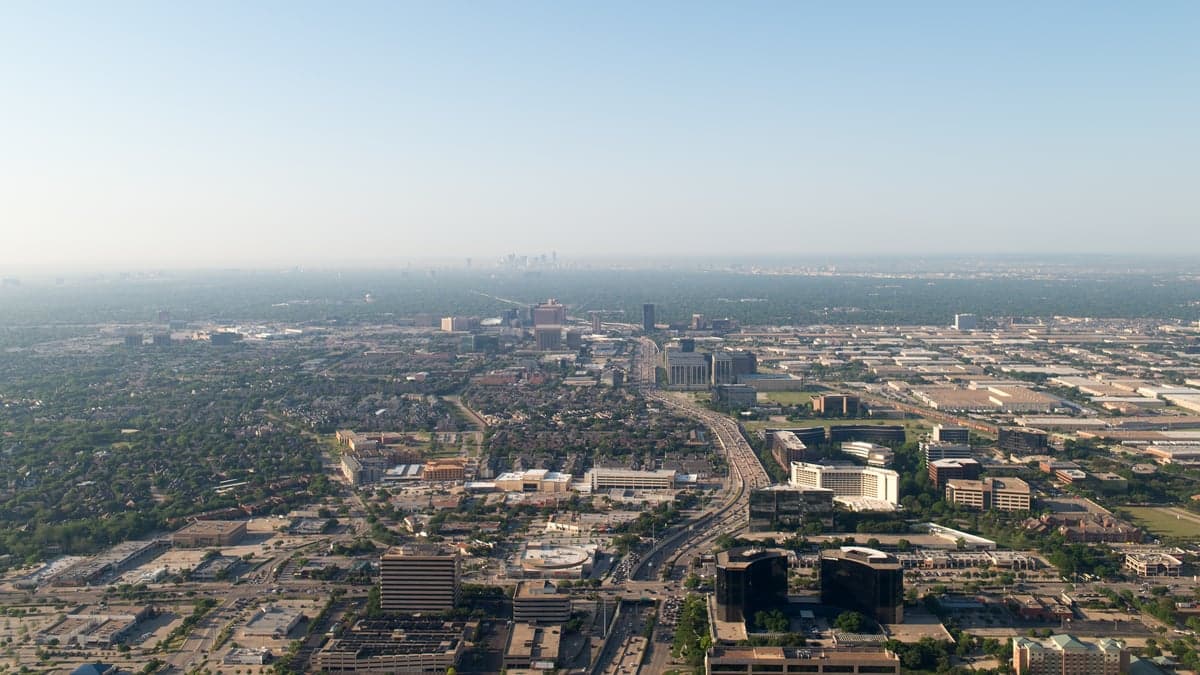
Photo: Wikipedia
Political ClimatePolitical Climate in Addison, TX
District shown is the primary district for this city’s centroid. Cities may span multiple districts.
Local Political AnalysisPolitical Analysis of Addison, TX
Addison is a deep blue island in a red sea. With a Cook Partisan Voting Index (PVI) of D+13, the town votes more than a dozen points more Democratic than the national average, making it one of the most reliably liberal suburbs in the Dallas-Fort Worth metroplex. That’s a stark contrast to the surrounding state of Texas, which, while its exact PVI isn’t published, has voted Republican in every presidential election since 1980 and leans somewhere around R+5 to R+8 by most estimates. The gap isn’t just a quirk of one election; it’s a long-term trend that has only widened as Addison’s population has grown denser, younger, and more diverse.
How it compares
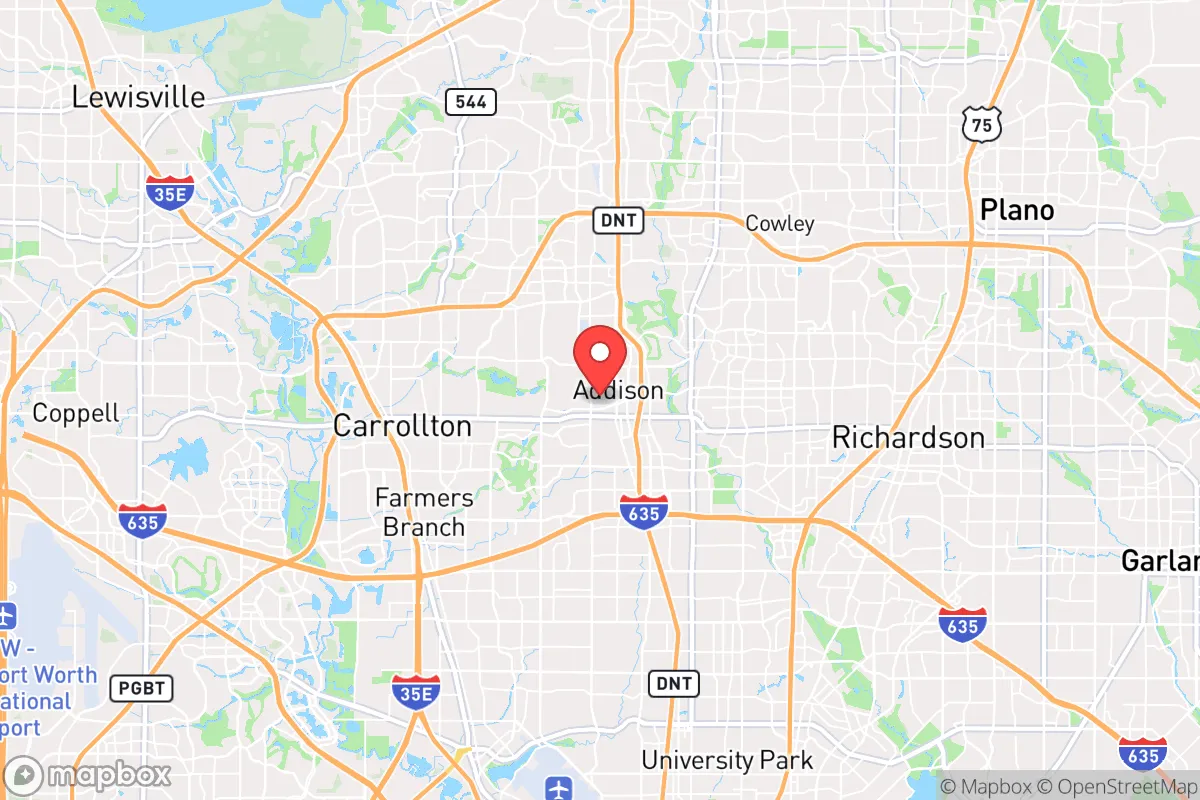
Drive ten minutes north to Plano or west to Carrollton, and you’ll find suburbs that are much more politically mixed—Plano’s northern half is solidly red, while its southern end is trending purple. Head south into Dallas proper, and you’re back in D+20-plus territory. Addison sits right on that border, but its own politics are unambiguous. The town’s small footprint—just over four square miles—means its electorate is heavily shaped by the young professionals and tech workers who live in its dense apartment complexes and condos. In 2020, Joe Biden carried Addison by a margin that mirrored its D+13 rating, while Donald Trump won Dallas County overall by a much narrower margin. The surrounding suburbs, like Farmer’s Branch and Richardson, are more competitive, often flipping between parties depending on the race. Addison’s trajectory is clear: it’s getting bluer, not redder, as more out-of-state transplants and younger renters move in.
What this means for residents
For liberal residents, Addison feels like a safe space in a state that often feels hostile. Local elections are dominated by Democrats or moderate Republicans who don’t push culture-war issues. You’ll see pride flags on businesses, and the town council rarely debates abortion or gun rights. For conservative residents, the reality is more nuanced. You’re not going to be ostracized—Addison is still Texas, and plenty of folks hunt, own guns, and go to church. But you’ll be in the minority at the ballot box. School board races and city council seats tend to go to candidates who prioritize development, density, and public transit over tax cuts or social conservatism. If you’re a Republican, you might feel like your vote doesn’t matter much locally, but you’re still represented by a Republican governor and legislature in Austin. The practical effect is that Addison’s policies lean progressive on housing (lots of mixed-use zoning), environmental issues (a robust recycling program), and social services (the town funds a strong public library and community events). Taxes are moderate for the area, but the town’s reliance on sales tax from its famous restaurant row means less pressure on property owners.
Culturally, Addison stands out for its embrace of urban density in a state that worships the single-family home. The town’s motto, “The City of Addison,” isn’t just branding—it feels like a small city, with a walkable downtown core, a heavy concentration of apartments, and a nightlife scene that draws people from across the metroplex. Policy-wise, Addison was an early adopter of complete streets and transit-oriented development, which is rare in North Texas. The biggest distinction from the rest of Texas is the sheer lack of suburban sprawl mentality. You won’t find many HOA-dominated subdivisions here. Instead, you get a dense, car-light (by Texas standards) environment where politics and lifestyle align: a blue town that votes for bike lanes, high-density housing, and a vibrant public square. For anyone moving here, the political climate is less about red vs. blue and more about whether you want to live in a place that feels like a walkable urban enclave in the middle of a sprawling, conservative state.

State Political ClimatePolitical Climate in Texas
State Political AnalysisPolitical Environment in the State
Texas has been a reliably Republican state in presidential elections since 1980, but the margin has narrowed significantly over the past two decades. In 2024, Donald Trump carried the state by roughly 14 points, down from 19 points in 2016 and 16 points in 2020, reflecting a steady demographic shift driven by explosive growth in the urban crescent from Dallas-Fort Worth down through Austin to San Antonio and Houston. The dominant coalition remains a mix of rural conservatives, suburban moderates, and a growing number of Hispanic voters who have trended rightward, but the state’s fast-growing cities and suburbs are increasingly competitive, making Texas a perennial battleground in waiting.
Urban vs. rural divide
The political map of Texas is a study in contrasts. The big four metros—Houston, Dallas-Fort Worth, San Antonio, and Austin—are Democratic strongholds, with Harris County (Houston) and Travis County (Austin) routinely delivering 60-70% of their votes to Democratic candidates. Meanwhile, rural West Texas, the Panhandle, and East Texas are deeply Republican; counties like Lubbock’s Lubbock County and Midland’s Midland County vote 75-80% Republican. The real action is in the suburbs: Collin County (north of Dallas) and Fort Bend County (southwest of Houston) have shifted from reliably red to purple, with Collin County voting for Trump by only 10 points in 2024 after supporting him by 22 points in 2016. The Rio Grande Valley, once a Democratic firewall, has seen a dramatic rightward shift—Starr County, which voted for Hillary Clinton by 60 points in 2016, went for Trump by 5 points in 2024, driven by conservative Hispanic voters and a growing working-class base.
Policy environment
Texas operates under a low-tax, low-regulation model that defines its political identity. There is no state income tax, and property taxes are high—among the highest in the nation—to compensate, though a 2023 law (SB 2) increased the homestead exemption to $100,000 and provided compression for school district tax rates. The regulatory posture is business-friendly, with minimal zoning in many cities and a right-to-work law that limits union power. Education policy is dominated by school choice debates: the 2023 legislative session saw a push for education savings accounts (ESAs) fail in the House, but Governor Greg Abbott made it a priority for 2025, and a new bill (SB 1) passed in 2025, creating a $10,000 per-student ESA for families leaving underperforming public schools. Healthcare is a flashpoint: Texas has not expanded Medicaid under the Affordable Care Act, leaving roughly 1.5 million uninsured residents, but the state has invested in rural hospital subsidies and telehealth. Election laws tightened in 2021 with SB 1, which added ID requirements for mail-in ballots, limited drive-through voting, and banned 24-hour polling places—changes that have been upheld in court.
Recent policy direction
The 2023 and 2025 legislative sessions have pushed Texas sharply in a conservative direction across multiple fronts. On gun and self-defense law, the state became permitless carry in 2021 (HB 1927), allowing most adults to carry a handgun without a license, and in 2023 it passed a law (HB 17) prohibiting local governments from contracting with companies that "discriminate" against firearm businesses. Parental and education rights saw a major win with the 2023 passage of HB 900, which requires book vendors to rate materials for "sexually explicit" content and restricts access in school libraries—a law currently tied up in court. Speech protections were bolstered by a 2023 law (HB 20) that bars social media platforms from moderating content based on viewpoint, though it faces First Amendment challenges. On privacy and surveillance, Texas passed a consumer data privacy law (HB 4390) in 2023, giving residents the right to opt out of data collection, but it lacks a private right of action. Medical and bodily autonomy is the most contested area: Texas enacted a near-total abortion ban (SB 8) in 2021, enforced through private civil lawsuits, and a trigger law (HB 1280) that banned abortion from conception with narrow exceptions. In 2023, the state banned gender-affirming care for minors (SB 14), which has been blocked by court orders. Property rights were strengthened by a 2023 law (HB 3167) limiting eminent domain for private projects, and a 2025 law (SB 12) expanded homestead protections against forced sale. Taxation remains a central focus: the 2023 property tax cut package (SB 2 and SB 3) was the largest in state history, totaling $18 billion over two years. Voting and ballot access remain restrictive: the 2021 SB 1 is still in effect, and a 2025 bill (SB 7) added a requirement for voter ID to be presented when returning a mail-in ballot in person.
Civil unrest & political movements
Texas has seen significant political activism on both sides. The 2020 Black Lives Matter protests in Austin and Dallas were among the largest in the state, with Austin seeing nightly demonstrations for weeks and a subsequent police budget cut that was later partially restored. On the right, the "Texas Nationalist Movement" has gained some traction, pushing for a non-binding referendum on secession in 2024, though it has no serious legislative support. Immigration politics are a constant flashpoint: Governor Abbott’s Operation Lone Star, launched in 2021, has deployed state troopers and National Guard to the border, bused migrants to Democratic-led cities, and installed razor wire along the Rio Grande—a policy that has sparked lawsuits from the Biden administration and civil rights groups. Sanctuary city policies are effectively banned by a 2017 law (SB 4) that allows law enforcement to inquire about immigration status, though it has been partially blocked by courts. Election integrity controversies have been persistent: the 2020 election saw Trump’s legal challenges fail in Texas courts, but the 2021 SB 1 was a direct response to those claims, and a 2024 audit of Harris County’s 2022 election found no widespread fraud but did identify administrative errors. Visible flashpoints for a new resident include regular protests at the state capitol in Austin during legislative sessions, and occasional clashes at school board meetings over curriculum and library books, particularly in suburban districts like Frisco and Katy.
Projection
Over the next 5-10 years, Texas will continue to trend purple, driven by in-migration from blue states and the natural growth of diverse urban populations. The 2024 election results suggest the Republican margin could shrink to single digits by 2028, especially if Democrats can turn out young and Hispanic voters in the suburbs and the Rio Grande Valley. However, the state’s political infrastructure—gerrymandered congressional districts, restrictive voting laws, and a conservative judiciary—will likely keep the legislature in Republican hands for the foreseeable future. The biggest wildcard is the Hispanic vote: if the rightward trend among working-class Hispanic voters continues, Texas could remain competitive but lean Republican for another decade. A new resident moving in now should expect a state where the culture wars are fought in the legislature and the courts, where property taxes will remain a top concern, and where the political climate will feel increasingly like a battleground—especially in the suburbs of Dallas, Houston, and Austin.
For a new resident, the bottom line is that Texas offers a low-tax, business-friendly environment with a strong conservative tilt on social issues, but the political landscape is shifting fast. If you’re a conservative, you’ll find a state government that largely aligns with your values, with a focus on school choice, gun rights, and property tax relief. If you’re a liberal, you’ll find vibrant urban communities in Austin and Houston where your views are shared, but you’ll face state-level policies that may feel restrictive, especially on abortion and voting. The key is to choose your community carefully—the political reality in Lubbock is very different from that in Austin, and the gap is only widening.
* Values derived from national, state, county, city and local statistics and may differ in a specific area. Last updated: 2026-10-06T01:25:23.000Z
Narrative content on this page is AI-generated and may contain mistakes. Verify any details that matter before acting on them.
ReloMaps may earn a commission from affiliate links at no extra cost to you.

