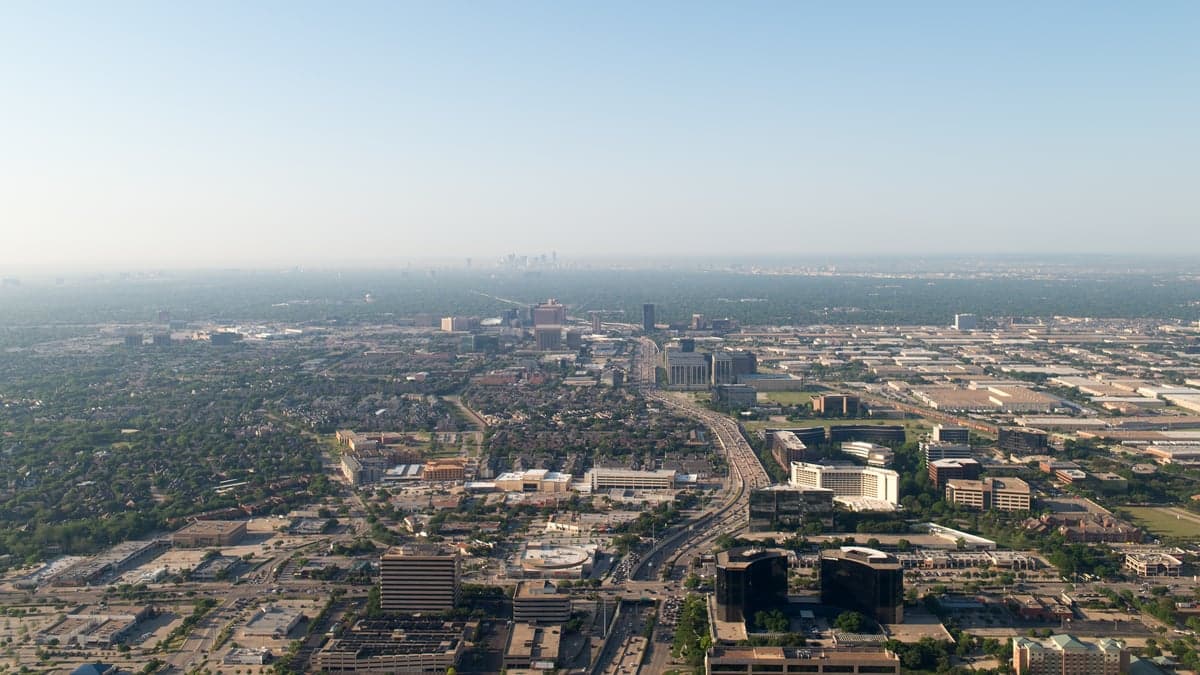
Photo: Wikipedia
Personal Sovereignty in Addison, TX
Strong independent fundamentals that actively favor personal liberty and low regulation.
What does Personal Sovereignty tell us?
Personal Sovereignty measures your capacity for self-reliance and independence with minimal government friction. Higher scores mean fewer barriers between you and the way you want to live... but it assumes you have the space you need and good neighbors.
What does this tell us?
Personal Sovereignty measures your capacity for self-reliance and independence with minimal government friction. Higher scores mean fewer barriers between you and the way you want to live... but it assumes you have the space you need and good neighbors.
State Policy
Energy independence: Net exporter (220% of energy produced in-state)
Personal Liberty
Homesteading

Personal Liberty Analysis
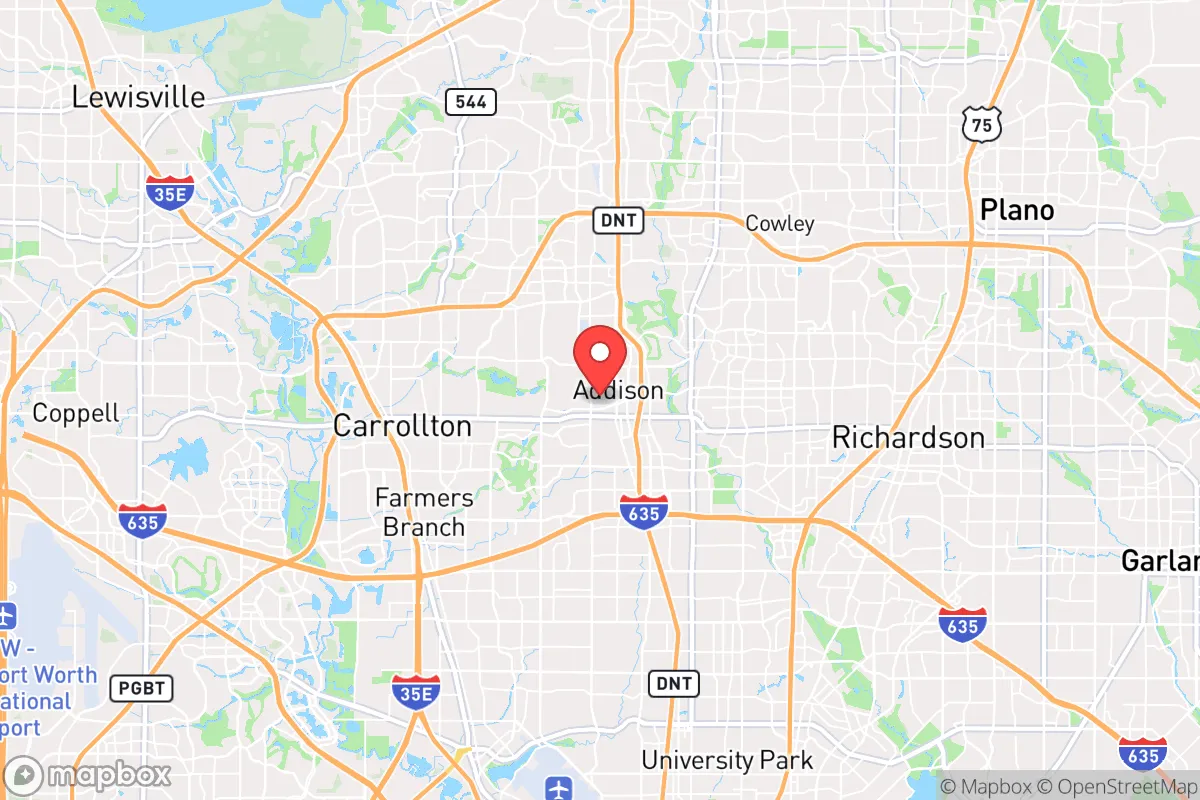
Addison, Texas, offers a notably high degree of personal sovereignty, anchored by the state’s strong preemption laws and a local regulatory posture that leans toward business-friendly minimalism rather than heavy-handed oversight. As a small, incorporated city of roughly 16,000 residents within the Dallas-Fort Worth metroplex, Addison combines the autonomy of a Texas municipality with the practical constraints of suburban zoning and HOA governance. For a relocation-minded individual or family who values independence, the environment is generally permissive—especially on taxes, self-defense, and property rights—but with specific trade-offs in land use and off-grid feasibility that require careful consideration.
Tax burden and regulatory posture: How Addison compares to surrounding cities
Addison’s tax burden is competitive within the Dallas-Fort Worth region, though not the absolute lowest. The city’s property tax rate for fiscal year 2025-2026 is approximately $0.54 per $100 of assessed value, which is moderate for Collin County suburbs. When combined with the Dallas County portion (Addison straddles both Collin and Dallas counties, depending on the exact address), the total effective rate typically lands between 2.2% and 2.5% of assessed value. This is lower than Dallas proper (around 2.7%) but slightly higher than some outer-ring Collin County towns like Frisco or McKinney. There is no city-level income tax, and Texas has no state income tax, so the primary recurring burden is property tax. Sales tax in Addison is 8.25% (state + local), which is standard for the region. On the regulatory side, Addison operates with a light-touch approach for businesses—permitting is streamlined, and the city’s economic development office actively courts corporate relocations with minimal red tape. For residents, however, the city enforces a standard suburban zoning code: single-family lots are typically 6,000 to 10,000 square feet, and home-based businesses are allowed with a conditional use permit. There are no rent control ordinances, no plastic bag bans, and no local mandates that exceed state law on issues like vaccine requirements or mask mandates. The city’s regulatory philosophy is best described as “pro-commerce, pro-property rights within a planned suburban framework.”
Self-defense and gun law specifics: What the Second Amendment looks like in Addison
Texas is a permitless carry state as of September 2021, and Addison fully respects that framework. Any law-abiding adult 21 or older can carry a handgun openly or concealed without a license, though a License to Carry (LTC) still offers reciprocity with other states and can simplify firearm purchases. Addison has no local ordinances that restrict the carry of firearms in public parks, city buildings (beyond what state law mandates), or on public streets. The city does not maintain its own gun registry, and there are no waiting periods or magazine capacity limits beyond state law. For home defense, the Castle Doctrine and Stand Your Ground laws apply fully: there is no duty to retreat in any place where a person has a legal right to be, and the use of deadly force is presumed reasonable if an intruder unlawfully enters a residence or vehicle. Addison’s police department, which is a full-service agency with about 60 sworn officers, has a reputation for professional, non-confrontational interactions with lawful gun owners. The only notable local nuance is that Addison is a densely built city (roughly 4.3 square miles), so discharging a firearm within city limits is prohibited except on a licensed shooting range—there are no indoor ranges within city limits, but several are a short drive away in Dallas or Carrollton. For the self-reliant individual, the legal environment is as permissive as any in the United States, with the practical caveat that suburban density limits where and how you can practice.
Self-reliance and homesteading viability: Lot sizes, zoning, and off-grid feasibility
Addison is not a homesteading destination. The city’s zoning code mandates minimum lot sizes of 6,000 square feet for single-family detached homes, and most subdivisions are platted with lots between 7,000 and 10,000 square feet. This is typical for an inner-ring suburb, but it means no acreage for livestock, substantial gardens, or alternative energy installations. Chickens are allowed on single-family lots, but only hens (no roosters), and with a maximum of six birds per property. Beekeeping is permitted with registration and setback requirements. Rainwater harvesting is legal and encouraged by the state (Texas has a robust rainwater harvesting statute that exempts collection systems from sales tax), but Addison’s HOA covenants—which cover roughly 70% of residential properties—often restrict visible rain barrels or cisterns. Solar panels are allowed under state law (Texas Property Code prohibits HOAs from banning them outright), but aesthetic restrictions can apply. Off-grid living is effectively impossible within city limits: Addison requires connection to municipal water and sewer, and there is no provision for composting toilets or private wells. For a family seeking true self-sufficiency, Addison is a poor fit. However, for the individual who wants a low-tax, low-regulation base of operations with easy access to urban amenities, the city works well as a “home base” from which to pursue self-reliance projects on rural land within a 60- to 90-minute drive (e.g., in Ellis or Kaufman counties). The city’s zoning is transparent and consistently enforced, so there are no surprises—but also no flexibility for alternative lifestyles.
Personal liberties: Parental rights, medical autonomy, speech, and property
Texas law provides strong protections for parental rights, and Addison operates within that framework. The state’s 1995 Parental Rights statute (Texas Family Code §151.001) affirms that parents have the right to direct their children’s education, medical care, and moral upbringing. Addison ISD, which serves most of the city, does not have any local policies that override these rights—there are no mask mandates, no vaccine requirements for school attendance beyond state law, and no controversial curriculum opt-out restrictions. Homeschooling is legal and lightly regulated: parents must provide a written curriculum covering reading, spelling, grammar, math, and good citizenship, but there are no standardized testing requirements or home visits. On medical autonomy, Texas has no state-level vaccine passport mandate, and Addison has not enacted any local health orders that restrict medical choice. The city’s public health department, which is part of Dallas County Health and Human Services, does not enforce any mandates beyond state law. Speech and assembly are protected under the First Amendment, and Addison has no local ordinances that restrict political signage, leafleting, or public demonstrations beyond standard time-place-manner rules. Property rights are robust: eminent domain is rarely used by the city, and when it is, it follows the Texas Property Code’s requirement for full market value compensation plus relocation costs. The city does not have rent control, and there are no local ordinances that restrict short-term rentals (like Airbnb) beyond standard hotel occupancy taxes. For the liberty-minded individual, Addison offers a legal environment that is permissive by national standards, with the primary constraint being the practical density of suburban life rather than government overreach.
Overall, Addison’s sovereignty profile is strong on fiscal and legal freedoms but limited on land-use autonomy. It ranks favorably against other Dallas-Fort Worth suburbs like Highland Park (higher taxes, more restrictive zoning) or Dallas proper (higher crime, more municipal bureaucracy). For the reader who prioritizes low taxes, strong self-defense laws, and minimal government intrusion into daily life, Addison is a solid choice—provided they are comfortable with suburban density and HOA governance. The city’s regulatory environment is transparent and predictable, which itself is a form of freedom: you know exactly what the rules are, and they rarely change. For those seeking true off-grid independence or large-scale homesteading, rural Texas counties offer more sovereignty, but for a metro-area base with excellent schools, low crime, and a pro-liberty legal framework, Addison is among the better options in North Texas.

* Values derived from national, state, county, city and local statistics and may differ in a specific area. Last updated: 2026-10-06T01:25:23.000Z
Narrative content on this page is AI-generated and may contain mistakes. Verify any details that matter before acting on them.
ReloMaps may earn a commission from affiliate links at no extra cost to you.

