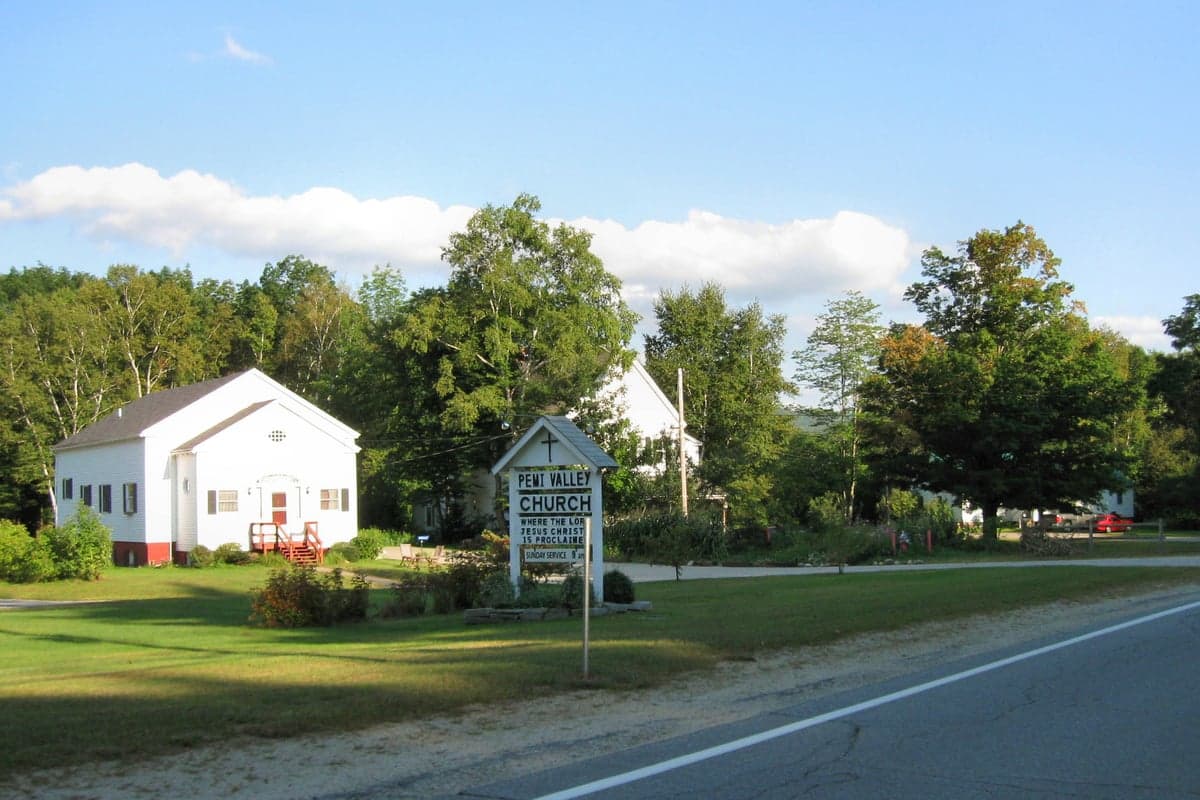
Photo: Wikipedia
Personal Sovereignty in Woodstock, NH
Viable for self-reliance. Generally workable, though some barriers may limit total independence.
What does Personal Sovereignty tell us?
Personal Sovereignty measures your capacity for self-reliance and independence with minimal government friction. Higher scores mean fewer barriers between you and the way you want to live... but it assumes you have the space you need and good neighbors.
What does this tell us?
Personal Sovereignty measures your capacity for self-reliance and independence with minimal government friction. Higher scores mean fewer barriers between you and the way you want to live... but it assumes you have the space you need and good neighbors.
State Policy
Energy independence: Importer (10% of energy produced in-state)
Personal Liberty
Homesteading

Personal Liberty Analysis
Woodstock, New Hampshire, offers one of the strongest personal sovereignty environments in New England, anchored by the state’s lack of a broad-based income or sales tax and a deeply ingrained Live Free or Die ethos. For individuals and families prioritizing autonomy, the town sits in Grafton County, where local governance is generally light-touch, and the state’s constitutional framework explicitly protects personal rights. This analysis examines the specific tax, regulatory, self-defense, homesteading, and liberty factors that define Woodstock’s sovereignty profile for a relocation-minded audience.
Tax burden and regulatory posture: How New Hampshire’s structure benefits Woodstock residents
New Hampshire’s tax structure is a major draw for sovereignty-minded relocators. The state imposes no broad-based personal income tax and no general sales tax, meaning Woodstock residents keep more of their earnings. The primary local revenue source is the property tax, which in Woodstock averages roughly $18–$22 per $1,000 of assessed value, depending on the specific property and any exemptions. This is moderate by New Hampshire standards but higher than some southern states; however, the absence of income and sales taxes often offsets this for households with moderate property values. The regulatory posture in Woodstock is similarly restrained. The town operates under a general law town structure with a select board and town meeting, giving residents direct say in local ordinances. Zoning is minimal outside the village center, and there is no town-wide planning board oversight for most rural parcels. The state’s Right-to-Know law and Right-to-Farm law further protect property owners from excessive local regulation, making Woodstock a favorable environment for those seeking to minimize government intrusion in daily life.
Self-defense and gun law specifics: Constitutional carry and stand your ground in Woodstock
New Hampshire is one of the most firearm-friendly states in the Northeast, and Woodstock residents benefit directly from these laws. The state has constitutional carry (permitless carry for both open and concealed firearms) for anyone legally allowed to possess a firearm. No state permit is required to purchase a handgun, rifle, or shotgun, and there is no waiting period or firearm registration. The state also has a stand your ground law (RSA 627:4), which removes any duty to retreat before using deadly force in self-defense when lawfully present. Woodstock’s rural character—with large tracts of forest and low population density—means that responsible firearm ownership is common and socially accepted. Local law enforcement in Grafton County generally respects these rights, and there are no county-level restrictions beyond state law. For families, this means the ability to keep firearms for home defense, hunting, or sport without bureaucratic hurdles. The only notable limitation is that New Hampshire does not have a preemption statute that explicitly bars local ordinances on firearms, but Woodstock has not enacted any such restrictions, and the state’s political culture strongly discourages them.
Self-reliance and homesteading viability: Lot sizes, zoning, and off-grid feasibility in Woodstock
Woodstock’s land use regulations are designed to accommodate self-reliance. The town’s zoning ordinance allows for minimum lot sizes of 2 acres in most rural districts, with larger parcels common in the more remote areas. This makes small-scale homesteading—gardening, keeping chickens, goats, or even a few cows—entirely feasible without special permits. The Right-to-Farm law (RSA 432:34) protects agricultural activities from nuisance lawsuits, so neighbors cannot easily shut down a hobby farm. Off-grid living is also viable, though with some practical considerations. Woodstock has no town-wide building code for single-family homes outside the village district, meaning owner-builders can construct their own dwellings without mandatory inspections, as long as they meet basic septic and well requirements. Solar panels, rainwater collection, and composting toilets are all legal, though the state does require a permit for wells and septic systems (administered by the New Hampshire Department of Environmental Services). The town does not have a municipal water or sewer system in most areas, so residents are responsible for their own utilities. Woodstock’s location in the White Mountain region means heating costs can be high, but wood stoves are common and legal. Overall, the regulatory environment supports a high degree of self-reliance for those willing to manage their own infrastructure.
Personal liberties: Parental rights, medical autonomy, speech, and property protections
New Hampshire’s legal framework strongly protects personal liberties, and Woodstock residents enjoy these protections in practice. Parental rights are explicitly recognized in state law (RSA 169-C:19), giving parents broad authority over their children’s education, healthcare, and upbringing. The state has no mandatory vaccination requirements for school attendance (only opt-out forms), and homeschooling is lightly regulated—parents need only file a simple notice of intent and provide an annual evaluation, which can be a portfolio review or standardized test. Medical autonomy is similarly robust. New Hampshire does not have a state-level vaccine mandate for adults, and the Right to Try Act allows terminally ill patients access to experimental treatments. The state also has a Health Freedom law (RSA 126-X) that protects individuals from being forced to accept medical procedures against their will. Free speech is protected by the state constitution’s Part I, Article 22, which is even broader than the First Amendment in some interpretations. Woodstock’s small-town character means that local government meetings and public forums are accessible, and residents regularly exercise their voice without fear of retaliation. Property rights are secured by the state’s strong eminent domain protections (RSA 498-A), which require just compensation and public necessity for any taking. Woodstock has no local rent control or landlord licensing, and property owners can generally use their land as they see fit, subject only to minimal zoning and health regulations.
In the broader context of New England, Woodstock stands out as a high-sovereignty location. Compared to neighboring Vermont or Massachusetts, New Hampshire’s lack of income tax, constitutional carry, and light-touch regulation create a significantly more autonomous environment. Within New Hampshire itself, Woodstock is typical of the rural North Country—less regulated than southern towns like Nashua or Manchester, but with the same state-level protections. For a relocator who values personal freedom, self-reliance, and minimal government interference, Woodstock offers a practical and legally supported foundation for that lifestyle, with the added benefit of stunning natural surroundings and a community that generally respects individual choice.

* Values derived from national, state, county, city and local statistics and may differ in a specific area. Last updated: 2026-10-20T07:45:58.000Z
Narrative content on this page is AI-generated and may contain mistakes. Verify any details that matter before acting on them.
ReloMaps may earn a commission from affiliate links at no extra cost to you.

