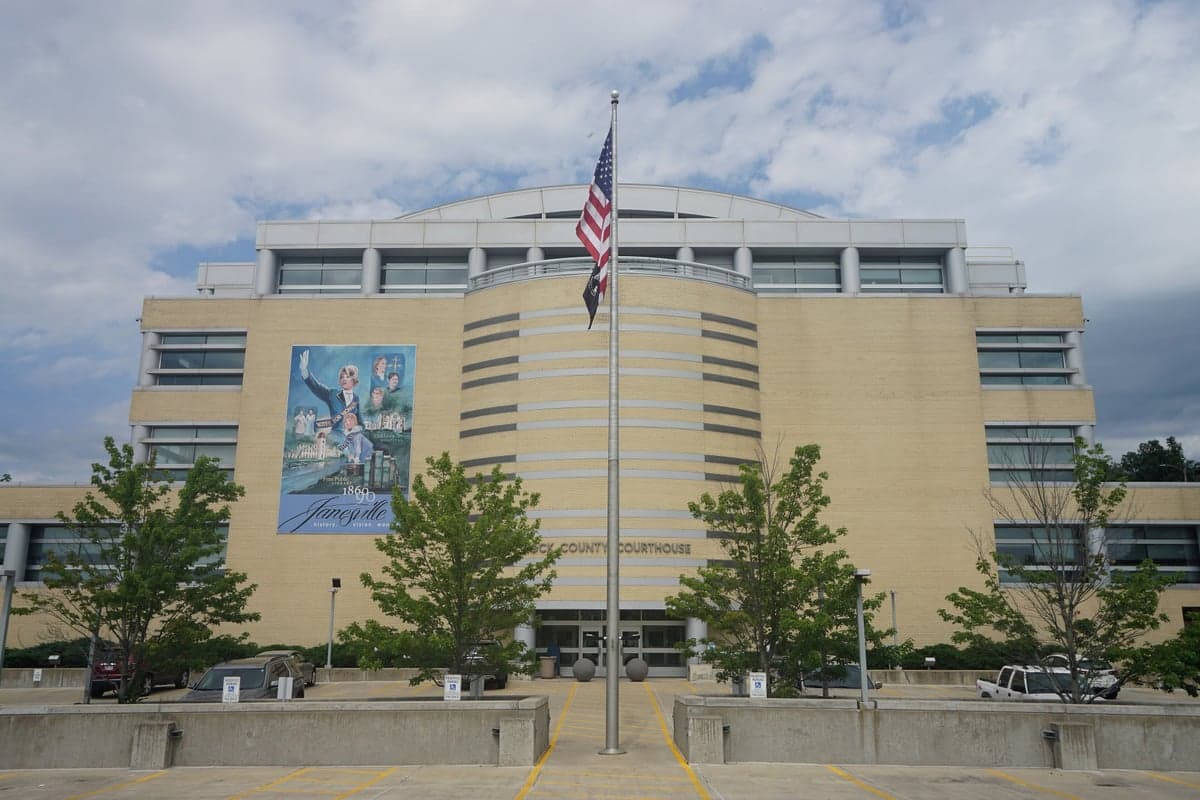
Photo: Wikipedia
Political ClimatePolitical Climate in Rock County
Showing district-level results — no local-only data available.
Local Political AnalysisPolitical Analysis of Rock County
Rock County, Wisconsin, is a place that used to feel a lot more balanced, but over the last decade or so, it’s shifted hard to the left. The Cook PVI rating of D+21 tells you the story right off the bat—this isn’t a purple county anymore; it’s a deep blue stronghold, especially when you compare it to the state of Wisconsin as a whole, which sits at EVEN. That means while the rest of the state is still a genuine battleground, Rock County has become a reliable engine for progressive candidates and policies, and for those of us who value personal freedoms and limited government, that’s a trend worth watching closely.
How it compares
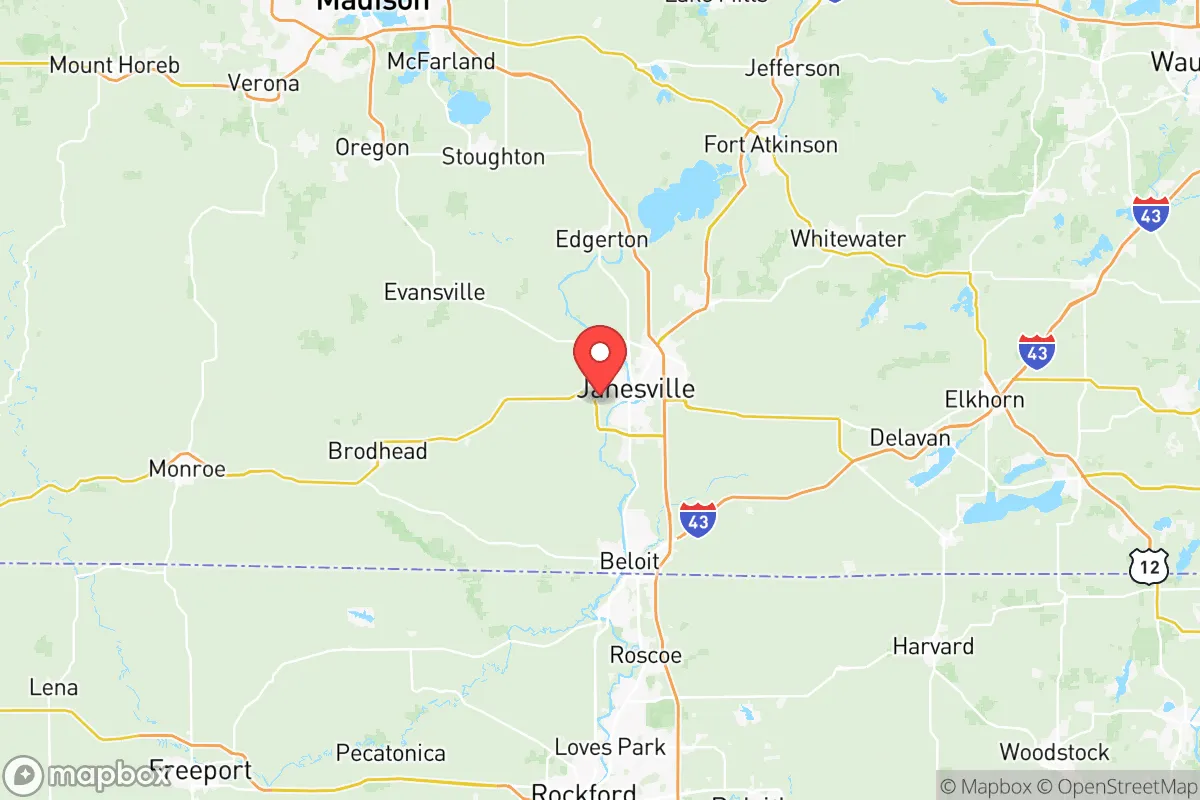
The contrast between Rock County and the rest of Wisconsin is stark. The state’s EVEN rating reflects a true toss-up, where rural and suburban conservatives in places like Waukesha County or the Northwoods can offset the liberal strongholds of Dane and Milwaukee. But Rock County is essentially an extension of Dane County’s politics now. The city of Janesville, the county seat, is the epicenter of this blue wave—it’s where you’ll find the most progressive activism, from city council decisions to school board policies. Beloit leans even further left, driven by its college-town energy and a growing population of younger, more transient residents. Meanwhile, the smaller towns and rural townships—places like Clinton, Edgerton, and Orfordville—still vote more conservatively, but their influence is shrinking as the county’s population concentrates in the urban centers. The swing precincts that used to exist, like some of the outer Janesville wards, have largely solidified for Democrats in recent cycles. It’s a classic story of urban growth overwhelming rural common sense.
What this means for residents
For folks who live here and lean conservative, the practical effect is that you’re increasingly outnumbered at the ballot box, and that has real consequences. Local government here has become more willing to embrace progressive policies that feel like overreach—think mask mandates that lasted longer than in neighboring counties, zoning restrictions that make it harder to start a small business, and school curricula that prioritize social agendas over core academics. Property taxes have crept up to fund these priorities, and there’s a growing sense that your voice doesn’t carry the same weight it used to. If you’re a hunter, a gun owner, or just someone who believes in keeping government out of your personal life, you’ll find yourself on the defensive more often than not. The county board and city councils are dominated by Democrats, so even basic issues like road maintenance or public safety funding can get tangled up in ideological fights.
One cultural distinction that stands out is the area’s relationship with organized labor. Rock County has deep union roots, especially in manufacturing—General Motors’ old Janesville plant was a huge deal for decades. That legacy still influences local politics, but it’s shifted from a focus on worker rights to a broader progressive platform that includes environmental regulations and social justice initiatives. For a conservative, that feels like a bait-and-switch: the unions that once stood for hard work and fair pay now often back candidates who push for higher taxes and more government control. Looking ahead, I don’t see this trend reversing. As long as Janesville and Beloit keep growing and the rural towns keep losing population, Rock County will only get bluer. If you value personal liberty and fiscal restraint, you might find yourself feeling like a stranger in your own county.

State Political ClimatePolitical Climate in Wisconsin
State Political AnalysisPolitical Environment in the State
Wisconsin is a classic swing state with a Cook PVI of EVEN, meaning it’s a perfect 50/50 battleground that has seesawed between parties for the past two decades. Over the last 10-20 years, the state has shifted from a reliably blue-leaning Midwestern stronghold to a deeply polarized toss-up, driven by a sharp urban-rural split and a wave of conservative activism in the exurbs and small towns. The dominant coalitions are a Democratic stronghold in the Milwaukee-Madison corridor and a Republican base across the rest of the state, with the key swing counties — Waukesha, Brown, and Outagamie — often deciding the outcome. Since 2016, the state has voted for Trump twice (2016 and 2024) and for Biden once (2020), with margins under 1% each time, making it one of the most competitive states in the country.
Urban vs. rural divide
The political map of Wisconsin is a textbook example of the urban-rural chasm. Milwaukee County, home to the city of Milwaukee, is the Democratic anchor, delivering margins of 60-70% for Democrats in every recent election. Dane County, anchored by Madison, is even more progressive — it gave Biden over 75% of the vote in 2020, making it the bluest large county in the state. These two counties alone produce a Democratic vote surplus of roughly 200,000, which Republicans must overcome in the rest of the state. The rural and exurban areas — places like Waukesha County (the Milwaukee suburbs), Washington County, and Ozaukee County — are deeply Republican, often voting 60-65% for GOP candidates. The key battlegrounds are the "WOW" counties (Waukesha, Ozaukee, Washington) and the Fox Valley region, including Brown County (Green Bay) and Outagamie County (Appleton). These areas have trended rightward over the past decade, driven by suburban parents concerned about school policies and urban crime spillover. The northern and western rural counties — like Vilas, Oneida, and Polk — are reliably red, while the Driftless Region in the southwest (e.g., Crawford, Grant counties) has become more competitive as small family farms decline and retirees move in.
Policy environment
Wisconsin’s policy environment is a mixed bag for conservatives. On the plus side, the state has a flat income tax rate of 4.4% (as of 2025), down from 7.65% in 2010, thanks to Republican-led tax cuts under Governor Scott Walker and subsequent GOP legislatures. Property taxes are moderate, with the median effective rate around 1.6%, though they vary widely by county — Waukesha County is around 1.8%, while rural Burnett County is closer to 1.2%. The state has a right-to-work law (passed in 2015) and is a "shall-issue" state for concealed carry permits, with no permit required for open carry. However, the state has a Democratic governor, Tony Evers, who has vetoed Republican bills on school choice expansion, abortion restrictions, and election integrity reforms. Education policy is a flashpoint: Wisconsin has a robust school choice program (the Milwaukee Parental Choice Program, started in 1990, and the statewide program expanded in 2013), but Evers has blocked efforts to expand it further. Healthcare is a mixed bag — the state expanded Medicaid under Walker in 2013 (a conservative compromise that included work requirements, later dropped), but Evers has resisted work requirement reinstatement. Election laws are relatively strict: voter ID is required, and the state has a 28-day residency requirement for voting, though no-excuse absentee voting remains legal (a point of contention since 2020).
Trajectory & freedom
Wisconsin’s trajectory on personal freedom is a tug-of-war. On the positive side, the state has seen significant expansions of gun rights: in 2011, Wisconsin became a "shall-issue" state for concealed carry, and in 2015, it passed a law allowing concealed carry in vehicles without a permit. In 2023, the legislature passed a bill to eliminate the permit requirement entirely (constitutional carry), but Governor Evers vetoed it. Parental rights have been a battleground: in 2021, the legislature passed a bill requiring schools to notify parents of any changes to a student’s gender identity or sexual orientation, but Evers vetoed it. The state has no school mask or vaccine mandates for children, and COVID-era restrictions were lifted early (2021) in most rural counties. However, the state has seen a concerning expansion of government overreach in the name of "public health": in 2020, Evers issued a statewide stay-at-home order that was struck down by the state Supreme Court in May 2020 (Wisconsin Legislature v. Palm). Medical autonomy is a mixed bag: the state has no vaccine passport requirement, but it does have a prescription drug monitoring program that some conservatives view as a privacy intrusion. Property rights are generally strong, with no statewide rent control and limited zoning restrictions outside of Milwaukee and Madison. The biggest freedom concern for conservatives is the ongoing battle over election integrity: the 2020 election saw widespread use of private grant funding (Zuckerberg-funded) for election administration in Democratic-leaning cities, which the legislature has since banned (2021 Act 109). The state Supreme Court flipped to a 4-3 liberal majority in 2023 after the election of Justice Janet Protasiewicz, who ran on a platform of abortion rights and redistricting reform — a major red flag for conservatives worried about judicial activism.
Civil unrest & political movements
Wisconsin has a history of visible political flashpoints. The 2011 Act 10 protests in Madison, which drew over 100,000 people to the Capitol to oppose Walker’s collective bargaining reforms, were a defining moment for the state’s conservative movement — they galvanized grassroots activism and led to Walker’s recall election in 2012 (which he won). The 2020 Kenosha unrest, following the shooting of Jacob Blake, saw two nights of riots, arson, and looting, and the subsequent Kyle Rittenhouse trial became a national flashpoint for self-defense rights. The state has a strong conservative activist network, including the Wisconsin Family Action (focused on parental rights and school choice) and the Wisconsin Institute for Law & Liberty (a conservative legal group that has sued over election procedures and COVID mandates). On the left, the state has a robust progressive movement centered in Madison, with groups like the Wisconsin Alliance for Retired Americans and the League of Women Voters pushing for expanded voting access. Immigration politics are relatively quiet compared to border states, but the state has seen a surge in migrant labor in the dairy industry, with some rural counties (like Clark and Marathon) seeing significant Hispanic population growth. There is no sanctuary city policy in Wisconsin, though Milwaukee has a "welcoming city" ordinance that limits cooperation with ICE — a point of tension with the state legislature, which has passed bills to ban such policies (vetoed by Evers). Election integrity remains a hot-button issue: the 2020 election saw a lawsuit from Trump challenging the use of drop boxes, which the state Supreme Court (then conservative-controlled) allowed in 2022, only for the new liberal majority to uphold them in 2024. The state has no secession or nullification rhetoric of note, but there is a strong "Wisconsin First" sentiment in rural areas, with some counties (like Langlade and Rusk) passing resolutions declaring themselves "Second Amendment sanctuaries."
Projection
Over the next 5-10 years, Wisconsin is likely to remain a battleground, but with a slight rightward tilt due to demographic shifts. The key trend is the continued growth of the exurbs and Fox Valley — places like Waukesha, Brown, and Outagamie counties are adding population, while Milwaukee and Dane counties are growing more slowly. The state’s population is aging, with the median age at 40.5, and retirees moving to the Northwoods (Vilas, Oneida counties) tend to vote Republican. However, the in-migration of remote workers from Illinois and Minnesota — drawn by lower taxes and housing costs — could shift the balance. These newcomers often bring progressive voting habits, especially if they settle in Madison or Milwaukee. The biggest wildcard is the state Supreme Court: with a liberal majority until at least 2028, expect rulings on redistricting that could favor Democrats, potentially flipping the state Assembly or congressional maps. If the court imposes a gerrymandered map, the state could become more competitive for Democrats in the long run. On the policy front, expect continued battles over school choice, abortion (the state has a 1849 law that bans abortion, but it’s currently blocked by a court order), and election laws. A conservative moving in now should expect a state that is politically volatile but still winnable — the GOP base is strong and organized, but the urban centers are growing more progressive. The bottom line: Wisconsin is a state where your vote matters, but you’ll need to stay engaged in local politics to protect the freedoms that matter most.
For a new resident, the practical takeaway is that Wisconsin offers a relatively low-tax, high-freedom environment compared to neighboring Illinois or Minnesota, but it requires active civic participation to maintain. The state’s political climate is a constant tug-of-war, and the outcome of the next few elections — especially for the state Supreme Court and governor — will determine whether the state continues its conservative trajectory or shifts leftward. If you value gun rights, school choice, and low taxes, Wisconsin is a solid choice, but be prepared for a fight to keep it that way.
* Values derived from national, state, county, city and local statistics and may differ in a specific area. Last updated: 2026-05-12T08:22:18.000Z
Narrative content on this page is AI-generated and may contain mistakes. Verify any details that matter before acting on them.
ReloMaps may earn a commission from affiliate links at no extra cost to you.

