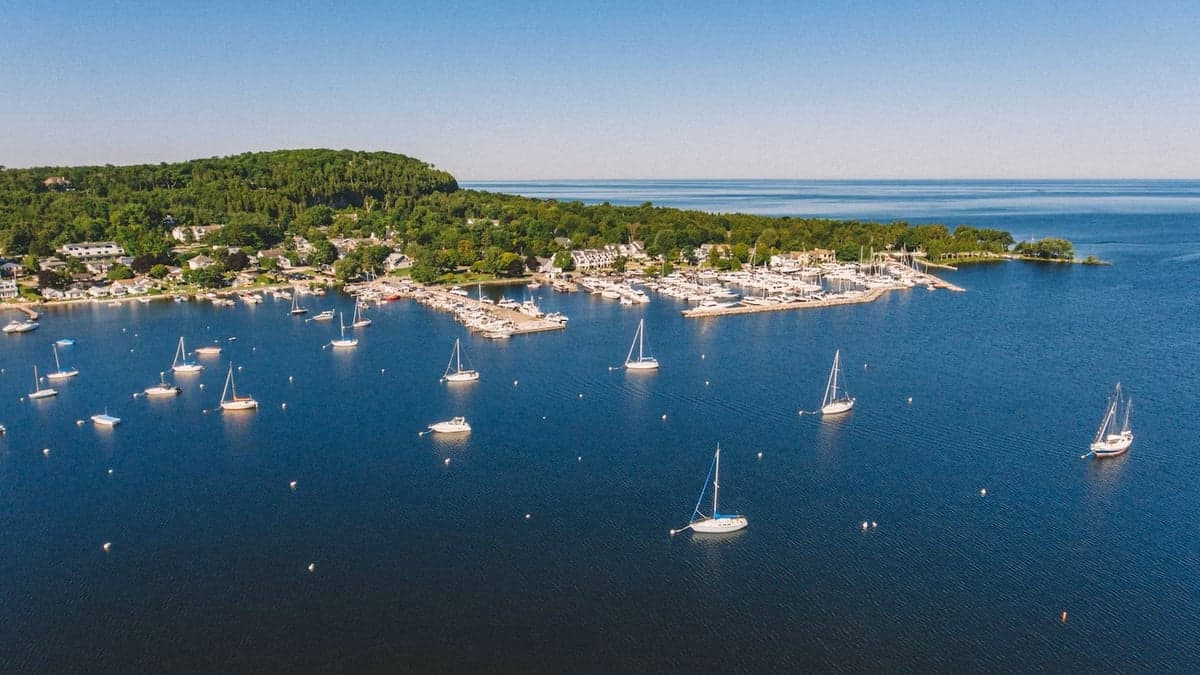
Photo: Wikipedia
Political ClimatePolitical Climate in Door County
Showing county-level results — no local-only data available.
Lean and PVI are calculated from this county’s 2020 and 2024 presidential results, Cook-style.
Political rankings in Wisconsin
- Most Conservative Cities in Wisconsin
- Most Liberal Cities in Wisconsin
- Best Liberal-Leaning Towns in the Midwest
- Safest Liberal-Leaning Towns in the Midwest
- Safest Conservative-Leaning Towns in the Midwest
- Affordable Small Towns for Conservatives
- Most Affordable Liberal-Leaning Small Towns in the U.S.
- Safest Conservative-Leaning Cities in the U.S.
- Most Conservative Counties in Wisconsin
- Most Liberal Counties in Wisconsin
Local Political AnalysisPolitical Analysis of Door County
Door County’s political identity is a study in contrasts, matching its statewide Cook PVI of EVEN but playing out in a uniquely local way. The county as a whole has trended slightly to the left over the past decade, flipping from a 2-point Republican lean in 2016 to a 2-point Democratic lean in 2020, before settling back to a near-even split in 2024. That shift is driven almost entirely by the growing Democratic margins in the village of Ephraim and the town of Gibraltar, where second-home owners and retirees from Chicago and Milwaukee have boosted turnout for blue candidates. Meanwhile, the southern half of the county—places like the town of Union and the village of Forestville—remains reliably red, often voting 60-40 or more for Republican candidates. The real swing precincts are in the town of Sevastopol and the village of Sister Bay, where independent voters and younger families working in tourism or remote tech jobs can tip a race by a few hundred votes.
How it compares
Door County’s political geography mirrors Wisconsin’s broader urban-rural divide, but with a twist. Like the state, the county’s Democratic strength is concentrated in its most tourist-heavy and waterfront communities—think Ephraim, Fish Creek, and Baileys Harbor—while the inland farming towns of Clay Banks, Nasewaupee, and Gardner vote much like rural Wisconsin counties such as Shawano or Marinette. The key difference is that Door County lacks a true urban anchor like Milwaukee or Madison; instead, its blue votes come from a diffuse network of small villages and lakeside hamlets. This makes the county more volatile than the state as a whole: a strong Republican turnout in the southern towns can easily offset Democratic gains in the north, and vice versa. In 2022, for example, Door County voted for Republican Tim Michels for governor by a slim 49.5% to 48.9%, while statewide he lost by 3.4 points—proof that the county’s EVEN rating masks a tighter, more unpredictable race than Wisconsin’s overall.
What this means for residents
For conservatives, Door County’s purple status means their votes carry real weight, especially in local races for county board or town supervisor. The county board remains majority-Republican, but by a narrow 14-7 margin, so a single swing precinct can decide zoning disputes, tourism funding, or shoreline development rules. Liberals, meanwhile, find that their influence is strongest in the northern villages, where they can shape school board policy in the Gibraltar and Sevastopol districts, or push for environmental protections on the lakeshore. Both sides should expect close elections every cycle—no race is a sure thing here. The practical upshot is that residents on either side of the aisle can’t afford to sit out primaries or local elections; a 50-vote swing in a town like Egg Harbor can determine the county’s direction for years.
One cultural distinction that sets Door County apart from much of Wisconsin is its unusually high tolerance for political disagreement in daily life. In the taverns of Sturgeon Bay or the coffee shops of Sister Bay, you’ll hear both Fox News and MSNBC playing in the background, and locals are more likely to argue about cherry harvests or ferry schedules than national politics. That said, the county’s reliance on tourism—which brings in over $500 million annually—creates a shared economic interest that often mutes partisan fights. Both conservative farmers and liberal innkeepers want clean water, good roads, and a steady stream of visitors. So while the politics here are as competitive as anywhere in Wisconsin, the culture leans toward pragmatism, with most residents agreeing that the cherry blossoms and the lake views matter more than who’s in the governor’s mansion.

State Political ClimatePolitical Climate in Wisconsin
State Political AnalysisPolitical Environment in the State
Wisconsin is the ultimate swing state, with a Cook PVI of EVEN that perfectly captures its knife-edge political balance. Over the past 20 years, the state has lurched from reliably blue (voting for Democrats in every presidential election from 1988 to 2012) to a pure toss-up, decided by margins of less than 1% in 2016 and 2020. The dominant coalition is a dead heat: the Democratic base is anchored in the urban crescent of Milwaukee, Madison, and the college towns, while the Republican base dominates the rural and exurban WOW counties (Waukesha, Ozaukee, Washington) and the vast, lightly populated northern and western regions. This isn't a state where one party rules; it's a state where every election is a ground war, and the outcome hinges on a few thousand votes in the suburbs of Milwaukee and Green Bay.
Urban vs. rural divide
The political map of Wisconsin is a study in stark contrasts. Milwaukee County is the Democratic powerhouse, delivering massive margins from the city itself and its inner-ring suburbs like Shorewood and Whitefish Bay. Dane County, anchored by Madison and the University of Wisconsin, is the other blue stronghold, with a highly educated, progressive electorate that routinely votes 75%+ Democratic. On the other side, the WOW counties (Waukesha, Ozaukee, Washington) are among the most reliably Republican suburban areas in the entire country, often delivering 60-65% of the vote for GOP candidates. The rural Northwoods region, from Hayward to Rhinelander, and the Driftless Area in the southwest, have shifted hard right over the past decade, mirroring national trends. The critical battlegrounds are the Fox Valley cities like Appleton, Oshkosh, and Green Bay, and the suburban Milwaukee ring beyond the WOW counties—places like Brookfield, Mequon, and Germantown. These areas have trended toward Democrats in recent cycles, particularly among college-educated women, but remain competitive. The Kenosha and Racine areas, once blue-collar Democratic strongholds, have become true swing zones, with working-class voters splitting tickets between populist Republicans and moderate Democrats.
Policy environment
Wisconsin's policy environment is a patchwork reflecting its divided government. The state has a flat income tax of 4.4% (down from 7.65% in 2011), with a 5% sales tax (local counties can add up to 0.5%). Property taxes are moderate, ranking around the middle nationally. The state is a right-to-work state (since 2015) and a constitutional carry state for firearms (since 2011). Education policy is a major battleground: the state has a robust school choice program, including vouchers for private and religious schools, and a thriving charter school sector, especially in Milwaukee. The University of Wisconsin system has seen significant budget cuts and a shift toward more conservative governance, including the elimination of tenure protections in 2015 (later partially restored). Healthcare is mixed: Wisconsin expanded Medicaid under the Affordable Care Act (called BadgerCare Plus), but the state has not created its own exchange, relying on the federal marketplace. Election laws are a flashpoint: the state has strict voter ID requirements (upheld by courts), no automatic voter registration, and a 28-day residency requirement. Absentee voting was heavily restricted in 2022, with new limits on drop boxes and a ban on third-party ballot collection.
Recent policy direction
The last five years have seen a sharp rightward turn on several fronts, even as Democrats hold the governor's mansion. Gun and self-defense law: In 2023, the Republican legislature passed a bill to allow concealed carry without a permit (permitless carry), which Governor Tony Evers vetoed. However, the state already has strong preemption laws preventing local gun ordinances. Parental and education rights: Act 20 (2023) banned the teaching of critical race theory and limited discussions of race and gender in K-12 classrooms. The state also passed a law requiring schools to notify parents if a student requests a name or pronoun change. Speech and privacy: No major changes, but the state has a strong open records law that is frequently used by both parties. Medical and bodily autonomy: Abortion is currently legal up to 20 weeks, following a 2023 Wisconsin Supreme Court ruling that overturned an 1849 near-total ban. The court is now considering a challenge to the state's ban on abortion pills by mail. Property rights: The state has relatively weak eminent domain protections, but no major changes recently. Taxation: The 2023-25 budget included a $2 billion tax cut, mostly benefiting the wealthy, with a reduction in the top income tax rate from 5.3% to 4.4%. Voting and ballot access: The 2022 election law overhaul (Act 264) banned private grants for election administration, limited early voting to two weeks, and required absentee ballots to be received by Election Day (not just postmarked). These changes were upheld by the state Supreme Court in 2024.
Civil unrest & political movements
Wisconsin has been a flashpoint for political movements on both sides. The 2020 Kenosha protests and the killing of Jacob Blake sparked weeks of unrest, including the shooting of two protesters by Kyle Rittenhouse, who was later acquitted. The 2020 election integrity controversy was intense, with Donald Trump's campaign challenging results in Milwaukee and Dane counties, and a subsequent Republican-ordered audit finding no widespread fraud but leading to the 2022 voting restrictions. The 2022 Supreme Court race was the most expensive judicial election in U.S. history, with liberal Janet Protasiewicz winning on a platform that emphasized abortion rights and fair legislative maps. Immigration politics are relatively low-key compared to border states, but there is a vocal anti-sanctuary city movement, with several counties passing resolutions declaring themselves "Second Amendment sanctuaries" or "sanctuary counties" for gun rights. The John Doe investigations of the early 2010s, which targeted conservative activists and Governor Scott Walker's campaign, remain a sore point on the right. The 2024 election saw massive turnout in both urban and rural areas, with no major unrest, but the state remains a focus of election integrity debates.
Projection
Over the next 5-10 years, Wisconsin is likely to remain a battleground, but with a slight shift toward Democrats driven by demographic trends. The Milwaukee suburbs are becoming more diverse and more Democratic, particularly among college-educated voters. The Fox Valley is trending blue as younger workers move into Appleton and Green Bay. However, the rural exodus is accelerating, with small towns losing population and becoming even more Republican. The 2024 redistricting (ordered by the state Supreme Court) will likely produce more competitive legislative maps, giving Democrats a chance to break the Republican supermajority in the Assembly. The in-migration from Illinois (especially Chicago) is a wild card: these newcomers tend to be more moderate or conservative than the average Illinois Democrat, but they are still likely to vote Democratic in state races. The University of Wisconsin system is a key factor: if it continues to lose state funding and faculty, the brain drain could accelerate, hurting the Democratic base in Madison. The 2026 governor's race will be a major test: if a Republican wins, expect a wave of conservative legislation on abortion, guns, and education. If a Democrat wins, the state will likely remain in a policy stalemate.
For a new resident, the bottom line is this: Wisconsin is a state where your vote truly matters, and where the political climate will directly affect your daily life. If you lean conservative, you'll find a strong network of school choice options, low taxes, and a gun-friendly environment, but you'll also face a governor who can veto your priorities. If you lean liberal, you'll find vibrant urban centers and strong unions, but you'll be frustrated by a legislature that can override your governor's vetoes. The key is to pick your community wisely: Waukesha County for a reliably conservative suburb, Dane County for a progressive enclave, or the Fox Valley for a true swing zone where your neighbors are as divided as the state itself. Expect every election to be a nail-biter, and expect your neighbors to have strong opinions about it. That's Wisconsin.
* Values derived from national, state, county, city and local statistics and may differ in a specific area. Last updated: 2026-11-23T04:51:19.000Z
Narrative content on this page is AI-generated and may contain mistakes. Verify any details that matter before acting on them.
ReloMaps may earn a commission from affiliate links at no extra cost to you.

