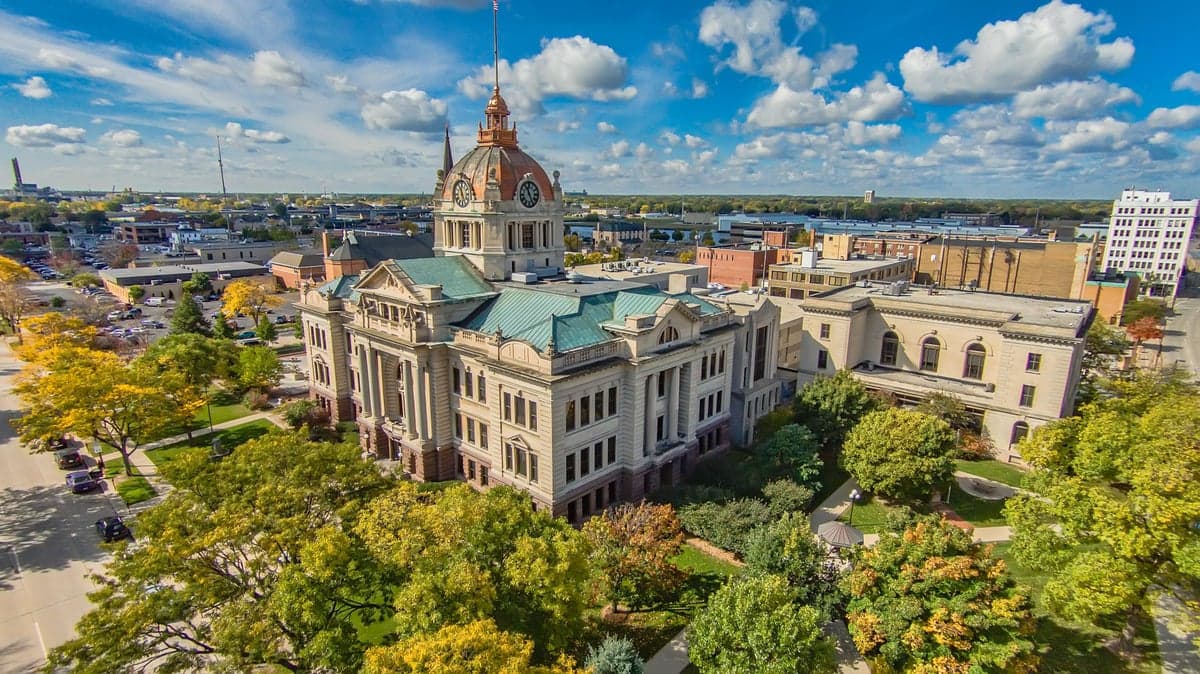
Photo: Wikipedia
Political ClimatePolitical Climate in Brown County
Showing district-level results — no local-only data available.
Local Political AnalysisPolitical Analysis of Brown County
Brown County leans reliably Republican with a Cook Partisan Voting Index (PVI) of R+8, meaning its typical presidential election margin is eight points more Republican than the national average. This stands in stark contrast to the state of Wisconsin as a whole, which carries a PVI of EVEN—a pure swing state that flipped from Trump to Biden by fewer than 21,000 votes in 2020. Locally, the county has been trending redder over the past decade, driven largely by suburban growth in the Green Bay metro area and a steady influx of conservative-leaning retirees and families from more rural parts of the state. The shift isn't dramatic, but it's consistent: in 2012, Mitt Romney carried Brown County by about 7 points; in 2020, Donald Trump won it by nearly 12.
How it compares
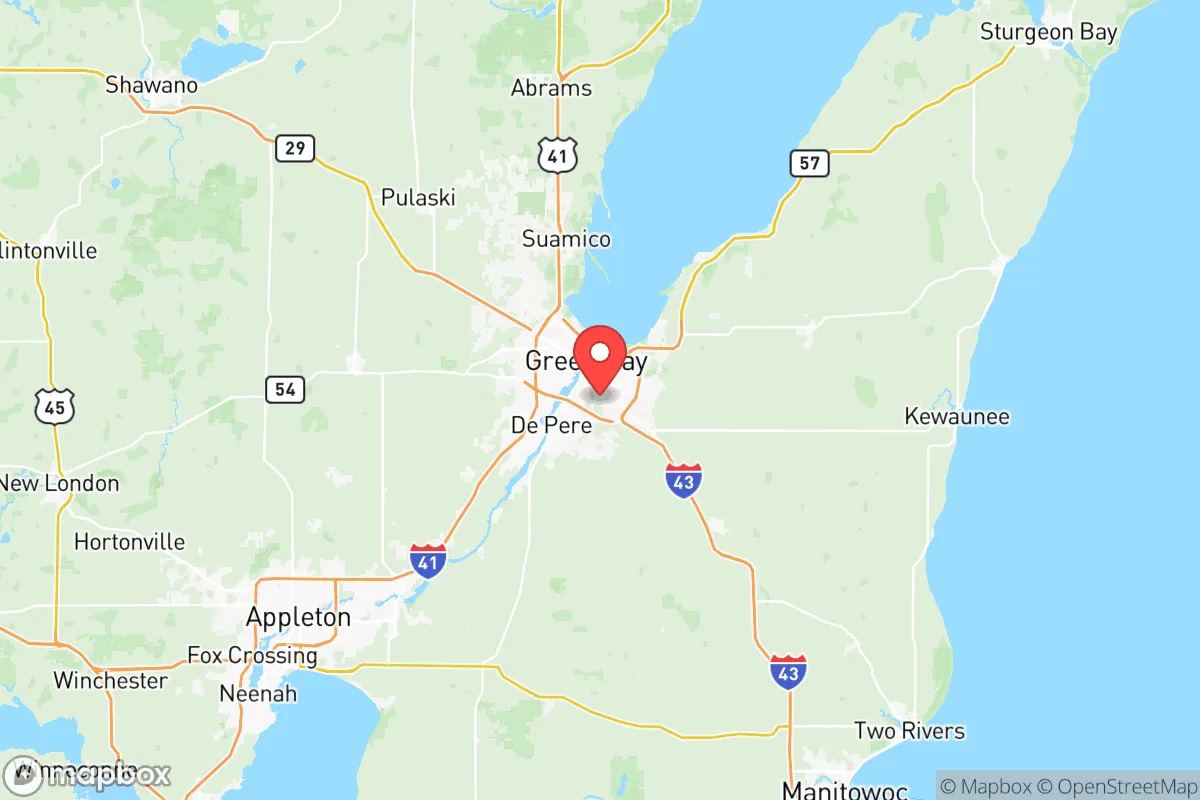
The gap between Brown County and Wisconsin's statewide PVI—a full 8 points—is one of the largest in the state for a county of its size. While Wisconsin as a whole is a toss-up, Brown County is a solid Republican stronghold, similar to Waukesha County in the southeast but with a more moderate flavor. Within the county, the political geography is surprisingly varied. The city of Green Bay itself is a blue island, with precincts near the university and downtown consistently voting Democratic by 10-15 points. Suburbs like Howard and Suamico lean Republican but are more competitive, often swinging by just a few points in local races. Meanwhile, towns like Wrightstown and Denmark in the southern and eastern parts of the county are deep red, routinely voting 65-70% Republican. The swing precincts are in the fast-growing western suburbs—places like Ashwaubenon and Hobart—where new housing developments are drawing a mix of young families and older conservatives, making those areas the ones to watch in future elections.
What this means for residents
For conservative residents, Brown County offers a comfortable political environment where their views are the local norm. Republican candidates for county board, state legislature, and Congress (the county is split between the 8th and 6th districts) typically win easily, and conservative policy priorities—like lower taxes and Second Amendment rights—are reflected in local governance. For liberal residents, the picture is more nuanced. While they are a clear minority countywide, they hold significant influence in Green Bay proper, where the city council and mayor's office have been Democratic for years. This creates a dynamic where progressive policies on housing, transit, and climate are debated seriously in the city, but often stall at the county level. The practical effect is that a liberal resident can find community and representation in the city, but may feel out of step in the broader county, especially in school board or county board elections where turnout is lower and the conservative base is more reliable.
One cultural distinction worth noting is the influence of the Green Bay Packers—the team is a near-universal unifier that transcends political divides. Tailgate conversations rarely turn to partisan bickering, and local politics often takes a backseat to game-day talk. That said, the county's political lean does shape policy in tangible ways: property taxes are among the lowest in the state for a metro area, and the county government has been slow to adopt mask mandates or other public health measures favored by liberals. For a new resident, the key takeaway is that Brown County is a place where conservative values dominate the levers of power, but the presence of a blue city and a strong local identity around the Packers keeps the political temperature cooler than in many other R+8 counties across the Midwest.

State Political ClimatePolitical Climate in Wisconsin
State Political AnalysisPolitical Environment in the State
Wisconsin is the ultimate swing state, with a Cook PVI of EVEN that perfectly captures its knife-edge political balance. Over the past 20 years, the state has shifted from a reliably blue-leaning battleground to a true toss-up, decided by razor-thin margins in every major election since 2000. The dominant coalitions are a near 50-50 split between a resurgent conservative base concentrated in the WOW counties (Waukesha, Ozaukee, Washington) and the rural north and west, versus a Democratic stronghold in Dane County (Madison) and Milwaukee, with Green Bay and the Driftless Region acting as perennial swing zones.
Urban vs. rural divide
The political map of Wisconsin is a study in geographic polarization. Milwaukee County and Dane County (Madison) together deliver roughly 40% of the Democratic vote statewide, with Madison’s university-fueled progressivism and Milwaukee’s union and minority-heavy base creating deep blue islands. In contrast, the Waukesha County suburbs west of Milwaukee are the GOP’s engine room, routinely producing margins of 60-70% for Republican candidates. The rural Northwoods and Driftless Region have trended hard right over the past decade, while the Fox Valley (Appleton, Oshkosh, Green Bay) remains the ultimate swing region — culturally conservative but economically populist, often deciding statewide races by a few thousand votes. The divide isn’t just urban vs. rural; it’s also suburban vs. exurban, with fast-growing exurbs like Mukwonago and Hartland pulling the state rightward.
Policy environment
Wisconsin’s policy environment reflects its divided government. The state has a flat income tax rate of 4.4% (down from 7.65% in 2011), with a sales tax of 5% that local municipalities can add up to 1.5%. Property taxes are above the national median but capped by state levy limits. The regulatory posture is generally business-friendly, with right-to-work legislation passed in 2015 and Act 10 (2011) effectively ending collective bargaining for most public employees. Education policy is a patchwork: the state has a robust school choice program (vouchers and charter schools) in Milwaukee and Racine, but rural and suburban districts remain traditional. Healthcare is dominated by two major systems (Aurora and UW Health), and the state did not expand Medicaid under the Affordable Care Act, leaving a coverage gap. Election laws are moderately restrictive: voter ID is required, same-day registration is allowed, and absentee voting was expanded during COVID but later rolled back. The state’s nonpartisan redistricting commission was eliminated in 2011, leading to heavily gerrymandered legislative maps that have kept the GOP in control of the Assembly and Senate even when Democrats win statewide.
Recent policy direction
The last five years have seen Wisconsin lurch rightward on several fronts. In 2023, the legislature passed a constitutional amendment requiring photo ID to vote, which voters approved overwhelmingly. The same year, a permitless carry law for concealed firearms was enacted, making Wisconsin one of 25 states with constitutional carry. On education, the state expanded its school choice program to universal eligibility in 2023, allowing any family to use public funds for private or religious schools. Abortion policy remains in flux: a 1849 law banning abortion was effectively blocked by a court ruling in 2023, but the legislature has not repealed it, leaving the issue to the courts. Property rights saw a win for landowners with the passage of a private property rights protection act in 2022, limiting eminent domain for private development. On voting, the state has tightened absentee ballot drop box rules and banned private funding of election administration. The overall direction is toward lower taxes, expanded gun rights, school choice, and election security, while social issues like abortion remain contested in the courts.
Civil unrest & political movements
Wisconsin has been a flashpoint for political movements on both sides. The 2020 Kenosha protests and the subsequent Kyle Rittenhouse trial drew national attention, exposing deep divides over policing, self-defense, and racial justice. The 2020 election integrity controversy remains a live issue, with a Republican-ordered investigation (the Michael Gableman probe) finding no evidence of widespread fraud but fueling ongoing distrust. On the left, the Wisconsin Democratic Party has become a well-funded organizing machine, while the right has seen the rise of grassroots groups like the Wisconsin Institute for Law & Liberty (WILL) and the MacIver Institute, which litigate and advocate for conservative policies. Immigration politics are relatively muted compared to border states, but the issue flares up around sanctuary city debates in Madison and Milwaukee. The state has no sanctuary policies, and local law enforcement generally cooperates with ICE. The overall climate is one of high political engagement but low physical unrest — most conflict plays out in courtrooms and at the ballot box rather than in the streets.
Projection
Over the next 5-10 years, Wisconsin is likely to remain a toss-up, but with a slight rightward tilt driven by demographic shifts. In-migration from Illinois (especially from Chicago and its suburbs) is bringing more conservative-leaning retirees and remote workers to the WOW counties and the Driftless Region, while the Fox Valley is growing modestly. Dane County and Milwaukee are also growing, but at a slower pace. The state’s aging population (median age 40.5) favors the GOP, while the growing Hispanic population (now 7% of the state) could shift the calculus if Democrats turn out that vote. The wild card is the 2024 redistricting — if the state Supreme Court (now with a 4-3 liberal majority) orders new legislative maps, the GOP’s structural advantage could erode, making the state more competitive at all levels. For a new resident, expect a decade of continued political gridlock, with major policy changes only happening when one party wins trifecta control — which has happened only twice since 2010.
For a conservative relocating to Wisconsin, the practical takeaway is that the state offers a favorable tax and regulatory environment, strong gun rights, and school choice, but you’ll need to navigate a deeply divided political landscape where your vote truly matters. For a liberal, the state provides strong urban communities and a vibrant civic culture, but you’ll face a legislature that is structurally tilted against your priorities. Either way, Wisconsin is a place where politics is personal — your neighbors will have strong opinions, and every election feels like it could tip the balance of the country.
* Values derived from national, state, county, city and local statistics and may differ in a specific area. Last updated: 2026-08-23T03:15:36.000Z
Narrative content on this page is AI-generated and may contain mistakes. Verify any details that matter before acting on them.
ReloMaps may earn a commission from affiliate links at no extra cost to you.

