Photo: Wikipedia
Demographics of Brown County
Affluence Level in Brown County
A middle-class area roughly in line with national averages across income, home values, education, and employment.
People of Brown County
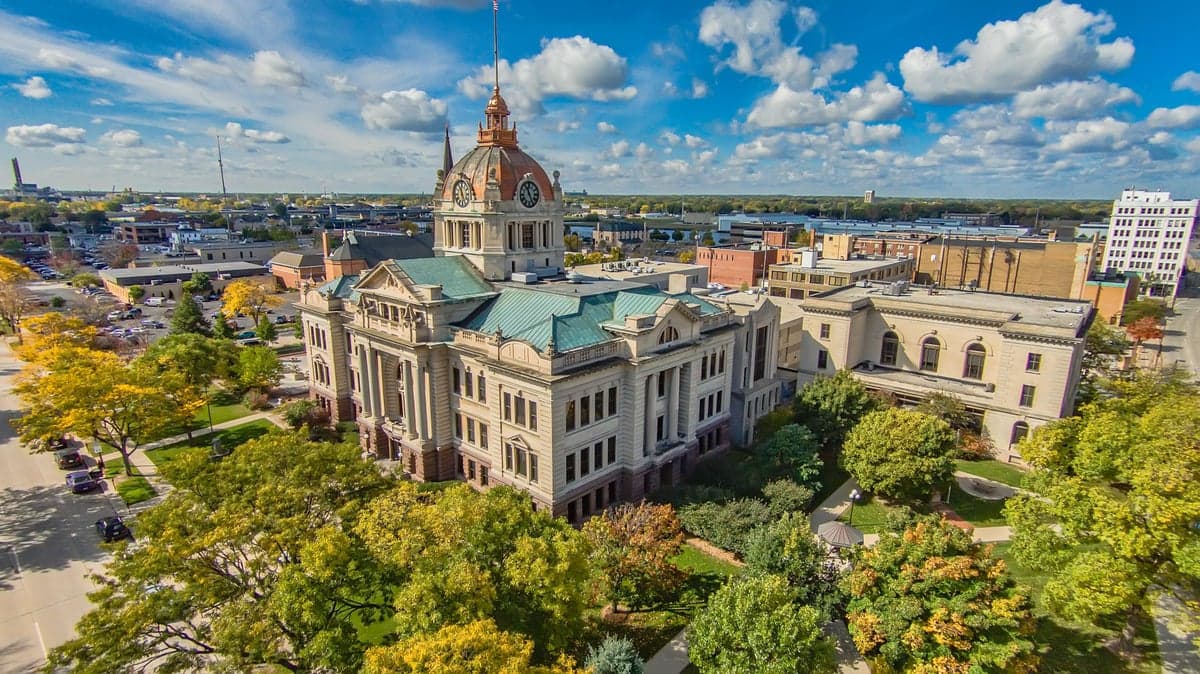
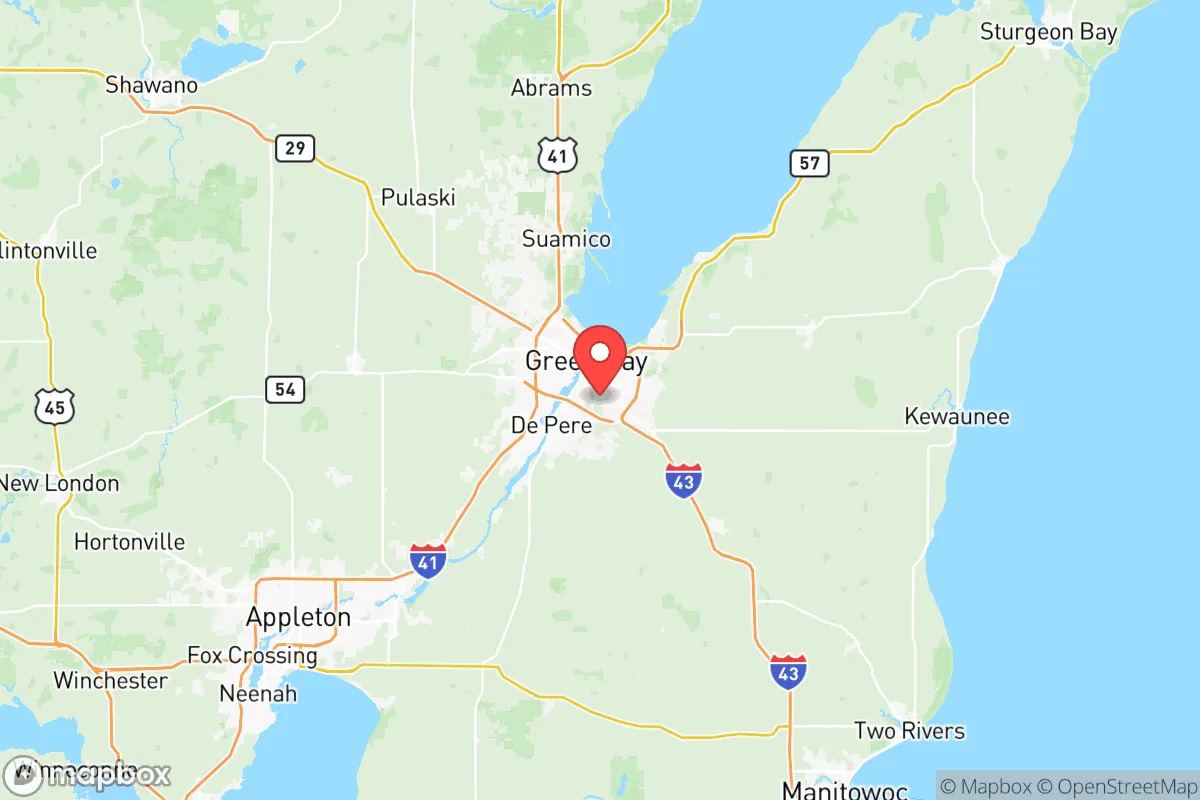
Brown County, Wisconsin, is home to 269,425 residents, making it the fourth-most populous county in the state, anchored by the city of Green Bay. The population is predominantly White (78.1%), with a growing Hispanic community (10.0%) and smaller Black (2.5%), East/Southeast Asian (2.5%), and Indian subcontinent (0.7%) populations. The county’s identity is shaped by its deep-rooted Catholic and Lutheran heritage, a strong manufacturing and agricultural economy, and a civic culture centered on the Green Bay Packers, with a foreign-born share of just 3.1% reflecting a historically low-immigration region that is now slowly diversifying.
Settlement & growth (pre-1960)
Before European settlement, the area now known as Brown County was the homeland of the Menominee and Ho-Chunk nations, with the Menominee ceding the land through treaties in the 1830s. The first permanent European settlers were French-Canadian fur traders and missionaries who established a presence at Green Bay as early as the 1630s, making it one of the oldest continuous European settlements in the Upper Midwest. The French built a mission and trading post at the mouth of the Fox River, and the region remained a sparsely populated fur-trade outpost under French and then British control until the United States took possession after the War of 1812.
The major wave of American settlement began in the 1830s and 1840s, driven by the opening of the Erie Canal and the promise of cheap farmland. Yankees from New England and New York poured into the county, founding the city of Green Bay and the village of De Pere along the Fox River. These early settlers established the county’s first sawmills, gristmills, and commercial districts, and they brought with them a tradition of town-meeting governance and Protestant Congregationalism. By the 1850s, the population had reached roughly 10,000, and the county was a thriving lumber and shipping hub.
The second major wave came from Germany and Belgium between 1850 and 1890. German immigrants, many from Pomerania and West Prussia, settled in the rural townships of Eaton, Holland, and Morrison, where they established dairy farms and Catholic parishes. Belgian immigrants, fleeing poverty and religious conflict, concentrated in the town of Champion and the village of Brussels in the county’s northeastern corner, creating a distinct Walloon-speaking enclave that persists in local surnames and festivals today. By 1900, Brown County’s population had grown to over 40,000, with Germans and Belgians forming the largest ethnic blocs alongside the Yankee founding stock.
The third wave, from 1900 to 1960, was dominated by Polish and Irish immigrants who settled in Green Bay’s working-class neighborhoods, particularly on the city’s east side near the packing plants and paper mills. The rise of the meatpacking industry—anchored by the Green Bay Packing Company (later part of the Oscar Mayer empire) and the Fort Howard Paper Company—drew thousands of laborers from Eastern and Southern Europe. The city of Green Bay grew from 23,000 in 1900 to over 62,000 by 1950, while the village of Allouez and the town of Howard developed as streetcar suburbs for the growing middle class. The county’s population reached 125,000 by 1960, overwhelmingly White and native-born, with a strong Catholic majority and a Republican-leaning but union-friendly political culture.
Modern era (post-1965)
The 1965 Hart-Cellar Act had a modest impact on Brown County compared to coastal or Sun Belt regions. The foreign-born share remained below 4% through the 1990s, and the county’s demographic change came primarily through domestic migration and natural increase. The most significant shift began in the 1980s and accelerated after 2000: a wave of Hispanic immigration, primarily from Mexico and Puerto Rico, drawn by jobs in meatpacking, food processing, and construction. These newcomers settled in Green Bay’s near-east side and in the village of Ashwaubenon, where they established Spanish-language churches, grocery stores, and community organizations. The Hispanic share of the county’s population rose from under 2% in 1990 to 10.0% by the 2020 census, making it the fastest-growing demographic group.
Domestic migration since 1970 has been dominated by suburbanization. Families moved outward from Green Bay’s central city into the villages of Howard, Suamico, and Hobart, where new subdivisions and big-box retail followed the expansion of State Highway 29 and Interstate 41. The village of Hobart, in particular, grew from a rural crossroads of 1,500 in 1990 to over 10,000 by 2020, attracting both White middle-class families and a growing Hmong community. The Hmong population, which arrived as refugees from Laos after the Vietnam War, concentrated in Green Bay’s west side and in De Pere, where they established a vibrant cultural center and annual New Year celebrations. The East/Southeast Asian share of the county’s population now stands at 2.5%, with the Hmong forming the largest subgroup.
The Black population, at 2.5%, is smaller than in many Midwestern counties of similar size, but it has grown steadily since 2000, driven by African American families relocating from Chicago and Milwaukee for lower housing costs and manufacturing jobs. The Indian subcontinent population, at 0.7%, is a more recent arrival, concentrated among professionals working in healthcare and information technology at Bellin Health, Prevea Health, and the Green Bay Packers organization. The county’s college-educated share, at 32.4%, is slightly below the national average but rising, as the University of Wisconsin-Green Bay and Northeast Wisconsin Technical College expand their programs and attract out-of-area students.
The future
Brown County is projected to become more diverse over the next two decades, though at a slower pace than the nation as a whole. The Hispanic population is expected to grow to 15-18% by 2040, driven by higher birth rates and continued immigration from Mexico and Central America, with new enclaves forming in Ashwaubenon and the town of Lawrence. The East/Southeast Asian population, led by the Hmong community, is likely to grow to 4-5% as families reunite and second-generation residents remain in the area. The White population, while still the majority, is aging and declining in absolute numbers, as younger White residents move to larger metro areas for career opportunities.
The county’s cultural identity is evolving from a homogeneous, Catholic-and-Lutheran, Packers-centric community into a more pluralistic one, though the pace of change is gradual and often contested. Suburbanization will continue to push development north and west, with Suamico and Hobart absorbing most new housing construction. The foreign-born share, currently 3.1%, may rise to 5-6% by 2040, still low by national standards but significant for a region that was 98% White as recently as 1980. The key demographic challenge will be retaining young adults, as the county’s population skews older than the state average and many college graduates leave for the Twin Cities or Chicago.
For someone moving in now, Brown County offers a stable, family-oriented community with a strong economy, low crime rates, and a cost of living below the national average. The population is becoming more diverse, but the pace is slow enough that the county retains its traditional Midwestern character—neighborly, conservative-leaning, and deeply rooted in local institutions. The next 10-20 years will see a gradual shift toward a more multicultural society, but the county’s identity will remain anchored in its German, Belgian, and Polish heritage, with the Packers as the enduring civic glue.

* Values derived from national, state, county, city and local statistics and may differ in a specific area. Last updated: 2026-08-23T03:15:36.000Z
Narrative content on this page is AI-generated and may contain mistakes. Verify any details that matter before acting on them.
ReloMaps may earn a commission from affiliate links at no extra cost to you.

