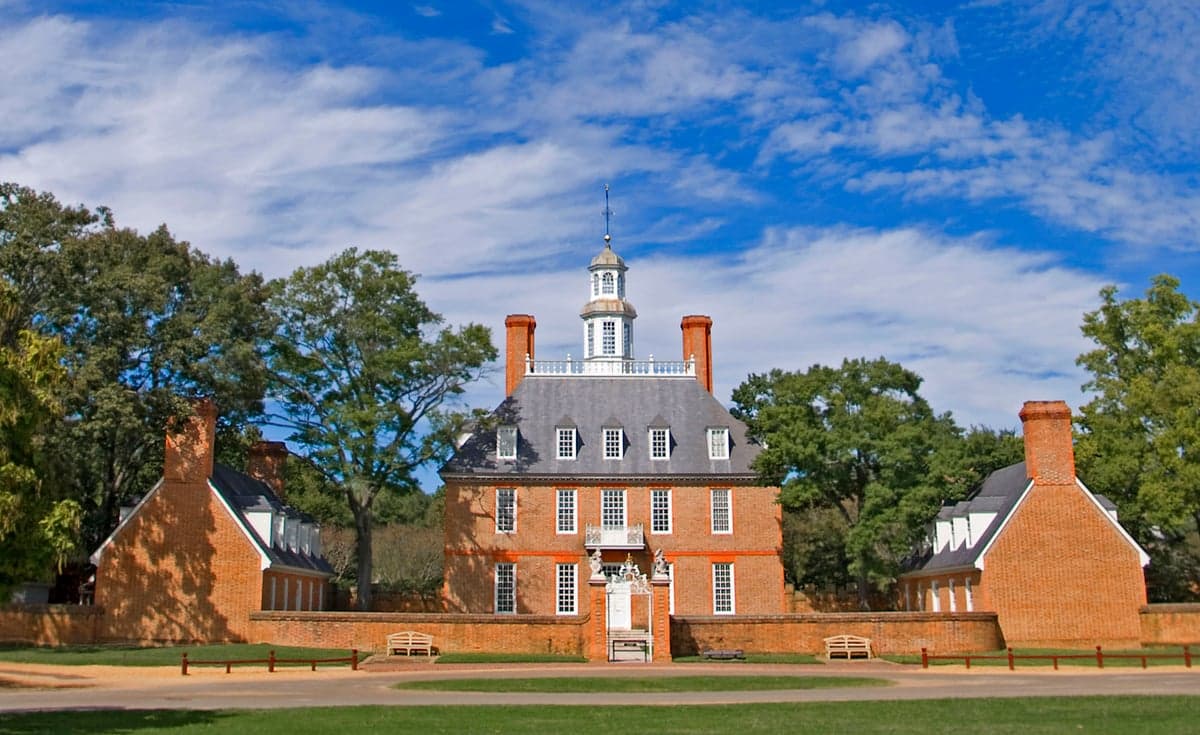
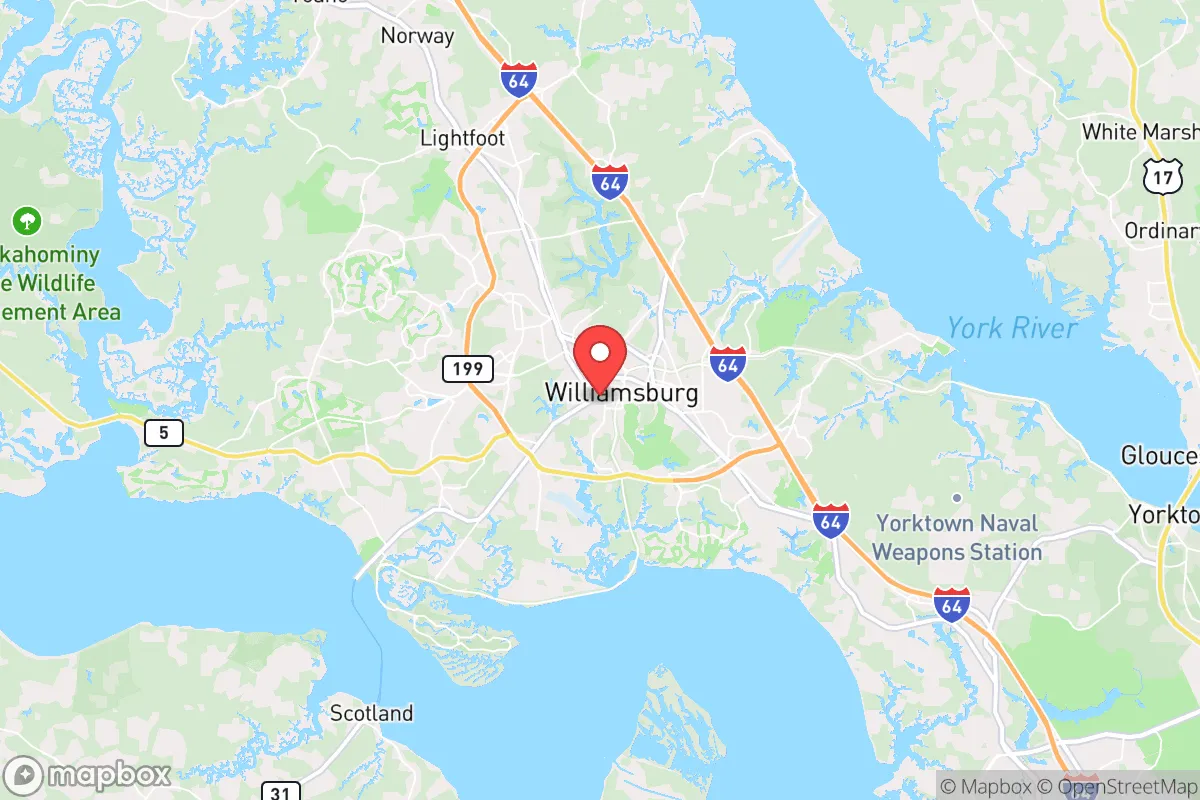
Photo: Wikipedia
Personal Sovereignty in Williamsburg, VA
Viable for self-reliance. Generally workable, though some barriers may limit total independence.
What does Personal Sovereignty tell us?
Personal Sovereignty measures your capacity for self-reliance and independence with minimal government friction. Higher scores mean fewer barriers between you and the way you want to live... but it assumes you have the space you need and good neighbors.
What does this tell us?
Personal Sovereignty measures your capacity for self-reliance and independence with minimal government friction. Higher scores mean fewer barriers between you and the way you want to live... but it assumes you have the space you need and good neighbors.
State Policy
Energy independence: Importer (20% of energy produced in-state)
Personal Liberty
Homesteading

Personal Liberty Analysis
Williamsburg, Virginia, presents a complex picture for those prioritizing personal sovereignty. While the city itself leans left politically and is governed by a city council that has shown a willingness to expand local regulatory power, the surrounding James City County and the broader state of Virginia offer a more nuanced environment for those seeking to minimize government overreach. The key for a survivalist or prepper mindset is understanding that Williamsburg is not a libertarian enclave, but a place where strategic choices about where you live within the area and how you engage with local governance can preserve a significant degree of autonomy. The state-level legal framework provides some strong protections, but local ordinances and the cultural climate in the city proper can create friction for those who value maximum personal freedom.
Tax burden and regulatory posture in Williamsburg and surrounding counties
Virginia's overall tax burden is moderate compared to other states, but the specific locality you choose within the Williamsburg area matters greatly. The city of Williamsburg itself has a higher real estate tax rate, currently around $0.87 per $100 of assessed value, which funds a robust municipal apparatus that includes active code enforcement and zoning regulations. In contrast, James City County's rate is lower, approximately $0.84 per $100, and York County's is even more favorable at roughly $0.72 per $100. For someone seeking to minimize the financial footprint of government, living outside the city limits is a clear strategic advantage. The state income tax is a flat 5.75%, which is a fixed cost, but there is no state-level tax on Social Security benefits, a small concession for retirees. On the regulatory front, Virginia is not a "right-to-work" state in the sense of having a right-to-work law on the books (it does, but it's a statutory provision, not a constitutional amendment), and the state has seen a steady creep of business regulations. However, for the individual, the most immediate regulatory burden comes from local building codes and land-use ordinances, which are more restrictive inside the city than in the unincorporated county areas. The overall posture is one of a state that respects property rights in theory but allows localities to impose significant restrictions, meaning the smart move is to choose a county jurisdiction with a more hands-off approach.
Self-defense and gun law specifics in Virginia's legal landscape
Virginia is a "shall-issue" state for concealed handgun permits, meaning that if you meet the statutory requirements—including a background check and completing a firearms safety course—the state must issue the permit. This is a solid foundation for the right to self-defense. However, the state has moved in a restrictive direction in recent years, notably with the passage of a "one-handgun-a-month" purchase limit and universal background checks for all firearm sales, including private transactions. These laws, passed by a Democratic-controlled legislature, represent a clear erosion of the pre-2020 legal environment. Open carry is generally legal for anyone who can legally possess a firearm, but localities can restrict it in certain public buildings and at permitted events. For the survivalist, the key concern is that the state government has demonstrated a willingness to tighten gun laws, and future political shifts could bring further restrictions, such as a ban on certain semi-automatic firearms or magazine capacity limits. The legal landscape for self-defense is currently functional but fragile, and anyone relocating here should be prepared to engage in the political process to defend these rights. Castle Doctrine and "stand your ground" principles are not codified in Virginia statute in the same way as in states like Florida or Texas; instead, the state relies on common law and a "duty to retreat" in public spaces if safely possible, which is a weaker legal protection for those who must defend themselves outside the home.
Self-reliance and homesteading viability: lot sizes, zoning, and off-grid feasibility
For those seeking to live off-grid or engage in serious homesteading, Williamsburg city is a non-starter. The city's zoning code is designed for suburban density, with minimum lot sizes typically around 6,000 to 10,000 square feet, and there are strict prohibitions on keeping livestock, raising chickens (beyond a limited number of hens with a permit), or installing alternative energy systems without extensive permitting. The city also has a strong code enforcement division that actively pursues complaints about "unkept" properties, which can include gardens that look too wild or visible composting systems. The surrounding counties offer more room. James City County has agricultural zoning districts where minimum lot sizes are 3 acres or more, and keeping chickens, goats, and even a few head of cattle is generally permissible. York County is similar but has more suburban-style subdivisions with homeowners' associations (HOAs) that can impose even stricter rules than the county itself. Off-grid feasibility is limited by state building codes that require connection to the electrical grid for new construction, though solar panels with net metering are allowed. Rainwater collection is legal for non-potable uses, but well water and septic systems are heavily regulated by the health department. The realistic path to self-reliance here is not full off-grid living, but rather a suburban homestead on a few acres in the county, where you can grow a significant portion of your own food, keep some animals, and reduce your dependence on the grid, all while staying within the legal framework.
Personal liberties: parental rights, medical autonomy, speech, and property
Parental rights in Virginia are generally strong under state law, with a legal presumption that parents have the right to direct the upbringing, education, and healthcare of their children. However, the state has seen increasing tension over school curriculum and medical decisions. The Williamsburg-James City County school division has adopted policies that include comprehensive sex education and support for LGBTQ+ student groups, which has led to clashes with parents who want more control over what their children are taught. Medical autonomy, particularly regarding vaccine mandates and emergency treatments, has been a flashpoint. Virginia does not have a broad religious or philosophical exemption to school vaccine requirements, and during the COVID-19 pandemic, the state imposed some of the strictest mandates in the South. For those concerned about medical freedom, this is a significant red flag. Free speech is protected under the First Amendment, but the city of Williamsburg has a history of enforcing noise ordinances and parade permit requirements that can be used to limit public demonstrations. Property rights are generally respected, but the state's "eminent domain" laws allow for takings for economic development, and the city has used this power in the past for redevelopment projects. The overall environment is one where personal liberties are legally protected on paper but are subject to constant political pressure and local interpretation, requiring vigilance and civic engagement to maintain.
In the broader context of the United States, Williamsburg and its surrounding area offer a middle-ground level of personal sovereignty. It is not a haven like rural Idaho or New Hampshire, where the culture and laws are more aligned with maximum individual autonomy. Nor is it a high-control environment like California or New York. The strategic advantage here is the ability to choose your jurisdiction—city versus county—and to leverage the state's relatively strong property rights and gun laws while being aware of the political trends that could erode them. For a survivalist or prepper, the area is viable if you are willing to live outside the city limits, engage in local politics, and accept that you are operating in a state that is politically divided and could shift further toward government control. The sovereignty you can achieve here is earned through careful location selection and active defense of your rights, not granted by a uniformly freedom-friendly legal environment.

* Values derived from national, state, county, city and local statistics and may differ in a specific area. Last updated: 2026-04-23T04:44:28.000Z
Narrative content on this page is AI-generated and may contain mistakes. Verify any details that matter before acting on them.
ReloMaps may earn a commission from affiliate links at no extra cost to you.

