Photo: Wikipedia
Demographics of Williamsburg, VA
Affluence Level in Williamsburg, VA
A middle-class area roughly in line with national averages across income, home values, education, and employment.
People of Williamsburg, VA
Today, Williamsburg, Virginia is a city of 15,564 residents defined by its dual identity as a historic tourism hub and a college town anchored by William & Mary. The population is notably older and more educated than the national average, with 48.5% holding a bachelor's degree or higher, and the city leans politically moderate to conservative in local elections. Its racial makeup is 67.3% White, 15.2% Black, 8.0% Hispanic, 5.3% East/Southeast Asian, and 1.4% Indian (subcontinent), with a foreign-born share of just 5.0% — lower than Virginia's statewide average of about 13%. The city's character is shaped by a stable, long-resident White and Black population, a growing Hispanic and Asian presence, and a transient student body that tempers the overall demographic profile.
How the city was settled and grew
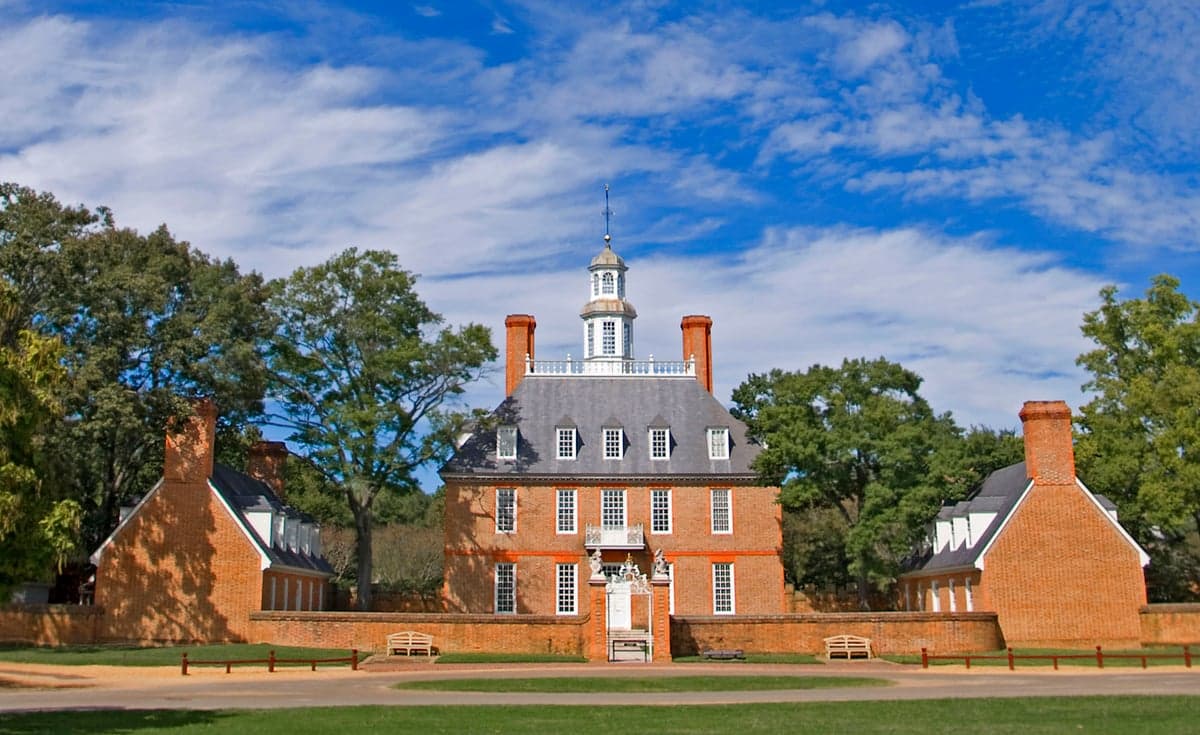
Williamsburg was founded in 1632 as Middle Plantation, a fortified settlement on high ground between the James and York Rivers, and became the capital of the Virginia Colony in 1699. The original population was overwhelmingly English, with enslaved Africans arriving as early as the 1660s to work on tobacco plantations that ringed the town. By the Revolutionary era, Williamsburg's population was roughly half White and half Black, the latter almost entirely enslaved. The historic Palace Green and Duke of Gloucester Street areas were the center of colonial governance and commerce, while enslaved laborers lived in quarters behind the grand homes and on outlying plantations like those in what is now the College Creek neighborhood. After the capital moved to Richmond in 1780, Williamsburg entered a long economic decline, and its population stagnated at around 1,500 for much of the 19th century. The founding of the College of William & Mary (1693) and the establishment of Eastern State Hospital (1773) provided steady institutional employment, but the city remained a small, sleepy county seat until the 20th century. The restoration of Colonial Williamsburg, beginning in 1926, brought a wave of skilled craftsmen, architects, and hospitality workers, many of whom settled in the Midtown and Quarterpath areas. This project also displaced much of the existing Black community from the historic core, pushing families into the Bray School area and the Norge community just outside city limits.
Modern era (post-1965)
The 1965 Hart-Cellar Act had a modest direct impact on Williamsburg, as the city's foreign-born population remains low at 5.0%. However, the post-1965 period saw significant domestic in-migration driven by the expansion of William & Mary, the growth of Busch Gardens (opened 1975), and the rise of the greater Hampton Roads metro area. White professionals from the Northeast and Midwest moved into newer subdivisions like Kingsmill and Ford's Colony, drawn by the historic ambiance and quality of life. The Black population, which had been concentrated in the Bray School and Norge areas, began a slow suburbanization into James City County, where newer housing was more affordable. The Hispanic population grew from near zero in 1970 to 8.0% today, driven by construction and hospitality jobs; many families settled in the Quarterpath area and along the Route 60 corridor. The East/Southeast Asian population (5.3%) is largely tied to William & Mary's academic and research sectors, with Chinese, Korean, and Vietnamese families clustering in the Kingsmill and Midtown neighborhoods. The Indian-subcontinent population (1.4%) is similarly professional and concentrated near the college. Notably, the city's White share has declined from roughly 80% in 1990 to 67.3% today, while the Hispanic and Asian shares have risen steadily, though from a low base.
The future
Williamsburg's population is likely to continue its slow diversification, but the pace will be constrained by high housing costs and limited rental stock. The city's foreign-born share, at 5.0%, is unlikely to rise dramatically because the local economy is dominated by tourism and education — sectors that offer many low-wage service jobs but few entry points for immigrant entrepreneurs. The Hispanic and East/Southeast Asian communities are growing but remain small enough that they are assimilating into the broader White and Black social fabric rather than forming distinct ethnic enclaves. The Black population, at 15.2%, is stable but aging, with younger Black families increasingly choosing James City County or York County over the city proper. The White population, while still the majority, is also aging, and the city's overall population has been flat to slightly declining since 2010. The next 10-20 years will likely see Williamsburg become slightly more Hispanic and Asian, but it will remain a predominantly White and Black city with a strong college-town character. The major demographic shift will be generational: as the large baby-boom cohort ages out, younger professionals and families — drawn by the schools and historic appeal — will gradually replace them, keeping the city's educational attainment high and its political leanings moderate.
For someone moving to Williamsburg today, the city offers a stable, safe, and highly educated environment with a strong sense of place. The population is not undergoing rapid transformation; instead, it is slowly diversifying while retaining its historic core of White and Black residents. Newcomers will find a community that values tradition, education, and civic engagement, with distinct neighborhoods — from the historic core to the golf-course subdivisions of Kingsmill — offering different lifestyles within a compact, walkable city. The bottom line: Williamsburg is becoming slightly more diverse and slightly more professional, but it remains a fundamentally stable, conservative-leaning college town where change comes gradually and the past is always present.

* Values derived from national, state, county, city and local statistics and may differ in a specific area. Last updated: 2026-04-23T04:44:28.000Z
Narrative content on this page is AI-generated and may contain mistakes. Verify any details that matter before acting on them.
ReloMaps may earn a commission from affiliate links at no extra cost to you.

