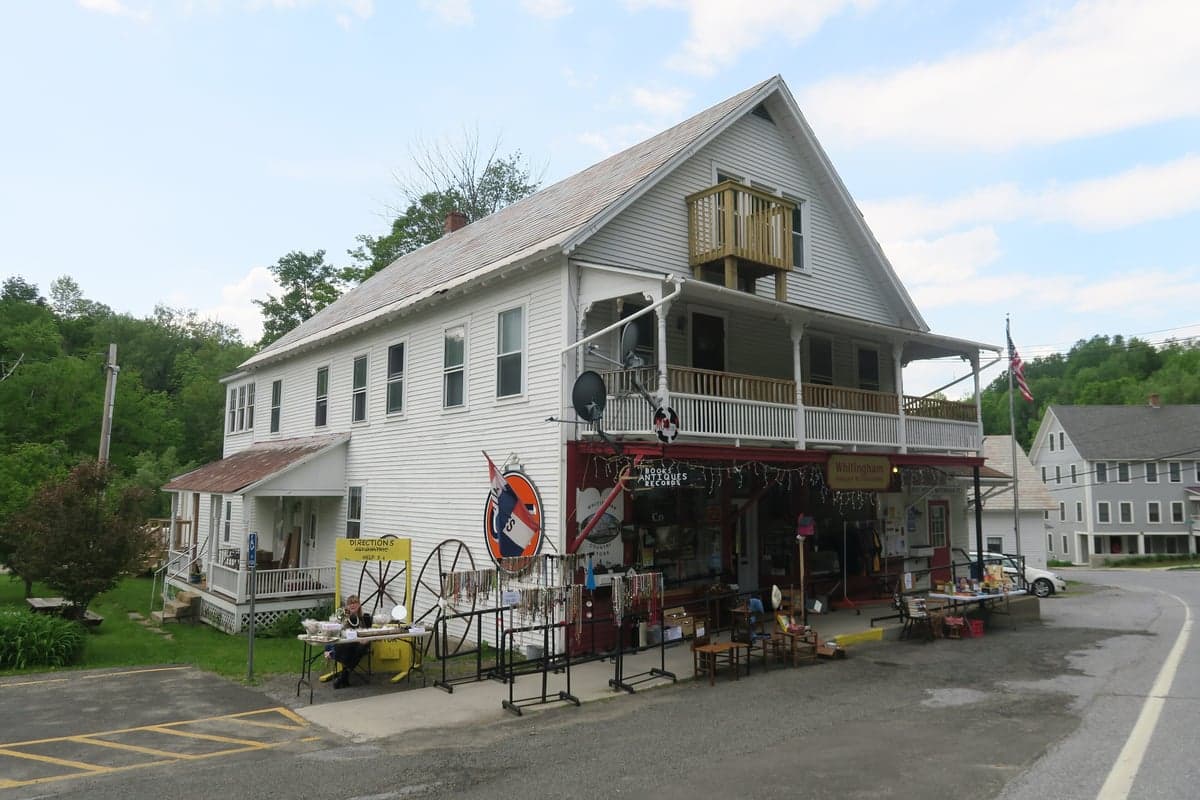
Photo: Wikipedia
Personal Sovereignty in Whitingham, VT
Moderate friction. Expect trade-offs in some aspect of personal liberty and independence.
What does Personal Sovereignty tell us?
Personal Sovereignty measures your capacity for self-reliance and independence with minimal government friction. Higher scores mean fewer barriers between you and the way you want to live... but it assumes you have the space you need and good neighbors.
What does this tell us?
Personal Sovereignty measures your capacity for self-reliance and independence with minimal government friction. Higher scores mean fewer barriers between you and the way you want to live... but it assumes you have the space you need and good neighbors.
State Policy
Energy independence: Importer (15% of energy produced in-state)
Personal Liberty
Homesteading

Personal Liberty Analysis
Whitingham, Vermont, offers a notably high degree of personal sovereignty within a state that balances progressive social policies with a deep-rooted tradition of local control and individual liberty. For the freedom-minded individual or family, the town’s rural character, low population density (roughly 1,300 residents), and limited local government footprint create an environment where autonomy is the default rather than the exception. While Vermont’s state-level tax and regulatory framework is more involved than in some other New England states, Whitingham’s practical, hands-off local governance and access to unincorporated land provide a meaningful buffer, making it a viable option for those prioritizing self-reliance and independence.
Tax burden and regulatory posture in Whitingham
Vermont’s state-level tax burden is among the highest in the nation, and Whitingham residents are subject to that reality. The state levies a progressive income tax with rates from 3.35% to 8.75%, and a statewide property tax that funds education, averaging roughly $1.50 to $2.00 per $100 of assessed value depending on the town’s Common Level of Appraisal. However, Whitingham’s local municipal property tax rate is relatively modest compared to more developed towns in southern Vermont, and the town has no local sales tax (Vermont has a 6% state sales tax). The regulatory posture at the local level is light: Whitingham has no zoning bylaws for most of its land area, meaning that building permits are generally not required for residential structures outside of state-level Act 250 jurisdiction (which applies to larger developments). This absence of local zoning is a significant advantage for those seeking to build a home, workshop, or outbuilding without bureaucratic delays. The town’s selectboard and planning commission operate with a minimalist approach, and residents report that interactions with town officials are straightforward and informal. For a conservative-leaning audience, the key trade-off is clear: you accept Vermont’s state-level tax and regulatory structure, but you gain near-total local autonomy over your property and daily affairs.
Self-defense and gun law specifics in Vermont
Vermont is one of the most firearm-friendly states in the Northeast, and Whitingham reflects that culture. The state has constitutional carry (permitless carry for both open and concealed firearms) for anyone 21 or older who can legally possess a firearm. No permit, training, or registration is required to purchase or carry a handgun, rifle, or shotgun. There is no state-level assault weapons ban, no magazine capacity restrictions, and no waiting period for firearm purchases. Private sales between individuals are legal without background checks. Vermont also has a strong Castle Doctrine and Stand Your Ground law, codified in 12 V.S.A. § 1753, which states that a person has no duty to retreat before using deadly force if they are in a place where they have a legal right to be and reasonably believe it is necessary to prevent death or great bodily harm. This applies to both home and public spaces. The state does have a “red flag” law (Extreme Risk Protection Order) that allows law enforcement to petition a court to temporarily remove firearms from an individual deemed a risk, but enforcement in rural areas like Whitingham is rare and typically only in cases of documented mental health crises. For the self-defense-minded individual, Whitingham offers a legal environment that is as permissive as any in the region, with no local ordinances that further restrict state law. The practical reality is that firearms are a common part of rural life here, and the culture is one of personal responsibility rather than government oversight.
Self-reliance and homesteading viability in Whitingham
Whitingham is a strong candidate for those seeking a self-reliant, homesteading lifestyle. The town’s land is predominantly rural, with many parcels of 5 to 50+ acres available at prices significantly lower than in southern Vermont’s more tourist-heavy areas (e.g., $3,000–$8,000 per acre for raw land, depending on access and topography). The absence of local zoning means that building a primary residence, barn, greenhouse, or workshop is largely unregulated at the town level, though you must comply with state building codes for structural safety and the state’s wastewater system permit (required for any dwelling with plumbing). Off-grid living is feasible: many properties have no municipal water or sewer, and residents commonly use private wells, septic systems, and alternative energy sources. Solar panels are common, and net metering is available through Green Mountain Power, though the state’s interconnection process is moderately bureaucratic. Wood stoves are the primary heat source for many homes, and firewood is abundant. Raising livestock (chickens, goats, pigs, cattle) is unrestricted by local ordinance, and the town’s agricultural soils and pastureland support small-scale farming. The Vermont Right to Farm law protects agricultural activities from nuisance lawsuits, which is a meaningful legal shield for homesteaders. The main constraint is the short growing season (USDA Zone 4b/5a) and the cost of state-level permits for any significant earthwork or wetland disturbance. Overall, Whitingham offers a high degree of practical self-reliance, with the primary barriers being the state’s environmental regulations rather than local ones.
Personal liberties in Whitingham: parental rights, medical autonomy, speech, and property
Vermont’s state-level policies on personal liberties are a mixed bag for a conservative-leaning audience. On the positive side, parental rights are broadly respected in practice, though the state has no explicit “parental bill of rights” statute. The town’s small school (Whitingham Elementary School, part of the Windham Southwest Supervisory Union) is community-oriented, and parents report a high degree of involvement and influence over curriculum and activities. The state does mandate comprehensive sex education and has policies supporting LGBTQ+ inclusion, which some conservative families may find objectionable, but local school boards have some discretion in implementation. Medical autonomy is a more complex picture: Vermont has no state-level vaccine mandate for adults, but it does require certain immunizations for school attendance (with medical and philosophical exemptions available). The state has legalized assisted suicide (Patient Choice and Control at End of Life Act) and recreational cannabis, which may be at odds with some personal values. However, there are no local ordinances in Whitingham that restrict medical choices, and the town has no hospital or large clinic, meaning medical decisions are largely private. Free speech is protected under the Vermont Constitution, which has its own strong free speech clause, and there are no local noise or signage ordinances that would restrict expressive activity. Property rights are robust: the absence of zoning means you can use your land for most lawful purposes without needing a variance or special permit. The state’s Act 250 does apply to commercial developments over 10 acres or 10,000 square feet of impervious surface, but for a single-family homestead or small home business, it is rarely triggered. The main property-rights concern is the state’s current use tax program (Use Value Appraisal), which offers tax breaks for forest and agricultural land but requires a 30-year commitment and can result in penalties if the land is developed. For most homesteaders, this is a voluntary program that can be avoided. Overall, Whitingham provides a high degree of personal liberty in daily life, with the primary friction points being state-level mandates on education and healthcare that may not align with all personal beliefs.
In the broader context of New England, Whitingham stands out as a pocket of strong personal sovereignty, particularly for those who value local control over their property, self-defense rights, and the ability to live off-grid or homestead. The trade-off is accepting Vermont’s state-level tax burden and certain progressive social policies, but the town’s minimal local government, absence of zoning, and rural character mean that most of the day-to-day decisions affecting your life remain firmly in your hands. For a conservative-leaning individual or family seeking a balance between state-level services and local autonomy, Whitingham offers a compelling, if not perfect, environment for personal freedom and self-reliance.

* Values derived from national, state, county, city and local statistics and may differ in a specific area. Last updated: 2026-10-16T21:51:01.000Z
Narrative content on this page is AI-generated and may contain mistakes. Verify any details that matter before acting on them.
ReloMaps may earn a commission from affiliate links at no extra cost to you.

