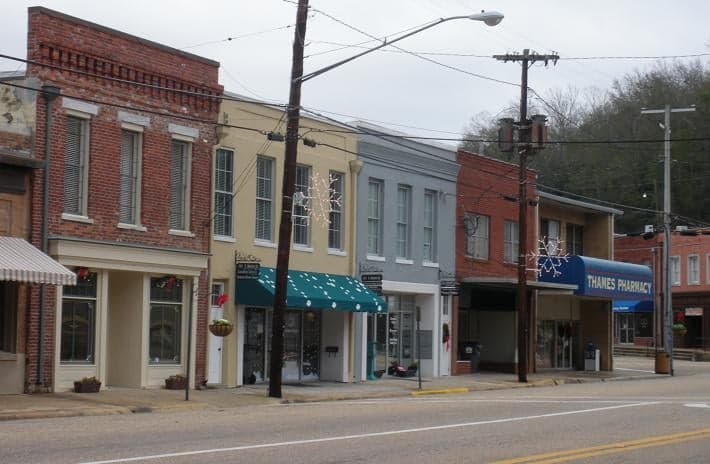
Photo: Wikipedia
Political ClimatePolitical Climate in Wetumpka, AL
District shown is the primary district for this city’s centroid. Cities may span multiple districts.
Local Political AnalysisPolitical Analysis of Wetumpka, AL
Wetumpka, Alabama, sits in a bit of a political pocket that doesn’t fully match the rest of the state. While Alabama as a whole has trended heavily Republican for decades, Wetumpka’s Cook Partisan Voting Index (PVI) of D+5 tells a different story—it’s one of the few places in the state where Democrats still hold a measurable edge in partisan voting patterns. That D+5 rating means the area leans about five points more Democratic than the national average, which is a stark contrast to the deep-red reputation of Alabama. Over the past decade, though, that lean has been slowly shifting rightward, mirroring broader suburban trends across the South, but it hasn’t flipped entirely. If you’re looking at the trajectory, Wetumpka is still a place where local races can be genuinely competitive, even as national politics pull it toward the GOP.
How it compares
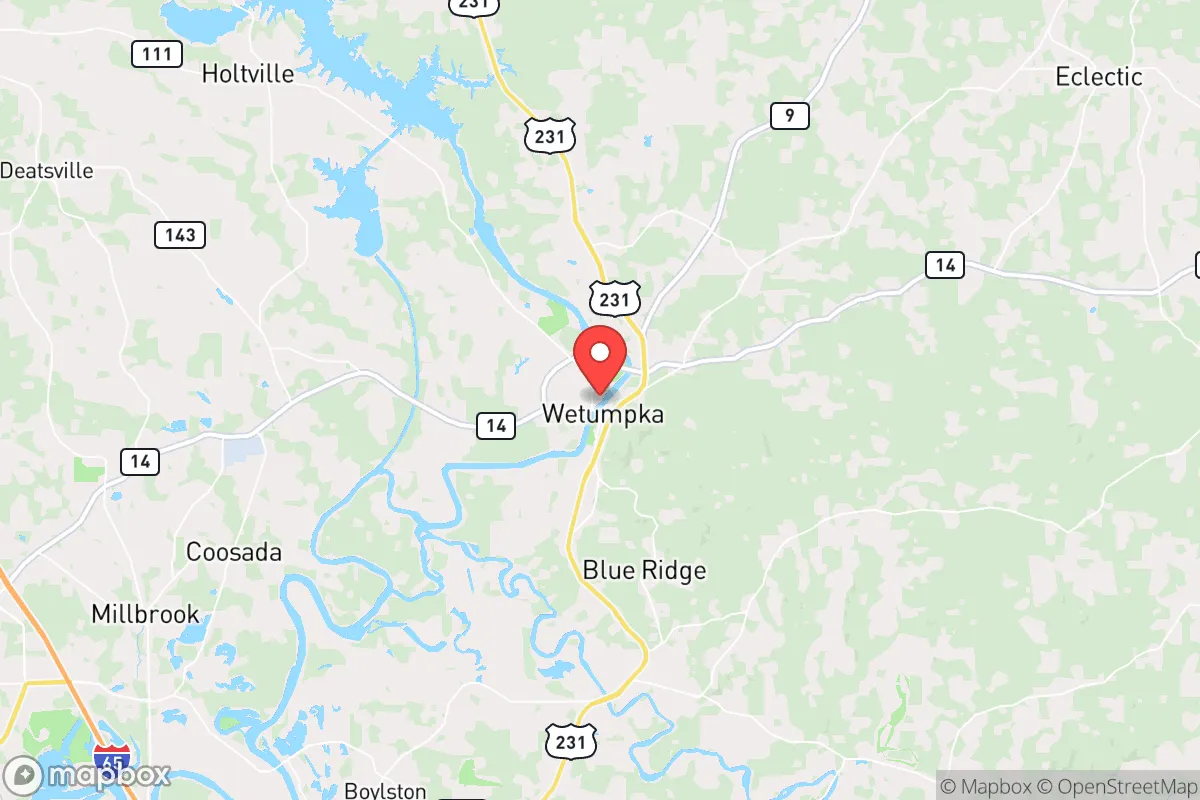
Compared to the rest of Alabama, Wetumpka is an outlier. The state’s Cook PVI is unknown in the data, but practically every county outside of the Black Belt and a few urban pockets votes Republican by double digits. For context, nearby Montgomery—just 15 miles south—has a D+15 PVI, making it a Democratic stronghold in the region. Drive 20 minutes north to Prattville, and you’re in R+20 territory, a reliably conservative suburb. Wetumpka sits right in the middle of that spectrum, closer to Montgomery’s lean than Prattville’s. This creates a unique dynamic: the city itself often votes more Democratic than its surrounding Elmore County, which leans Republican. In practice, that means a state representative from Wetumpka might need to appeal to both union workers at the nearby Hyundai plant and retirees from the Lake Martin area, a balancing act you don’t see in most Alabama towns.
What this means for residents
For conservative residents, Wetumpka’s D+5 lean doesn’t mean they’re out of step—it means they’re part of a genuine two-party conversation. Local elections, like city council or school board races, are often decided by a few hundred votes, so your vote actually carries weight. You’ll find plenty of conservative churches and gun clubs, and the county-level politics lean your way. For liberal residents, the D+5 rating offers a rare comfort zone in Alabama. You’re not isolated like you might be in a deep-red town; there’s a visible Democratic presence, especially among younger families moving from Montgomery for better schools. That said, state-level policies—like abortion restrictions or tax cuts—still reflect the statewide GOP majority, so don’t expect local lean to shield you from Alabama’s broader conservative laws. The practical takeaway: Wetumpka is one of the few places in the state where a Democrat can win a local office without it being a shock, but it’s not a liberal haven.
Culturally, Wetumpka’s political split shows up in subtle ways. The annual “Blueberry Festival” feels more like a community potluck than a partisan rally, but you’ll hear different conversations at the coffee shop on Main Street versus the bait shop near the Coosa River. The city’s recent growth—new subdivisions and a downtown revitalization—has brought in folks from both sides, keeping the political temperature moderate. Unlike Montgomery, where politics can feel like a battleground, Wetumpka’s D+5 lean fosters a “live and let live” vibe. You won’t see many yard signs for national races, but local issues like school funding or riverfront development get real debate. For anyone moving here, the key is that Wetumpka offers a middle ground in a polarized state—a place where your vote matters, but your neighbor’s opinion probably won’t ruin the barbecue.

State Political ClimatePolitical Climate in Alabama
State Political AnalysisPolitical Environment in the State
Alabama is one of the most reliably Republican states in the country, with a deep-red lean that has only solidified over the past two decades. The state hasn’t voted for a Democratic presidential candidate since 1976, and in 2024, Donald Trump carried it by roughly 30 points. The dominant coalition is a mix of rural white evangelicals, suburban conservatives, and a growing number of pro-business transplants, while the Democratic base is largely concentrated among Black voters in the Black Belt and a handful of urban centers. Over the last 10-20 years, the shift has been away from the old “Yellow Dog Democrat” tradition and toward a near-total GOP lock on state government, with Republicans holding supermajorities in both legislative chambers and every statewide elected office.
Urban vs. rural divide
The political map of Alabama is a stark study in contrasts. The state’s few urban centers—Birmingham, Montgomery, and Huntsville—are Democratic-leaning islands in a sea of red. Jefferson County (Birmingham) and Montgomery County reliably vote blue, driven by large Black populations and younger, college-educated professionals. Huntsville, home to the Redstone Arsenal and a booming aerospace sector, is more of a purple-to-light-red area; its tech and defense workers lean conservative on economics but are socially moderate. Meanwhile, the rural Black Belt counties like Lowndes and Wilcox are overwhelmingly Democratic due to their majority-Black populations, but they have low turnout and little statewide influence. The rest of the state—places like Mobile, Auburn, Tuscaloosa, and the sprawling exurbs of Baldwin County—is deeply Republican. Baldwin County, in particular, has become a GOP stronghold, with Fairhope and Daphne attracting conservative retirees and families fleeing higher-tax states. The rural-urban divide isn’t just about population density; it’s also racial and economic, with white rural voters driving the GOP’s margins and Black urban voters forming the Democratic base.
Policy environment
Alabama’s policy environment is a textbook example of a low-tax, low-regulation, socially conservative state. There’s no state income tax on retirement income, and the state’s combined state and local sales tax rate—averaging around 9-10%—is among the highest in the nation, which hits lower-income residents hardest. Property taxes are famously low, often under 0.5% of assessed value, a major draw for relocators. The regulatory posture is business-friendly, with right-to-work laws and minimal zoning restrictions outside major cities. Education policy is a mixed bag: the state has a school choice program (the Alabama Accountability Act) that provides tax credits for private school tuition, but public school funding per pupil remains near the bottom nationally. Healthcare is a flashpoint: Alabama has not expanded Medicaid under the Affordable Care Act, leaving a coverage gap for roughly 300,000 low-income adults. Election laws are restrictive by national standards, with strict voter ID requirements, limited early voting, and no online voter registration. The state also has a near-total abortion ban, with no exceptions for rape or incest, and a permitless carry law for firearms.
Recent policy direction
Over the past five years, Alabama has moved aggressively to the right on a broad range of issues. In 2023, the legislature passed a near-total abortion ban (the Human Life Protection Act), which took effect after the Dobbs decision, with no exceptions for rape or incest—only to save the mother’s life. On gun rights, the state enacted permitless carry (constitutional carry) in 2022, allowing anyone 21 or older to carry a concealed firearm without a permit. Parental rights have been a major focus: the 2022 “Don’t Say Gay” law (the Alabama Vulnerable Child Protection Act) bans classroom instruction on sexual orientation or gender identity in K-5, and a 2024 law requires schools to get parental consent before a student can use a name or pronoun that doesn’t match their birth certificate. On education, the state launched a universal school choice program in 2024 (the CHOOSE Act), offering education savings accounts worth up to $7,000 per child for private school or homeschooling expenses. Property rights saw a boost with a 2023 law limiting the ability of local governments to regulate short-term rentals. On voting, the legislature tightened absentee ballot rules in 2023, requiring a copy of a photo ID and banning ballot drop boxes. On the tax front, the state cut the grocery tax from 4% to 3% in 2023, but the overall tax burden remains regressive. There’s been no movement on medical marijuana (a 2021 law was effectively blocked by court challenges) or gambling expansion, despite repeated attempts.
Civil unrest & political movements
Alabama has a long history of civil rights activism, and that legacy continues in more muted forms today. The Black Lives Matter protests in 2020 were significant in Birmingham and Montgomery, with large, peaceful marches and some clashes with police, but they didn’t reach the intensity seen in larger cities. The state has seen a rise in organized conservative activism, particularly around school board meetings and library boards, where groups like Moms for Liberty have pushed for book bans and curriculum restrictions. Immigration politics are less heated than in border states, but there’s a vocal anti-immigrant faction that pushed for the 2011 HB 56 law, one of the strictest in the nation, though most of its provisions were struck down in court. There’s no sanctuary city movement to speak of; local law enforcement generally cooperates with ICE. Election integrity controversies have been minimal compared to states like Georgia or Arizona, though the 2020 election saw some local GOP officials question results in Mobile and Baldwin counties. Secession or nullification rhetoric is rare but surfaces occasionally among far-right groups, usually in the context of federal gun control or environmental regulations. A new resident would notice the strong presence of Confederate monuments and memorials, though some have been removed in Birmingham and Montgomery after legal battles.
Projection
Over the next 5-10 years, Alabama is likely to stay deeply red, but the nature of that red is shifting. In-migration from states like California, Illinois, and New York is accelerating, particularly to the Gulf Coast (Baldwin County) and the Huntsville metro. These newcomers tend to be fiscally conservative but socially moderate, which could soften the state’s hardline positions on issues like abortion and LGBTQ rights over time. However, the rural Black Belt is losing population, and the white working-class base is aging, so the GOP will need to adapt to retain its margins. The Democratic Party’s best hope is in growing the vote in Jefferson County and Montgomery while flipping a few suburban districts around Birmingham and Huntsville. Expect continued fights over school choice, Medicaid expansion (which could gain traction as rural hospitals close), and gambling legalization. The state’s tax structure is unlikely to change much, but there’s growing pressure to reduce the sales tax on groceries and find new revenue for infrastructure. A new resident moving in now should expect a state that remains culturally conservative but is slowly becoming more diverse and economically dynamic, with the political battles increasingly fought in the suburbs rather than the countryside.
For a new resident, the bottom line is this: Alabama offers a low-cost, low-regulation environment with a strong sense of community and tradition, but it comes with a specific set of political and cultural expectations. If you’re conservative, you’ll find your values reflected in state law and local governance. If you’re liberal, you’ll need to be comfortable living in a minority political position, though you’ll find like-minded communities in Birmingham, Montgomery, and parts of Huntsville. The state’s trajectory is toward more school choice, less regulation, and continued cultural battles over education and healthcare. It’s a place where your vote matters less in statewide races but can make a real difference in local school board and city council elections. Come for the low taxes and slower pace; stay for the genuine hospitality, but know that the politics are as deep-rooted as the red clay.
* Values derived from national, state, county, city and local statistics and may differ in a specific area. Last updated: 2026-09-27T14:07:47.000Z
Narrative content on this page is AI-generated and may contain mistakes. Verify any details that matter before acting on them.
ReloMaps may earn a commission from affiliate links at no extra cost to you.

