Photo: Wikipedia
Demographics of Wetumpka, AL
Affluence Level in Wetumpka, AL
A below-average socioeconomic profile. Incomes, home values, and educational attainment trail the U.S., with higher poverty and unemployment.
People of Wetumpka, AL
The people of Wetumpka, Alabama today number 7,182, forming a community that is predominantly White (64.2%) with a significant Black or African American population (29.8%) and small but growing East/Southeast Asian (2.5%) and Hispanic (1.4%) communities. The city’s character is notably stable and family-oriented, with a low foreign-born share of just 0.8% and a college-educated rate of 21.5%, reflecting a population rooted in local industry and government employment. Distinctive identity markers include a strong connection to the Coosa River and a civic pride centered on historic downtown and the nearby Fort Toulouse-Fort Jackson Park, which anchors the area’s Native American and early American heritage.
How the city was settled and grew
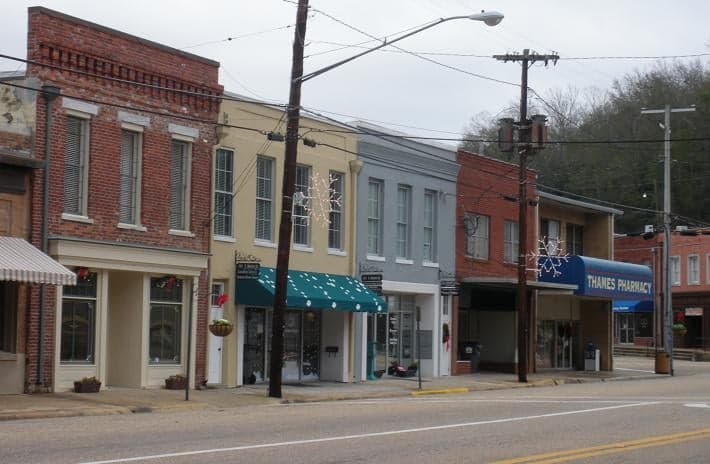
Wetumpka’s human history begins with the Creek (Muscogee) people, who established towns along the Coosa River centuries before European contact. The name “Wetumpka” itself is derived from the Creek words for “rumbling waters,” referencing the river’s rapids. After the Creek War of 1813–1814 and the subsequent forced removal of most Native Americans via the Trail of Tears, European-American settlers moved in, drawn by the fertile river bottomlands and the potential for water-powered industry. The city was officially incorporated in 1834, and its early growth was fueled by the cotton trade and the construction of a bridge across the Coosa River in 1836. The historic Downtown Wetumpka district, centered on Bridge Street, was the original commercial and residential hub, where merchants, lawyers, and skilled tradesmen built homes and businesses. A second wave of growth came after the Civil War, when freed African Americans established their own communities, notably in the South Wetumpka area, which became a center of Black-owned farms, churches, and schools. The arrival of the railroad in the late 19th century spurred further expansion, with the North Wetumpka neighborhood developing around the depot and attracting workers to the city’s new cotton gins and lumber mills. By the mid-20th century, Wetumpka’s population remained small and overwhelmingly rural in character, with a White majority and a sizable Black minority concentrated in the southern part of town.
Modern era (post-1965)
The post-1965 period brought significant demographic and spatial changes to Wetumpka. The passage of the Voting Rights Act and the end of legal segregation led to greater political representation for Black residents, though the city’s neighborhoods remained largely divided along racial lines. The South Wetumpka area continued as the historic core of the Black community, while White families increasingly moved to newer subdivisions on the city’s northern and eastern edges. The construction of the Wetumpka High School campus and the expansion of State Route 14 in the 1970s and 1980s spurred suburban-style growth, with the Coosa Pines and Lake Ridge neighborhoods attracting middle-class families—both White and Black—seeking larger lots and newer homes. The 1990s and 2000s saw a modest influx of East/Southeast Asian residents, primarily Vietnamese and Filipino families, who settled in the East Wetumpka area near the expanding industrial parks. These families were drawn by employment at the nearby Hyundai Motor Manufacturing plant in Montgomery (opened 2005) and at local suppliers. The Hispanic population, though still small at 1.4%, began to grow in the 2010s, with families moving into rental properties in the West Wetumpka corridor along US-231, working in construction, landscaping, and the service industry. The city’s overall population has remained remarkably stable, growing only modestly from roughly 5,700 in 2000 to 7,182 today, reflecting limited new housing construction and a low rate of in-migration.
The future
Wetumpka’s population is projected to remain relatively stable over the next 10–20 years, with slow growth driven primarily by natural increase (births minus deaths) rather than large-scale in-migration. The city’s demographic profile is likely to become slightly more diverse, as the East/Southeast Asian and Hispanic shares continue to inch upward from their current low bases, though the foreign-born share is expected to remain below 2%. New residential development is concentrated in the Coosa River Estates and Riverchase subdivisions on the city’s northern fringe, which are attracting a mix of White and Black families from the Montgomery metro area seeking lower taxes and a smaller-town feel. The historic Downtown Wetumpka district is experiencing a modest revival, with new apartments and townhomes drawing younger professionals and empty-nesters, but this is unlikely to dramatically alter the city’s overall demographic composition. The cultural identity of Wetumpka is evolving from a strictly biracial (White/Black) community toward a more multi-ethnic one, though the pace of change is slow. For someone moving in now, Wetumpka offers a stable, family-oriented environment with a strong sense of local history, but those seeking rapid growth or high diversity should look to larger cities in the region.
Wetumpka is becoming a quietly stable, slowly diversifying small city where the historic Black and White communities remain the dominant forces, and newer East/Southeast Asian and Hispanic families are gradually finding a place. For a relocating individual or family, this means a community with deep roots, low crime, and a strong civic identity, but also one where change comes at a deliberate, unhurried pace.

* Values derived from national, state, county, city and local statistics and may differ in a specific area. Last updated: 2026-09-27T14:07:47.000Z
Narrative content on this page is AI-generated and may contain mistakes. Verify any details that matter before acting on them.
ReloMaps may earn a commission from affiliate links at no extra cost to you.

