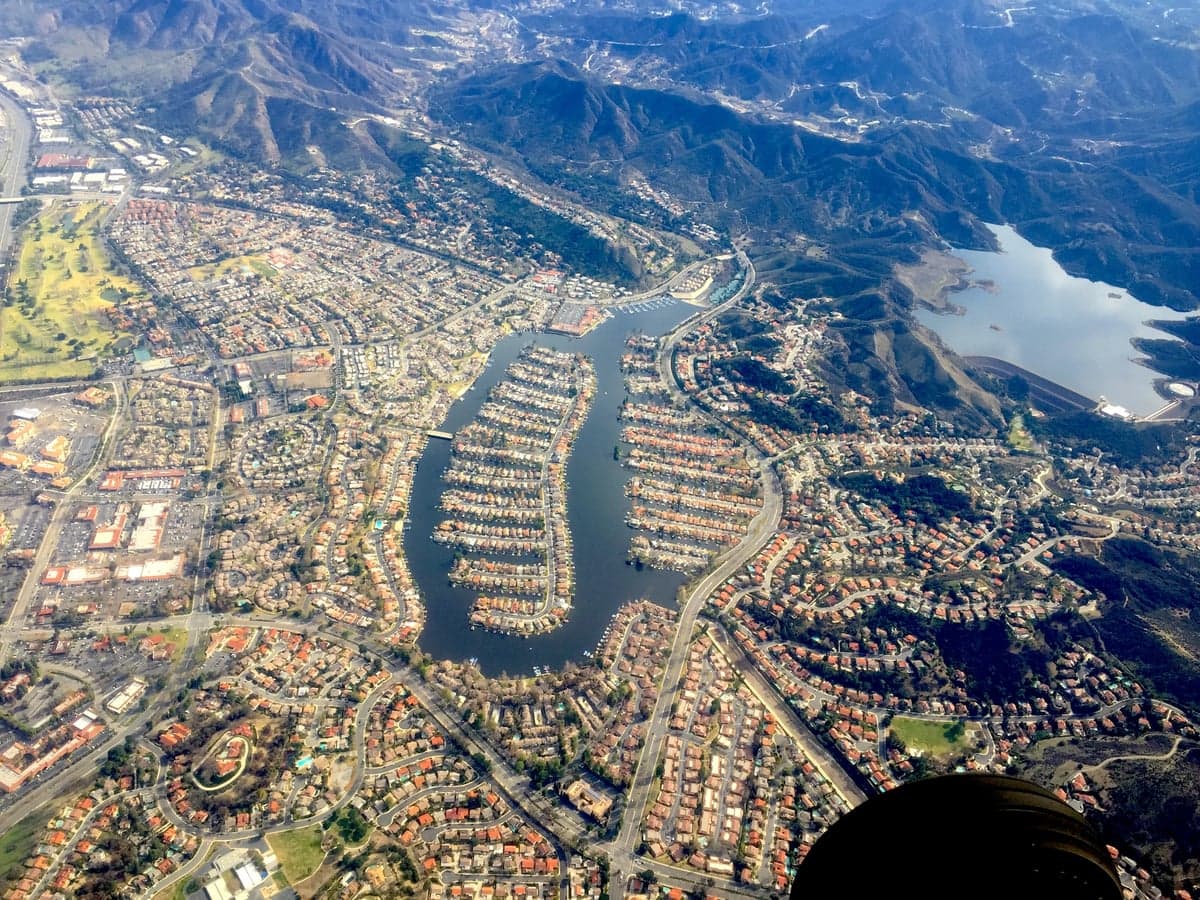
Photo: Wikipedia
Political ClimatePolitical Climate in Westlake Village, CA
District shown is the primary district for this city’s centroid. Cities may span multiple districts.
Local Political AnalysisPolitical Analysis of Westlake Village, CA
Westlake Village leans clearly Democratic, with a Cook PVI of D+8, meaning the area votes about eight points more Democratic than the national average. That puts it in line with the broader Conejo Valley trend, though it’s noticeably more moderate than nearby coastal enclaves like Malibu or Santa Monica. The political trajectory here has been a slow but steady shift leftward over the past two decades, mirroring what’s happened across most of Ventura County’s bedroom communities.
How it compares
If you’re coming from deep-blue Los Angeles proper, Westlake Village will feel slightly more balanced. The D+8 rating is roughly equivalent to the overall political makeup of California, which has a Cook PVI of D+13 — so Westlake Village is about five points more conservative than the state as a whole. That gap shows up in local elections and even in casual conversation. You’ll find a meaningful Republican minority here, especially among older residents and those who moved from the San Fernando Valley in the 1980s and 1990s. Drive ten minutes east to Agoura Hills or Oak Park and you’ll see similar dynamics; head north to Simi Valley, and the political landscape flips hard to the right, with a strong GOP presence that’s been a reliable counterweight in county politics for years.
What this means for residents
For liberal residents, the D+8 lean means you’re in friendly territory — Democratic candidates generally carry the city, and local school board and city council races tend to attract progressive-leaning candidates. You’ll see yard signs for statewide Democratic measures and candidates, and the local Democratic club is active. For conservative residents, it’s not a hostile environment, but you’ll be in the minority. The practical effect is that Republican voters here often focus on state-level races or find their political community in nearby Simi Valley or Thousand Oaks’ more conservative pockets. What’s notable is the lack of political friction in daily life — this is a wealthy, highly educated area where people tend to keep politics polite, and local issues like water supply, traffic on the 101, and school funding dominate more than partisan battles.
What this means for residents
In practice, the D+8 lean shapes local policy in subtle ways. The city council tends to prioritize quality-of-life issues — open space preservation, the Westlake Village Golf Course, and maintaining the low-density, upscale character of the city — over ideological agendas. Property taxes and housing policy are the big flashpoints, with most residents favoring the status quo on development. The political culture here is pragmatic, not activist. You won’t see the intense street-level organizing you’d find in West Hollywood or even parts of Thousand Oaks. Instead, the politics play out in homeowners’ association meetings and city council chambers, where the tone is measured and the focus is on maintaining property values and the area’s reputation as one of the safest, most desirable suburbs in Southern California.
One cultural distinction worth noting: Westlake Village’s political identity is tied to its geography and demographics — it’s a planned community that grew around the 101 corridor, attracting executives, entrepreneurs, and entertainment industry professionals. That mix creates a fiscally moderate, socially tolerant atmosphere. The city has no real history of political radicalism on either side; it’s a place where the two parties coexist, and the biggest political fights are usually about local land use, not national culture wars. As the region’s demographics continue to shift younger and more diverse, the D+8 lean is likely to hold or drift slightly further left, but don’t expect Westlake Village to become a progressive stronghold anytime soon — its DNA is too deeply rooted in suburban comfort and financial pragmatism.

State Political ClimatePolitical Climate in California
State Political AnalysisPolitical Environment in the State
California is a solidly Democratic state, with Democrats holding every statewide office and a supermajority in the state legislature, but the political reality is far more layered than the raw registration numbers suggest. The state’s 2024 presidential margin was roughly +17 for the Democratic nominee, a slight tightening from the +29 margin in 2020, reflecting a rightward drift among working-class voters even as the coastal elite suburbs remain deeply blue. Over the last two decades, the state has moved from a competitive battleground (it was the decisive state in the 2000 and 2004 elections) to a one-party dominant system, yet the internal friction between the mega-metros and the vast interior is the real story for anyone considering a move here.
Urban vs. rural divide
The political map of California is essentially a story of two states. The coastal corridor—from San Francisco down through Los Angeles and San Diego—generates the overwhelming majority of Democratic votes, powered by dense urban cores, tech wealth, and a large unionized service sector. These metros are the engine of the state’s progressive politics, and they dominate the legislature simply by population weight. However, the interior is a different country politically. The Central Valley, anchored by cities like Fresno and Bakersfield, has been trending Republican for a decade, driven by oil and agriculture workers who feel alienated from coastal environmental regulations. In the 2022 gubernatorial race, Fresno County went Republican by 12 points, a stark contrast to the statewide result. The Inland Empire, including Riverside and San Bernardino, is the true bellwether—these exurban counties flipped from blue to red in the 2020s as working-class homeowners reacted to housing costs and crime. Even in the deep blue Bay Area, there are distinct pockets like Pleasanton and Livermore in Alameda County that vote Republican at the local level, offering a suburban foothold for conservatives who want proximity to tech jobs without the San Francisco political culture.
Policy environment
California’s policy environment is defined by its tax code and regulatory density. The state has a progressive income tax with a top marginal rate of 13.3% for earners above $1 million, and a 7.25% statewide sales tax that local jurisdictions routinely push above 10%. Property taxes are capped at 1% of assessed value under Proposition 13, but the effective burden grows as homes are reassessed upon sale—a hidden cost for new buyers. The regulatory posture is the most aggressive in the nation: the California Environmental Quality Act (CEQA) is routinely used to block housing and energy projects, and the state’s energy policies have driven utility rates to roughly double the national average. On education, the state spends over $20,000 per pupil but ranks in the bottom third nationally on test scores, a paradox that reflects the power of the teachers’ unions in Sacramento. Healthcare is heavily regulated with an individual mandate still in effect, and the state runs its own insurance exchange, Covered California. Election law is the most expansive in the country: every registered voter receives a mail-in ballot automatically, and same-day voter registration is available, which critics argue weakens ballot integrity but supporters say maximizes turnout.
Recent policy direction
The last five years have seen California double down on a specific vision of governance that relocators need to weigh carefully. On gun policy, the state has passed some of the strictest laws in the nation, including a 2023 measure banning concealed carry in most public places (currently tied up in federal litigation) and a 2024 law requiring microstamping on all new handguns. Self-defense law is narrow—there is no "stand your ground" statute, and the "castle doctrine" is limited to the home. On parental rights, the state passed a 2024 law prohibiting school districts from requiring staff to notify parents if a student changes their gender identity, making California a national outlier on this issue. Speech is broadly protected, but the state has enacted a 2022 law allowing lawsuits against online platforms for "hate speech" that some legal scholars argue chills expression. Privacy is a mixed bag: the California Privacy Rights Act (CPRA) gives residents strong data control, but the state has also expanded surveillance, with a 2023 law allowing police to use drones for crowd monitoring at protests. Medical autonomy is expansive—abortion is a constitutional right under a 2022 ballot measure, and the state has become a sanctuary for out-of-state patients seeking gender-affirming care. Property rights are the most constrained in the nation, with rent control caps and a 2024 law allowing local governments to impose vacancy taxes on empty homes. On taxation, the 2024 ballot saw voters reject a measure to raise the corporate tax rate, but a 2023 law increased the payroll tax for disability insurance. The voting system remains the most accessible in the country, with automatic voter registration at the DMV and ballot drop boxes in every county.
Civil unrest & political movements
California is the epicenter of organized political activism on both ends of the spectrum. The left is dominated by well-funded progressive networks like the California Working Families Party and the ACLU of Northern California, which have successfully pushed the legislature on housing, criminal justice reform, and immigrant rights. The state’s sanctuary policies, codified in 2017’s SB 54, prohibit local law enforcement from cooperating with federal immigration authorities in most cases—a flashpoint that has created visible tension between Sacramento and the Trump administration. On the right, the movement is smaller but vocal, centered in the Central Valley and inland counties. The California Republican Party has been revitalized by a grassroots "election integrity" movement, with counties like Shasta and Butte passing local resolutions calling for hand-count audits of ballots. There is a persistent, if fringe, secession movement—the "Calexit" campaign has failed to qualify for the ballot twice, but the "State of Jefferson" movement in the far northern counties (including Redding and Yreka) continues to advocate for splitting the state along the Tehachapi line. Visible flashpoints for new residents include the homeless encampments in Los Angeles and San Francisco, which have become political battlegrounds over public safety and mental health policy, and the periodic protests at the state capitol in Sacramento over everything from COVID mandates to school curriculum.
Projection
Over the next five to ten years, California’s political trajectory points toward a slow but steady rightward shift in the interior, even as the coastal cities remain firmly Democratic. The state is losing population—roughly 500,000 residents net out-migrated between 2020 and 2024—and the leavers are disproportionately middle-income families and working-class voters who have moved to Texas, Arizona, and Nevada. Those who remain in the interior are becoming more politically organized, and the 2024 election saw Republican candidates win several Central Valley congressional seats that were previously competitive. However, the Democratic supermajority in the legislature is unlikely to be threatened, because the coastal population centers are growing in density and the state’s electoral map is drawn to favor urban districts. The realistic expectation for a new resident is a state that remains blue at the statewide level but becomes more internally polarized, with the interior pushing back on coastal policy through local ordinances and ballot initiatives. The 2026 gubernatorial race will be a test—if a moderate Democrat wins the primary, it signals the party is responding to the rightward drift; if a progressive wins, expect the interior’s alienation to deepen.
For a new resident, the bottom line is that California offers a world-class economy, unmatched natural beauty, and a dynamic cultural scene, but the political climate requires a tolerance for high taxes, heavy regulation, and a government that is actively expanding its role in daily life. If you are a conservative, you will find like-minded communities in the Central Valley and inland counties, but you will be fighting an uphill battle at the state level. If you are a liberal, you will find the policy environment largely aligned with your values, but you will pay a significant premium in cost of living and taxes. The state is not changing its fundamental character anytime soon—it is a progressive powerhouse with a vocal and growing conservative minority, and the tension between those two realities is the defining feature of life here.
* Values derived from national, state, county, city and local statistics and may differ in a specific area. Last updated: 2026-10-12T01:46:01.000Z
Narrative content on this page is AI-generated and may contain mistakes. Verify any details that matter before acting on them.
ReloMaps may earn a commission from affiliate links at no extra cost to you.

