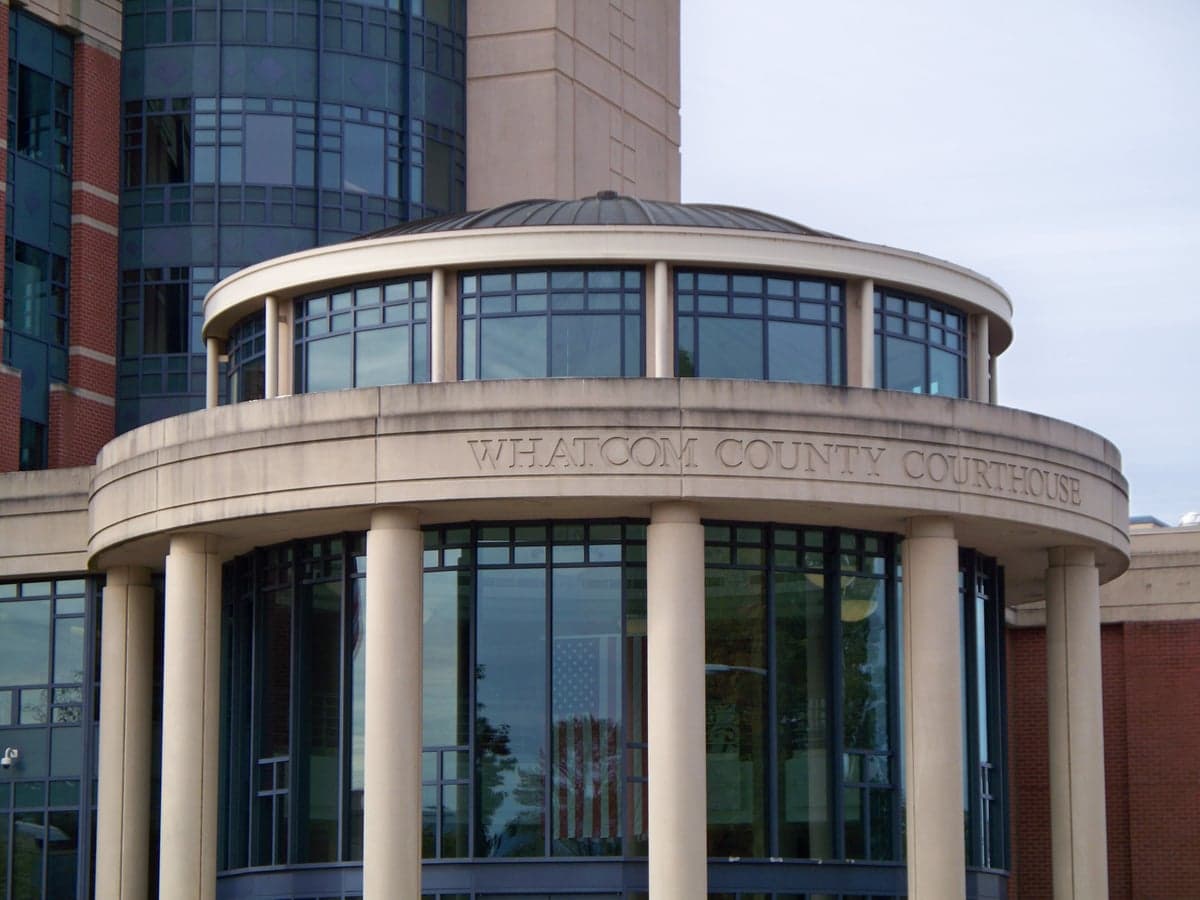
Photo: Wikipedia
Political ClimatePolitical Climate in Whatcom County
Showing district-level results — no local-only data available.
Local Political AnalysisPolitical Analysis of Whatcom County
Whatcom County has been a reliably Democratic stronghold for years, with a Cook Partisan Voting Index of D+12, meaning it votes about 12 points more Democratic than the national average. That said, the county is far from a monolith. The city of Bellingham, home to Western Washington University, is the deep blue engine of the county, consistently delivering margins of 70% or more for Democratic candidates. Drive just 20 minutes east to Lynden, and you'll find a deeply conservative, Dutch Reformed community that often votes 70% Republican. The rural areas around Everson, Nooksack, and the foothills of Mount Baker also lean red, while the fast-growing town of Ferndale has become a genuine swing area, with precincts flipping between parties depending on the race. Overall, the county's trajectory has been steadily leftward over the past decade, driven by population growth in Bellingham and the influx of remote workers from Seattle.
How it compares
Compared to Washington state as a whole, Whatcom County is noticeably more liberal. While the state's Cook PVI isn't officially calculated, Washington overall leans Democratic by roughly D+8, meaning Whatcom is about 4 points bluer than the state average. That gap is mostly driven by Bellingham's outsized influence. In statewide races, Whatcom County typically votes a few points to the left of King County's suburbs but is less progressive than Seattle proper. On the other hand, it's significantly more liberal than neighboring Skagit County to the south, which has a D+4 lean, and vastly different from conservative Okanogan County to the east. The contrast is most visible in presidential elections: in 2020, Whatcom gave Joe Biden 63% of the vote, while Washington state as a whole gave him 58%. The county's Republican voters, concentrated in Lynden and the rural east, often feel their votes are drowned out by Bellingham, but they remain organized and active in local races for city council and port commission seats.
What this means for residents
For liberal residents, living in Whatcom County means seeing your values reflected in most local policies. Bellingham has a strong renters' rights ordinance, a climate action plan targeting carbon neutrality by 2030, and a city council that frequently takes progressive stances on housing and homelessness. The county government, which includes more rural representation, is more moderate but still leans Democratic. For conservative residents, the reality is more mixed. You can find like-minded community in Lynden or the rural areas, and the county's Republican Party remains active, but you'll likely be in the minority in countywide elections. That said, the political divide isn't as bitter as in some parts of the country. People here tend to be neighborly across party lines, especially around shared concerns like wildfire risk, water rights, and the health of the local fishing and farming economies.
One cultural distinction worth noting: Whatcom County has a strong independent streak that doesn't always align with party labels. The local Democratic Party is more environmentalist and land-use-focused than the national party, while local Republicans often prioritize property rights and agricultural issues over social conservatism. The county also has a notable libertarian-leaning population, especially in the rural areas around Glacier and Maple Falls, who vote Republican but are skeptical of government overreach on land use. This mix creates a political climate where local issues—like the fate of the Cherry Point industrial zone or the expansion of the Bellingham International Airport—often generate unusual coalitions. For newcomers, the key takeaway is that while the county leans blue, the conversation is more nuanced than the D+12 label suggests, and your experience will vary significantly depending on whether you settle in Bellingham, Lynden, or somewhere in between.

State Political ClimatePolitical Climate in Washington
State Political AnalysisPolitical Environment in the State
Washington state has been a solidly Democratic-leaning state for over a decade, with Democrats controlling the governorship, both chambers of the legislature, and both U.S. Senate seats since 2012. The state’s overall partisan lean is roughly D+8 to D+10 in presidential elections, but that number masks a deep and growing geographic divide. Over the last 20 years, the state has shifted leftward primarily due to explosive population growth in the Seattle metro area, while rural and exurban counties have trended sharply right. For a conservative relocator, the reality is that you’ll be living under a unified Democratic state government, but your day-to-day experience will vary dramatically depending on whether you settle in King County or in a place like Spokane or Yakima.
Urban vs. rural divide
The political map of Washington is essentially a story of three regions. The Puget Sound corridor — anchored by Seattle, Bellevue, and Tacoma — drives the state’s Democratic majority. King County alone casts about 30% of the state’s votes and delivers margins of 70-75% Democratic. The I-5 corridor south to Olympia and Vancouver also leans blue, though Clark County (Vancouver) is more competitive, flipping between parties in local races. East of the Cascades, the political landscape flips entirely. Spokane County has been trending purple — it voted for Biden in 2020 by a slim margin — but the surrounding rural counties like Yakima, Grant, and Douglas are deeply red. The Tri-Cities (Kennewick, Pasco, Richland) are a conservative stronghold, with Benton and Franklin counties routinely voting 60%+ Republican. The divide isn’t just cultural; it’s legislative. Rural representatives often find themselves powerless on state-level votes, which fuels a growing sense of disenfranchisement east of the mountains.
Policy environment
Washington’s policy environment is defined by a few key features. There is no state income tax, which is a major draw for conservatives, but the state relies heavily on a high sales tax (6.5% state rate, plus local add-ons that can push it over 10%) and high property taxes. The regulatory posture is generally business-friendly in tech and manufacturing, but strict on labor and environmental issues. Education policy is controlled by the state, with a fully funded public school system that ranks in the top 10 nationally, but school choice is limited — there are no private school vouchers and charter schools are heavily restricted. Healthcare policy leans left: the state runs its own health insurance exchange, expanded Medicaid aggressively, and has some of the strongest abortion protections in the country. Election laws are among the most accessible in the nation — all elections are vote-by-mail, same-day registration is available, and ballots are automatically sent to every registered voter. This system is popular across the political spectrum for convenience, but conservatives often raise concerns about ballot security and signature verification processes.
Recent policy direction
The last five years have seen a clear acceleration of progressive policy. On gun and self-defense law, Washington passed a ban on assault weapons and high-capacity magazines in 2023, plus a requirement for a 10-day waiting period and a safety training course for purchases. A 2024 law also imposes liability on gun manufacturers for negligent marketing. On parental and education rights, the state has moved in the opposite direction from many red states: it mandates LGBTQ-inclusive curriculum, prohibits schools from notifying parents if a child changes their name or pronouns, and has strong protections for transgender students. Speech and privacy are generally protected under the state constitution, but a 2024 law restricts the use of facial recognition technology by law enforcement. On medical and bodily autonomy, Washington has codified abortion rights into law, protects gender-affirming care for minors, and has shield laws for providers and patients traveling from out of state. Property rights are a flashpoint: the state’s Growth Management Act heavily restricts development in rural areas, and a 2023 law effectively eliminated single-family zoning in most cities, allowing duplexes and fourplexes in neighborhoods previously reserved for detached homes. Taxation remains income-tax-free, but a 2021 capital gains tax (7% on gains over $250,000) was upheld by the state Supreme Court in 2023, and there is active discussion of a wealth tax. Voting and ballot access remains expansive, with no voter ID requirement beyond a signature match, which conservatives view as a vulnerability.
Civil unrest & political movements
Washington has a history of visible political activism. The 2020 protests in Seattle, including the Capitol Hill Autonomous Zone (CHAZ), drew national attention and remain a touchstone for conservative critics of the state’s governance. Since then, organized activism has become more routine: the left is active through groups like the Washington State Labor Council and environmental organizations pushing for a carbon tax, while the right is organized through county-level Republican parties, the Washington State Grange, and Second Amendment advocacy groups like the Washington Arms Collectors. Immigration politics are a major dividing line. Washington is a sanctuary state — state and local law enforcement are prohibited from cooperating with federal immigration enforcement in most circumstances. This has led to tensions in agricultural areas like Yakima Valley, where some local sheriffs have publicly opposed the policy. Election integrity controversies have been relatively muted compared to other states, but conservative activists have raised concerns about the vote-by-mail system, particularly after the 2020 and 2022 elections. There is no serious secession movement, but the "Greater Idaho" proposal — which would move parts of eastern Washington and Oregon into Idaho — has gained some traction in rural counties, though it remains a fringe idea with no legislative path.
Projection
Over the next 5-10 years, Washington is likely to become more Democratic at the state level, not less. The Seattle metro area continues to grow faster than the rest of the state, and in-migration from California and other blue states reinforces the existing political lean. The state’s Democratic majority is also becoming more progressive — the 2024 legislative session saw the passage of a public option for health insurance and a bill to create a state-run retirement savings program. However, the urban-rural divide will likely widen, with eastern Washington becoming more conservative and more vocal in its opposition. For a conservative relocator, the practical implication is that your vote in state elections will have limited impact, but your local community — especially if you choose a place like Spokane Valley, Wenatchee, or Richland — can still reflect your values. The state’s tax structure (no income tax) is unlikely to change in the near term, but a wealth tax or expanded capital gains tax is a real possibility. The biggest wildcard is housing: if the state’s zoning reforms succeed in increasing supply, it could moderate the cost of living and slow the demographic shift; if they fail, the Seattle area will continue to price out moderates and attract high-income progressives.
For a new resident, the bottom line is this: Washington offers a high quality of life, strong public services, and no income tax, but it comes with a progressive policy environment that touches nearly every aspect of daily life — from how you buy a gun to how your kids are educated to how your property can be developed. If you’re a conservative who values local community and outdoor lifestyle over state-level politics, you can find a good home in many parts of the state. But if you’re looking for a place where your vote will reliably shape state policy, Washington is not that place, and it’s not trending in that direction.
* Values derived from national, state, county, city and local statistics and may differ in a specific area. Last updated: 2026-06-21T02:04:14.000Z
Narrative content on this page is AI-generated and may contain mistakes. Verify any details that matter before acting on them.
ReloMaps may earn a commission from affiliate links at no extra cost to you.

