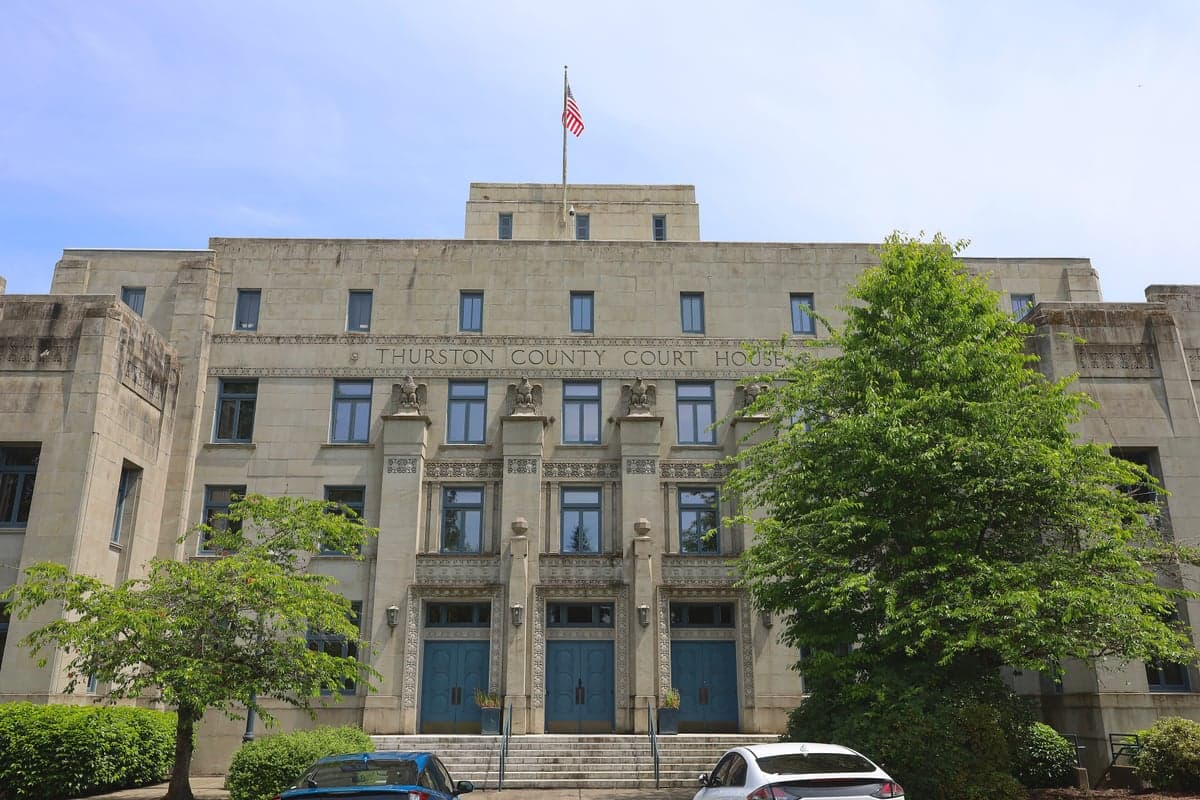
Photo: Wikipedia
Political ClimatePolitical Climate in Thurston County
Showing district-level results — no local-only data available.
Local Political AnalysisPolitical Analysis of Thurston County
Thurston County is a solidly Democratic stronghold in Washington State, with a Cook Partisan Voting Index of D+9, meaning it votes about nine points more Democratic than the national average. This lean is driven largely by the state capital, Olympia, and the university town of Lacey, where government employees, educators, and a younger, more progressive population create a deep blue core. However, the county is far from a monolith; the rural eastern and southern reaches, including towns like Tenino, Yelm, and Rainier, lean reliably Republican, creating a sharp urban-rural divide that defines local politics.
How it compares
Compared to Washington State as a whole, Thurston County is slightly more Democratic. While the state's overall Cook PVI is not officially calculated, it is widely considered to be around D+8, making Thurston County's D+9 a near mirror of the state's lean. The key difference is the nature of the political geography. In Washington, the deep blue strongholds are King County (Seattle) and a few other urban centers, while the rest of the state is a mix of purple and red. In Thurston County, the blue is concentrated in the urbanized western half (Olympia, Lacey, Tumwater), while the eastern half is more conservative. This means a conservative resident in Yelm feels a much stronger political minority than a conservative in, say, Spokane Valley, because the county government and many local institutions are dominated by the Olympia-area majority. Conversely, a liberal resident in Olympia may feel insulated from the state's more conservative rural areas, but the county's swing precincts—often found in the suburban fringe of Lacey and around the Tumwater-Olympia border—can decide close local races, reminding everyone that the county's overall blue hue is not absolute.
What this means for residents
For a liberal resident, living in Thurston County generally means seeing your values reflected in local policy, from environmental initiatives to social services. The county government and the Olympia city council are reliably progressive, and you'll find a strong network of like-minded community groups. For a conservative resident, the reality is more about navigating a political landscape where your views are often the minority. You may feel your voice is less heard in county-level decisions, but you'll find strong representation in the state legislature from the more rural districts, and your local town council in Yelm or Tenino will likely align with your values. The practical effect is that local elections—especially for county commission and city council seats in the swing areas—are where the real political battles are fought, and where a motivated minority can still have an outsized impact.
Culturally, the political divide in Thurston County is palpable. The Olympia area is known for its activist culture, farmers markets, and a strong emphasis on sustainability and public transit. Drive 20 minutes east to Yelm, and you'll find a more traditional, rural lifestyle centered on agriculture, the military community from Joint Base Lewis-McChord, and a greater emphasis on property rights and individual liberty. This creates a county that is politically polarized but also economically interdependent, with the state government jobs in Olympia supporting the entire region's economy. The trajectory is toward continued Democratic dominance in the urban core, but the rural areas are likely to remain a stubborn red counterweight, ensuring that Thurston County remains a fascinating microcosm of Washington State's larger political story.

State Political ClimatePolitical Climate in Washington
State Political AnalysisPolitical Environment in the State
Washington State has been a reliably Democratic stronghold for over a decade, but its political reality is far more nuanced than a simple blue label. The state hasn't voted for a Republican presidential candidate since 1984, and Democrats currently hold all statewide executive offices and both U.S. Senate seats. However, the 10-20 year trajectory shows a deepening urban-rural chasm, with the Seattle metro area's explosive growth pulling the state leftward while vast swaths of Eastern Washington and the Olympic Peninsula have moved aggressively in the opposite direction. For a conservative relocator, the practical takeaway is that you'll be living under a unified Democratic state government, but your day-to-day experience will vary dramatically depending on whether you settle in King County or a place like Spokane or Yakima.
Urban vs. rural divide
The political map of Washington is essentially a story of two states. The Puget Sound region—anchored by Seattle, Bellevue, and Tacoma—generates roughly two-thirds of the state's population and votes overwhelmingly Democratic. King County alone cast more votes for Joe Biden in 2020 than the entire eastern half of the state combined. Meanwhile, the rest of Washington is deeply conservative. Spokane County, the state's second-most populous, has trended redder in recent cycles, flipping from a swing county to a reliable Republican stronghold. Yakima County and the Tri-Cities area (Kennewick, Pasco, Richland) are conservative bastions, while rural counties like Ferry, Stevens, and Garfield routinely vote 70-80% Republican. The Olympic Peninsula tells a similar story—Clallam County has shifted rightward as retirees and veterans move in, while Jefferson County remains a liberal outlier. What this means in practice: a conservative family in Spokane Valley lives under the same state laws as a progressive family in Capitol Hill, but their local school boards, sheriff's offices, and city councils will reflect radically different priorities.
Policy environment
Washington's policy landscape is defined by a few structural features that directly affect relocators. The state has no personal income tax, which is a major draw for high earners, but it compensates with some of the highest sales taxes in the nation—typically 8-10% depending on the locality—and above-average property taxes. The regulatory environment is business-friendly in some sectors (tech, aerospace) but heavily restrictive in others (energy, land use, firearms). The state has a universal background check law for gun purchases, a red flag law, and a ban on certain semi-automatic firearms passed in 2023. Education policy is controlled by the state; Washington funds its public schools at above-average levels but has struggled with teacher shortages and achievement gaps. Healthcare is dominated by the Washington Health Benefit Exchange, and the state has expanded Medicaid under the Affordable Care Act. Election laws are among the most accessible in the country: all-mail voting is universal, same-day registration is available, and ballots are automatically sent to every registered voter. For a conservative relocator, the lack of income tax is a genuine financial benefit, but the gun laws and regulatory climate may be dealbreakers depending on your priorities.
Recent policy direction
The last five years have seen Washington's legislature move decisively leftward on several fronts. In 2023, the legislature passed HB 1240, banning the sale, manufacture, and import of dozens of semi-automatic firearms, and HB 1143, requiring a 10-day waiting period and safety training for all gun purchases. On education, the state passed SB 5599 in 2023, which allows shelter placement for minors seeking gender-affirming care without parental consent—a flashpoint for parental rights advocates. Property rights have been constrained by the Climate Commitment Act, a cap-and-trade program that drives up fuel costs and has been blamed for rising construction expenses. On the privacy front, the Washington My Health My Data Act imposes strict protections on health data, including reproductive health information. Voting access has been expanded further with automatic voter registration at the DMV and preregistration for 16- and 17-year-olds. For a conservative relocator, the cumulative effect is a state government that is actively restricting gun ownership, limiting parental authority in certain medical decisions, and imposing environmental regulations that raise the cost of living. These aren't hypotheticals—they're laws on the books that affect daily life.
Civil unrest & political movements
Washington has a visible history of political activism on both sides. The 2019-2020 CHOP/CHAZ protests in Seattle drew national attention and remain a touchstone for conservative critics of the state's governance. More recently, the 2023-2024 protests over the Israel-Hamas war have been large and sustained in Seattle and Olympia, with encampments and disruptions at state buildings. On the right, the Washington State Republican Party has been fractured between moderates and a more populist, Trump-aligned wing, but grassroots activism is strong in rural counties. The sanctuary state law, which limits local law enforcement cooperation with federal immigration authorities, is a persistent flashpoint, particularly in Yakima and Pasco, where agricultural communities have mixed views. Election integrity controversies have been relatively muted compared to states like Arizona or Georgia, but the 2020 and 2022 cycles saw organized efforts to challenge ballot drop boxes and mail-in voting procedures. A new resident will notice the political divide most acutely in the stark difference between Seattle's activist energy and the "Don't California My Washington" sentiment visible on bumper stickers east of the Cascades.
Projection
Over the next 5-10 years, Washington is likely to become more Democratic at the state level, but the urban-rural divide will continue to widen. In-migration from California and other high-cost states is driving growth in the Seattle suburbs and the Vancouver-Portland metro area, both of which lean left. However, conservative-leaning areas like Spokane County and the Tri-Cities are also growing, and the political geography of the state is becoming more polarized rather than more moderate. The state's Democratic supermajority in the legislature is likely to hold, meaning further movement on gun control, environmental regulation, and social policy. A conservative relocator moving to Washington today should expect that the state government will continue to pass laws they disagree with, but that local control in conservative counties will remain a meaningful buffer. The practical question is whether the lack of income tax and the natural beauty of the state outweigh the policy direction—and that answer will depend heavily on which part of Washington you choose to call home.
For a conservative individual or family considering Washington, the bottom line is this: you will be living under a Democratic state government that is actively moving left on guns, education, and regulation, but you will also enjoy no income tax, world-class outdoor recreation, and the ability to find a community that shares your values in places like Spokane, Yakima, or the Olympic Peninsula. The key is to choose your county carefully—your local experience will be shaped far more by your city council and sheriff than by Olympia. If you can tolerate state-level policies you disagree with in exchange for the economic and lifestyle benefits, Washington can still be a good fit. If those policies are non-negotiable, you may want to look at Idaho or Montana instead.
* Values derived from national, state, county, city and local statistics and may differ in a specific area. Last updated: 2026-07-24T16:22:48.000Z
Narrative content on this page is AI-generated and may contain mistakes. Verify any details that matter before acting on them.
ReloMaps may earn a commission from affiliate links at no extra cost to you.

