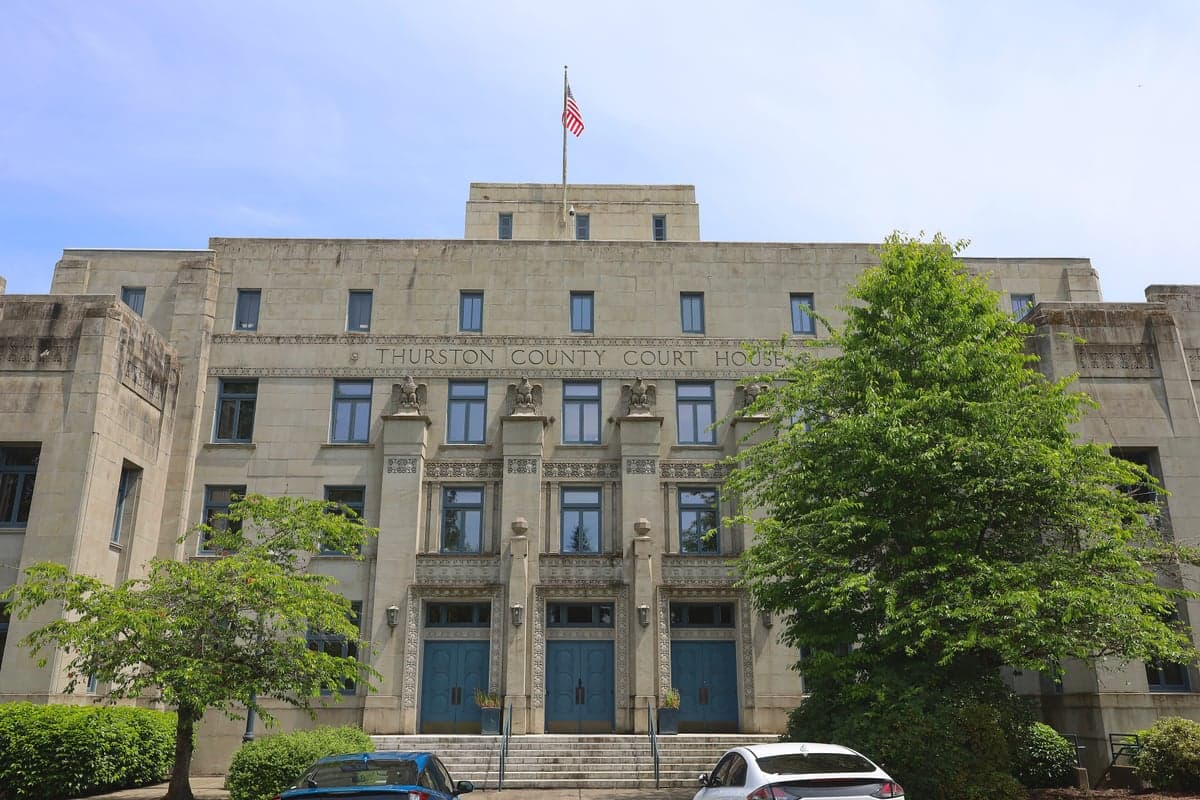
Photo: Wikipedia
Personal Sovereignty in Thurston County
Viable for self-reliance. Generally workable, though some barriers may limit total independence.
What does Personal Sovereignty tell us?
Personal Sovereignty measures your capacity for self-reliance and independence with minimal government friction. Higher scores mean fewer barriers between you and the way you want to live... but it assumes you have the space you need and good neighbors.
What does this tell us?
Personal Sovereignty measures your capacity for self-reliance and independence with minimal government friction. Higher scores mean fewer barriers between you and the way you want to live... but it assumes you have the space you need and good neighbors.
State Policy
Energy independence: Importer (55% of energy produced in-state)
Personal Liberty
Homesteading

Personal Liberty Analysis
Thurston County, Washington, presents a complex personal sovereignty environment where state-level progressive policies often clash with a more independent-minded local culture, particularly outside the Olympia city limits. While Washington State imposes a significant regulatory and tax framework, the practical experience of personal autonomy varies dramatically depending on whether you live in the urban core of Olympia, the suburban sprawl of Lacey and Tumwater, or the rural unincorporated areas like Rochester, Tenino, and Yelm. For the relocation researcher prioritizing personal freedom, the county offers a bifurcated reality: high state-level burdens paired with meaningful opportunities for self-reliance in its less populated precincts.
Tax burden and regulatory posture in Thurston County
Washington State has no personal income tax, which is a major advantage for earners, but it compensates with the highest state sales tax in the nation, reaching 10.1% in Olympia and 9.8% in Lacey and Tumwater. Property taxes in Thurston County are moderate by national standards but have been rising steadily, with the median effective rate around 0.93% of assessed value, driven by voter-approved levies for schools and infrastructure. The regulatory posture is heavily influenced by the state's Growth Management Act, which imposes strict urban growth boundaries (UGBs) that concentrate development and limit rural sprawl. This means that building a new home or adding an accessory dwelling unit (ADU) in unincorporated areas like Boston Harbor or Delphi requires navigating a permitting process that is more rigorous than in many Texas or Idaho counties, but less onerous than in King County. The state's environmental regulations, particularly the Shoreline Management Act and critical areas ordinances, add layers of review for any property near water or wetlands, which is common in this region. For the autonomy-minded individual, the key takeaway is that while the tax burden is manageable without an income tax, the regulatory overhead for property development is real and requires patience and professional guidance.
Self-defense law and gun law specifics in Washington State
Washington is a "shall-issue" state for concealed pistol licenses (CPL), meaning that if you pass a background check and complete a training course, the county sheriff must issue the permit. Thurston County's Sheriff's Office processes CPL applications efficiently, with typical turnaround times of 30 days or less. However, the state legislature has enacted significant restrictions in recent years: semi-automatic rifle purchases require a 10-business-day waiting period and a completed safety training course, and magazines capable of holding more than 10 rounds are effectively banned for new sales (though existing magazines are grandfathered). Open carry is legal without a permit, but the law prohibits carrying at public demonstrations, in courthouses, and on school grounds. The practical effect in Thurston County is that gun ownership is common and socially accepted in rural areas like Rainier and Bucoda, where shooting ranges and hunting are part of the culture, while in Olympia, the political climate is more restrictive and gun-friendly businesses are fewer. Stand-your-ground laws do not exist in Washington; the state follows a duty-to-retreat standard before using deadly force outside the home, which is a meaningful limitation for personal sovereignty advocates. For the self-defense-minded relocator, Thurston County offers lawful access to firearms but within a legal framework that is more restrictive than in Idaho or Montana.
Self-reliance and homesteading viability across the county
Homesteading viability in Thurston County is highly dependent on location due to zoning and lot size regulations. In unincorporated areas zoned as "Rural Residential" or "Rural Farm Forest," minimum lot sizes range from 1 to 5 acres, with 5-acre parcels being the most common for keeping livestock. Rochester and Tenino are the most homestead-friendly areas, with larger parcels, fewer HOA restrictions, and a local culture that supports small-scale agriculture, beekeeping, and chicken keeping. The county's Right to Farm ordinance provides some protection for agricultural operations against nuisance complaints, which is critical for anyone raising animals or running a farm stand. Off-grid feasibility is limited by state building codes: Washington requires all new homes to be connected to the electrical grid or have a permitted alternative energy system, and composting toilets must meet strict health department standards. Rainwater collection is legal and encouraged for outdoor use, but potable water systems must be permitted. The county's well-drilling regulations are moderate, with permits required but generally granted for properties outside urban growth areas. For the self-reliant individual, the best strategy is to target properties in the southern and western parts of the county—around Grand Mound and Littlerock—where zoning is looser and neighbors are more likely to be like-minded homesteaders rather than suburban commuters.
Personal liberties: parental rights, medical autonomy, speech, and property
Washington State has some of the strongest parental rights laws in the nation regarding educational choice, with charter schools, private schools, and home-based instruction all legally available. Thurston County has a robust homeschooling community, with several support groups and co-ops operating in the Olympia and Yelm areas, and the state's legal requirements for homeschooling are straightforward: file a declaration of intent and provide annual assessments. Medical autonomy is more constrained at the state level, with Washington mandating childhood vaccinations for school attendance (with medical and philosophical exemptions available but requiring annual paperwork) and maintaining a strong public health apparatus. The state's "shield laws" protect access to gender-affirming care and abortion, which may be a positive or negative depending on the reader's values. Free speech protections are robust, with public comment periods at county commission meetings and a generally open political environment, though Olympia's dominant progressive culture can create social pressure against conservative viewpoints. Property rights are significantly limited by the Growth Management Act, which restricts what owners can do with their land, particularly in designated critical areas and shorelines. Eminent domain is rarely used in Thurston County, but the regulatory takings issue—where environmental rules reduce property value without compensation—is a real concern for rural landowners.
Overall, Thurston County offers a moderate-to-low personal sovereignty environment compared to states like Idaho, Montana, or Texas, but it is one of the more freedom-friendly areas within Washington State. The absence of an income tax and the presence of a functional concealed carry system are meaningful advantages, while the Growth Management Act, magazine capacity ban, and duty-to-retreat standard are significant limitations. For the relocation researcher, the county's best value lies in its rural southern and western precincts—Rochester, Tenino, and Bucoda—where the regulatory burden is lighter, the gun culture is stronger, and the path to self-reliance is clearer than in the Olympia-Lacey-Tumwater corridor. If personal sovereignty is your top priority, Thurston County is a compromise location that works well for those who can navigate its state-level constraints while leveraging its local opportunities for independence.

* Values derived from national, state, county, city and local statistics and may differ in a specific area. Last updated: 2026-07-24T16:22:48.000Z
Narrative content on this page is AI-generated and may contain mistakes. Verify any details that matter before acting on them.
ReloMaps may earn a commission from affiliate links at no extra cost to you.

