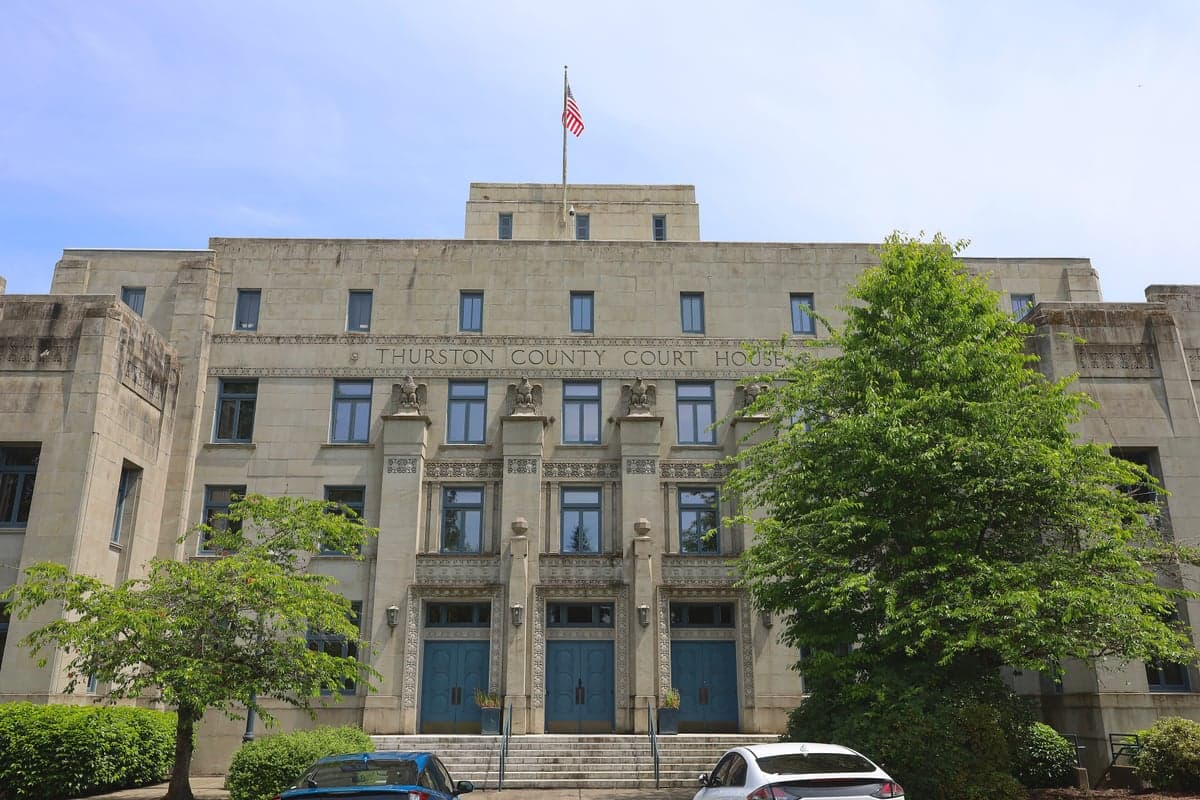
Photo: Wikipedia
Demographics of Thurston County
Affluence Level in Thurston County
A middle-class area roughly in line with national averages across income, home values, education, and employment.
People of Thurston County
Thurston County's 296,640 residents form a community shaped by government employment, military service, and a deep connection to the Pacific Northwest's natural landscape. The population is predominantly white (70.6%) with a growing Hispanic community (10.3%) and notable East/Southeast Asian presence (5.4%), concentrated in the urban core of Olympia, Lacey, and Tumwater. The county's identity is distinctly tied to state government, with the Capitol campus in Olympia anchoring a workforce that is more college-educated (37.2%) than the national average, yet the area retains a practical, outdoors-oriented character that appeals to families seeking stability and access to nature. Only 3.5% of residents are foreign-born, making Thurston County one of the less internationally diverse counties in the Puget Sound region, though domestic migration from other parts of Washington and California has steadily reshaped its population.
Settlement & growth (pre-1960)
The original inhabitants of Thurston County were the Coast Salish peoples, particularly the Squaxin Island Tribe and the Nisqually Tribe, who lived in permanent villages along the inlets and rivers of what is now the southern Puget Sound region. The Squaxin Island Tribe's ancestral territory encompassed the entire southern Sound, with winter villages at locations that would later become Olympia, Tumwater, and Shelton. The Nisqually people occupied the Nisqually River watershed, including areas around present-day Lacey and Yelm. These tribes relied on salmon runs, shellfish beds, and camas prairies, and they maintained extensive trade networks across the Cascade Range to the Columbia Plateau. The 1854 Medicine Creek Treaty forced the tribes onto reservations, including the Squaxin Island Reservation and the Nisqually Reservation, though the Nisqually Tribe's reservation was later reduced in size after the 1856 Treaty of Olympia.
American settlement began in earnest in 1845 when Michael Simmons and a party of settlers from the Willamette Valley established a landing at the falls of the Deschutes River, founding what would become Tumwater, the first permanent American settlement on Puget Sound. These early settlers were primarily from the Midwest and Upper South, drawn by the Donation Land Claim Act of 1850, which offered 320 acres to married couples willing to farm the territory. The settlement of Olympia was platted in 1851 by Edmund Sylvester and Levi Lathrop Smith, and it quickly became the commercial and political hub of the region, serving as the capital of Washington Territory from 1853 onward. The town of Bucoda, founded in the 1850s, became a center for logging and later a notorious prison labor camp, while Tenino grew around sandstone quarrying and the Northern Pacific Railroad depot established there in the 1870s.
The late 19th and early 20th centuries brought a wave of European immigrants, though in smaller numbers than in the Midwest or East Coast. Scandinavian immigrants, particularly Swedes and Norwegians, arrived in the 1880s and 1890s to work in the logging camps and sawmills that dotted the county's timber-rich landscape. Many settled in Rainier and the rural areas east of Olympia, where they established small farms and logging operations. German immigrants also arrived during this period, concentrating in the farming communities around Rochester and Grand Mound, where they grew hops, dairy, and vegetables for the growing Seattle market. The 1910s and 1920s saw the arrival of Japanese immigrants, who worked in the railroad and agricultural sectors, particularly in the hop fields and berry farms near Lacey and Tenino, though most were forcibly removed to internment camps during World War II and did not return in significant numbers.
The single most transformative event for Thurston County's population was the decision to locate the state capital permanently in Olympia, ratified by voters in 1890. This decision created a stable base of government employment that insulated the county from the boom-and-bust cycles that affected timber-dependent communities elsewhere in Washington. The construction of the Washington State Capitol Campus in the 1910s and 1920s brought architects, engineers, and administrators from across the country, many of whom settled in the newly developed neighborhoods of Olympia's South Capitol and Bigelow Highlands. The Great Depression and World War II era saw the expansion of Fort Lewis (now Joint Base Lewis-McChord) just north of the county line, which brought military personnel and their families to the northern parts of Thurston County, particularly Lacey and the Nisqually Valley, where defense-related housing developments sprang up in the 1940s.
Modern era (post-1965)
The 1965 Hart-Cellar Act had a relatively modest impact on Thurston County compared to major urban centers, as the county's foreign-born population remains low at 3.5%. However, the act did open the door for East and Southeast Asian immigration that reshaped the county's demographic profile. Vietnamese refugees began arriving in the late 1970s and 1980s, many sponsored by churches and resettlement agencies in Olympia and Lacey. A smaller wave of Filipino immigrants came in the 1980s and 1990s, drawn by healthcare and government jobs, settling primarily in Lacey and Tumwater. These communities remain relatively small but established, with Asian grocery stores and restaurants concentrated along Martin Way and Pacific Avenue in Lacey. The Indian subcontinent population remains minimal at 0.4%, with no significant enclave forming in the county.
The most significant demographic shift since 1965 has been domestic migration, not international immigration. The 1970s and 1980s saw an influx of Californians and Oregonians seeking lower housing costs and a slower pace of life, a trend that accelerated in the 1990s and 2000s as the Seattle metropolitan area became increasingly expensive. These domestic migrants tended to be white, college-educated professionals working in government, healthcare, and technology, and they concentrated in the master-planned suburbs of Lacey and the Hawks Prairie area, which grew from a few thousand residents in 1990 to over 50,000 by 2020. The Hispanic population grew from under 2% in 1990 to 10.3% by 2025, driven primarily by domestic migration from California and Texas rather than direct immigration from Latin America. These Hispanic residents have concentrated in Olympia's east side and the rural areas around Rochester and Grand Mound, where agricultural work in nurseries and berry farms provides employment.
The Black population in Thurston County remains small at 3.2%, with most Black residents concentrated in Lacey and the northern parts of Olympia near Joint Base Lewis-McChord. The military base has been the primary driver of Black population growth, as active-duty service members and veterans from diverse backgrounds settle in the county after their service. The county's Black community is relatively dispersed compared to larger cities, with no single neighborhood reaching majority-Black status. The 2010s and 2020s have seen modest growth in the Black population as remote work and military retirement have drawn more families to the area.
The future
Thurston County is projected to become slightly more diverse over the next two decades, though it will likely remain less diverse than King or Pierce counties. The Hispanic population is expected to grow from 10.3% to approximately 15-18% by 2040, driven by natural increase and continued domestic migration from the Southwest and California. The East and Southeast Asian population is projected to grow modestly, reaching 7-8%, as the healthcare and technology sectors in Olympia and Lacey continue to expand. The white population share will decline gradually from 70.6% to the mid-60% range, but will remain the dominant demographic group. The Indian subcontinent population is expected to remain below 1%, as the county lacks the technology and academic sectors that draw Indian professionals to the Eastside suburbs of Seattle.
The most significant population trend is the continued suburbanization of the county's northern half. The Hawks Prairie and Meridian corridors in Lacey are expected to absorb the majority of new housing development, with the area's population potentially doubling by 2040. The city of Yelm is also experiencing rapid growth as a bedroom community for Joint Base Lewis-Machord and as a destination for families seeking larger lots and lower home prices. The rural areas of Rochester, Tenino, and Bucoda are likely to see slower growth, as they lack the infrastructure and employment centers to attract large-scale development. The county's cultural identity is evolving from a sleepy government town to a more dynamic suburban region, though it retains a distinctly Pacific Northwest character that values outdoor recreation, environmental stewardship, and a moderate pace of life.
For someone moving to Thurston County now, the area offers a stable, family-oriented community with good schools, reliable government employment, and access to the outdoors, all at a lower cost than Seattle or Portland. The population is becoming more diverse and more suburban, but the county's fundamental character as a place where government workers, military families, and nature enthusiasts coexist is likely to persist. The trade-off is a relatively homogeneous social environment compared to major metropolitan areas, with fewer ethnic enclaves and international cultural offerings, balanced by a strong sense of community and a slower, more predictable pace of life.

* Values derived from national, state, county, city and local statistics and may differ in a specific area. Last updated: 2026-07-24T16:22:48.000Z
Narrative content on this page is AI-generated and may contain mistakes. Verify any details that matter before acting on them.
ReloMaps may earn a commission from affiliate links at no extra cost to you.

