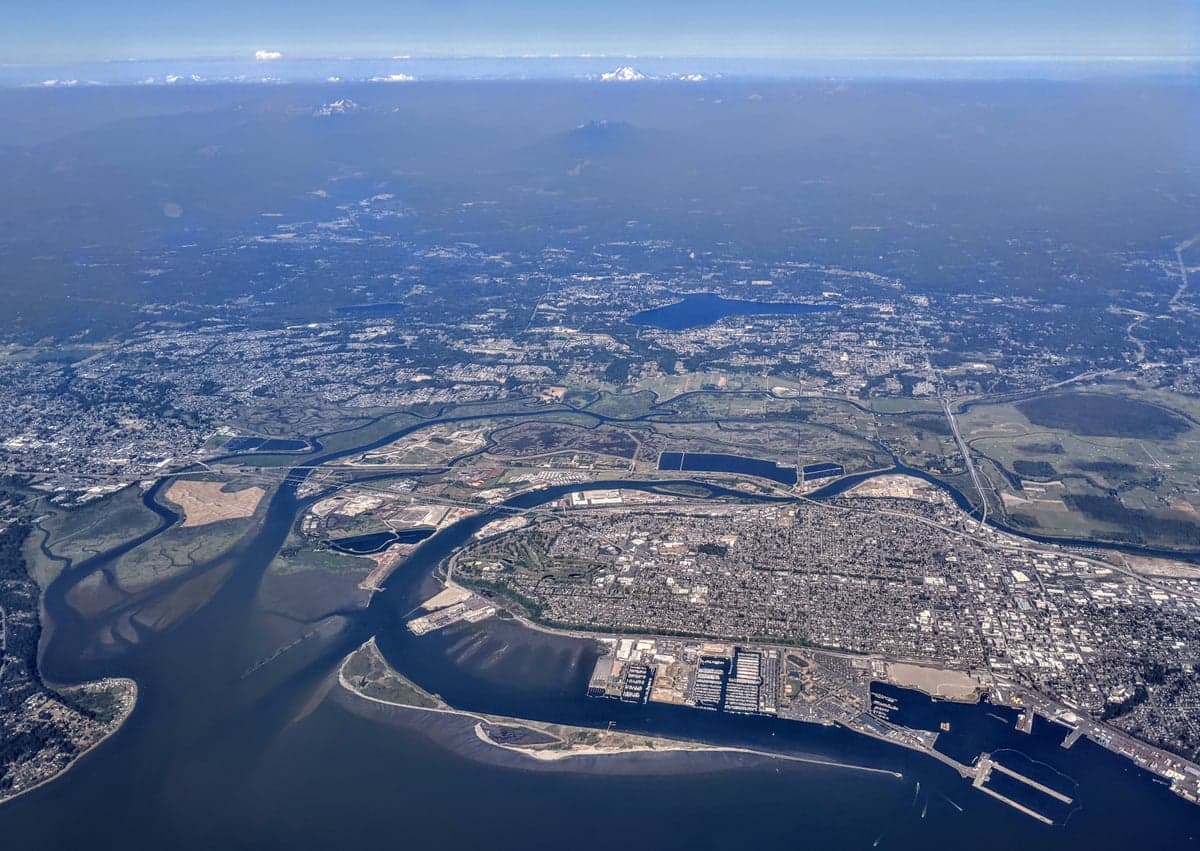
Photo: Wikipedia
Political ClimatePolitical Climate in Snohomish County
Showing district-level results — no local-only data available.
Local Political AnalysisPolitical Analysis of Snohomish County
Snohomish County leans Democratic overall — its Cook PVI is D+3 — but that average hides a real mix. I’ve lived here long enough to watch Everett go safely blue while Arlington and Stanwood stay reliably red, and places like Lake Stevens and Snohomish city swing depending on the cycle. As the Seattle metro pushes north, the county’s blue base is slowly growing, but rural pockets in the northeast and east still vote solidly Republican. It’s not a monolith: you can knock doors in Bothell one day and get a mix of Seattle tech transplants and old farming families.
How it compares
Compared to Washington state as a whole — which sits around D+8, give or take — Snohomish County is a few points more moderate. King County pulls the state hard left; Snohomish is the first real brake on that slide. That means countywide races are often tighter than statewide ones. In 2024, for example, Snohomish County’s presidential margin was about 7 points bluer than King County’s, but still a couple points redder than Washington overall. The state’s Cook PVI isn’t officially published for the whole state, but every local politico knows Snohomish is where both parties have to work hardest. Republicans keep their hopes alive in the 1st and 10th legislative districts, which stretch from Marysville up to the Skagit line, while Democrats dominate the 32nd (south Everett, part of Edmonds) and the 21st (Lynnwood, Mukilteo).
What this means for residents
For conservatives, living here means being the minority countywide but not lonely. You can find pro-business, pro-property rights candidates who win school board and city council seats in places like Granite Falls or Arlington. The sneaker effect is real: national Democrats don’t pour big money into Snohomish the way they do for King County, so local GOP messaging on taxes and public safety still lands. For liberals, the county is a comfortable but not uncontested base. You’ll push for transit expansions and denser zoning in Everett or Lynnwood, but hit a wall when you try the same in a residential part of Snohomish. The county council often splits 3-2 Democrat, meaning one swing member can decide issues like the carbon fee or JBLM expansion. Practically, this means both sides have to actually show up to meetings — no one can take the vote for granted.
Culturally, Snohomish County is the most union-heavy part of the state outside King County, so labor politics color a lot of the conversation. The timber and aerospace history gives liberals a working-class edge not as common in Seattle proper. You’ll also see a strong independent streak: lots of no-party voters who split tickets. Policy differences from the state include slower adoption of small-area zoning changes and a tougher line on rural land preservation. Both sides agree that growth management is the defining issue — whether you see it as overreach or necessity depends on which part of the county you call home.

State Political ClimatePolitical Climate in Washington
State Political AnalysisPolitical Environment in the State
Washington state has been a reliably blue stronghold for over a decade, but it’s a blue built on a deep urban-rural fault line. The Democratic coalition dominates statewide elections, powered by King County (Seattle) and the Puget Sound corridor, while vast stretches of Eastern Washington and the rural Olympic Peninsula vote Republican by wide margins. Over the last 20 years, the state has shifted leftward, but the shift is almost entirely demographic—Seattle’s explosive growth and the influx of tech workers have swamped the conservative vote in the rest of the state. In 2024, Kamala Harris won Washington by about 19 points, but that margin is almost entirely driven by King County, which alone casts roughly a third of all votes.
Urban vs. rural divide
The political map of Washington is a study in contrasts. The I-5 corridor from Olympia north through Tacoma, Seattle, and Everett is the Democratic engine room. King County alone delivers a 40-point margin for Democrats, and Snohomish and Pierce counties have trended blue as suburban sprawl from Seattle pushes outward. Meanwhile, Eastern Washington—places like Spokane, Yakima, and the Tri-Cities (Kennewick, Pasco, Richland)—is solidly Republican, though Spokane County has become a battleground as the city of Spokane itself grows more liberal. The rural counties—Ferry, Stevens, Pend Oreille, and the Olympic Peninsula’s Clallam and Jefferson—vote Republican by 30-40 points. The real political story is in the exurbs: counties like Skagit and Whatcom were once swing areas but have moved left as Seattle commuters and remote workers relocate north. The only reliably red metro is the Tri-Cities, where Hanford’s nuclear workforce and agricultural base keep the area conservative.
Policy environment
Washington’s policy environment is defined by a progressive tax structure and aggressive regulation. The state has no income tax—a major draw for conservatives—but relies heavily on a high sales tax (state rate 6.5%, with local add-ons pushing it over 10% in Seattle) and high property taxes. The state’s regulatory posture is among the most stringent in the nation: Washington has a strict carbon cap-and-trade program (the Climate Commitment Act), a long-standing assault weapons ban (passed in 1994, updated in 2023), and some of the nation’s strongest tenant protections. Education policy is dominated by the state’s McCleary decision, which forced the legislature to fully fund K-12, leading to higher property taxes statewide. Healthcare is heavily regulated, with a state-based insurance exchange and a public option law passed in 2021. Election laws are among the most accessible: all-mail voting is universal, same-day registration is available, and ballots are automatically sent to every registered voter. For conservatives, the lack of an income tax is a major plus, but the high sales and property taxes, combined with strict gun laws and environmental regulations, are significant drawbacks.
Recent policy direction
The last five years have seen Washington accelerate its progressive agenda. In 2023, the legislature passed a ban on the sale of assault weapons and high-capacity magazines, along with a 10-day waiting period for all firearm purchases. A 2024 law requires safe storage of firearms and imposes liability on gun owners whose weapons are used by unauthorized persons. On education, the state has expanded LGBTQ+ inclusive curriculum mandates and passed a law requiring schools to provide menstrual products in all bathrooms. Parental rights have been a flashpoint: a 2023 law prohibits school districts from notifying parents if a child changes their name or pronouns without the child’s consent, a policy that has drawn fierce opposition from conservative families. On privacy, Washington has one of the strongest state-level data privacy laws (the Washington My Health My Data Act), which restricts the collection and sale of health data, including reproductive health information. Medical and bodily autonomy is fully protected: abortion remains legal up to viability, and a 2023 law shields providers from out-of-state lawsuits. Property rights are constrained by the state’s Growth Management Act, which limits development in rural areas and mandates urban growth boundaries. Voting access has been expanded with automatic voter registration and pre-registration for 16- and 17-year-olds. For a conservative relocator, the net direction is toward tighter regulation on guns, education, and property, with no sign of reversal.
Civil unrest & political movements
Washington has a long history of political activism, from the 1999 WTO protests in Seattle to the 2020 CHAZ/CHOP occupation in Capitol Hill. The 2020 protests were particularly intense: Seattle saw nightly demonstrations for months, with the city’s police department facing heavy criticism and subsequent defunding efforts. On the right, the state has a robust Second Amendment movement, with groups like the Washington Arms Collectors and the Citizens Committee for the Right to Keep and Bear Arms actively litigating against new gun laws. The 2023 assault weapons ban is currently being challenged in federal court. Immigration politics are a major fault line: Washington is a sanctuary state, with a 2019 law prohibiting state and local law enforcement from cooperating with federal immigration authorities. This has led to tensions in rural counties like Yakima, where agricultural employers rely on immigrant labor but local officials oppose sanctuary policies. Election integrity has been a recurring issue: the 2020 election saw Trump supporters protest outside the King County elections office, and a 2024 ballot drop box fire in Vancouver (Clark County) was ruled an act of arson. The most visible flashpoint for a new resident is likely the homeless encampments in Seattle and Portland, which have fueled a backlash and led to the 2023 passage of a state law allowing the removal of encampments near schools and parks.
Projection
Over the next 5-10 years, Washington’s political trajectory is likely to remain blue, but the margin may narrow slightly as remote work allows more conservatives to move to lower-cost areas like Spokane or the Tri-Cities. The state’s Democratic majority is aging and concentrated in the urban core, while the fastest-growing counties are the exurbs and Eastern Washington, which lean Republican. However, the Democratic advantage in King County is so large that it will take a generation of demographic change to flip the state. The real shift will be internal: expect more policy battles over housing density (the state is pushing to upzone single-family neighborhoods), carbon regulation (the cap-and-trade program will raise gas prices), and education (school choice remains illegal, but pressure is building). A conservative moving to Washington now should expect to live under a Democratic trifecta for the foreseeable future, with the only real check being the state Supreme Court, which is also liberal. The practical reality is that Washington will continue to be a national leader on climate, gun control, and abortion rights, while the lack of an income tax will remain a bipartisan selling point.
For a new resident, the bottom line is this: Washington is a state where your political experience will depend heavily on where you live. If you move to Seattle or its inner suburbs, you’ll be in a deep-blue environment where conservative views are a distinct minority. If you choose Spokane, the Tri-Cities, or a rural county, you’ll find a more conservative community, but you’ll still be subject to state laws passed by a Seattle-dominated legislature. The lack of an income tax is a real financial benefit, but it’s offset by high sales and property taxes, strict gun laws, and a regulatory environment that favors environmental protection over economic development. If you’re a conservative who values low taxes and outdoor recreation, Washington can work—but you’ll need to be comfortable living in a state where your vote for president or governor will almost certainly be in the minority. The key is to pick your county carefully: King, Snohomish, and Whatcom are solidly blue; Pierce and Spokane are purple; and the rest of the state is red, but with limited political power.
* Values derived from national, state, county, city and local statistics and may differ in a specific area. Last updated: 2026-06-16T00:29:23.000Z
Narrative content on this page is AI-generated and may contain mistakes. Verify any details that matter before acting on them.
ReloMaps may earn a commission from affiliate links at no extra cost to you.

