Photo: Wikipedia
Demographics of Skagit County
Affluence Level in Skagit County
A middle-class area roughly in line with national averages across income, home values, education, and employment.
People of Skagit County
Skagit County, Washington is home to roughly 130,400 residents, a population that remains predominantly white (71.7%) but has grown significantly more diverse in recent decades, driven largely by a rising Hispanic community that now makes up 18.9% of the county. The county’s character is shaped by its agricultural heartland, the coastal city of Anacortes, and the commercial hub of Mount Vernon, creating a mix of rural farming families, small-town retirees, and a growing service-sector workforce. Only 5.1% of residents are foreign-born, and 29.1% hold a college degree, reflecting a population that is less globally connected and less formally educated than the Seattle metro area to the south. The people of Skagit County are defined by a quiet, working-roots independence — a place where the legacy of early settlers and the rhythms of the Skagit River delta still set the cultural tone.
Settlement & growth (pre-1960)
The original inhabitants of Skagit County were the Coast Salish peoples, including the Swinomish, Upper Skagit, and Samish tribes, who lived in permanent winter villages along the Skagit River and the saltwater shores of Padilla Bay and Fidalgo Island. Their economies centered on salmon fishing, shellfish harvesting, and cedar-wood craftsmanship, and their presence is still felt today through the Swinomish Indian Reservation near La Conner and the Upper Skagit tribal lands near Sedro-Woolley. European contact began in the late 18th century with Spanish and British explorers, but sustained American settlement did not begin until the 1850s, following the Oregon Treaty of 1846 and the subsequent Donation Land Claim Act.
The first major wave of American settlers arrived in the 1850s and 1860s, primarily from the Midwest and New England. These early pioneers — many of them farmers, loggers, and merchants — established the towns of Mount Vernon (founded 1852), Sedro-Woolley (originally two separate settlements that merged in 1898), and La Conner (founded 1869). The rich alluvial soil of the Skagit River delta attracted farmers who drained the tidal marshes to create some of the most productive agricultural land in the Pacific Northwest. By the 1880s, the arrival of the Seattle, Lake Shore & Eastern Railway and the Great Northern Railway transformed Mount Vernon and Sedro-Woolley into shipping hubs for lumber, coal, and agricultural goods.
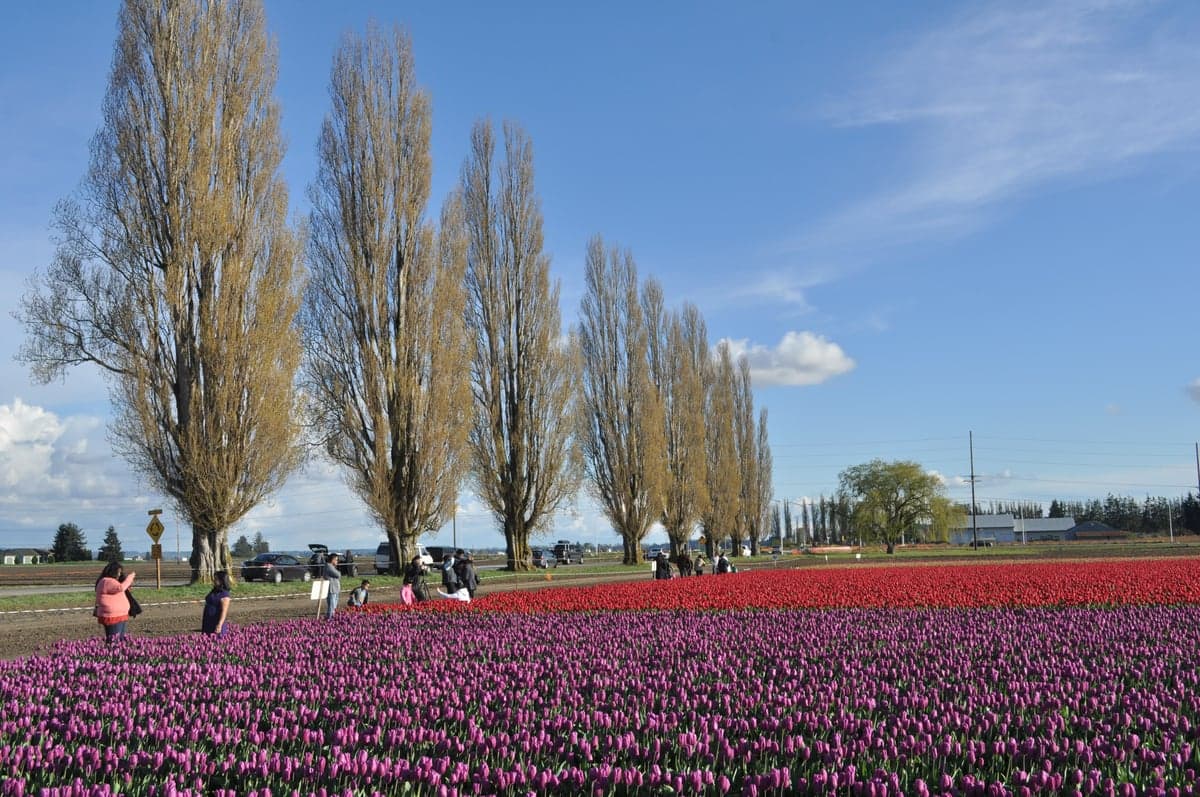
A second significant wave came in the 1890s and early 1900s, when Scandinavian immigrants — particularly Swedes, Norwegians, and Finns — arrived to work in the logging camps, sawmills, and fishing fleets. Many settled in the towns of Anacortes, which grew as a fishing and canning center on Fidalgo Island, and in the rural farming communities of Burlington and Bow. The Scandinavian influence remains visible in place names, Lutheran churches, and annual festivals like the Skagit Valley Tulip Festival, which itself was introduced by Dutch immigrants who began settling in the valley in the 1920s and 1930s. The Dutch brought bulb-farming expertise, and their descendants still dominate the tulip and daffodil fields that draw visitors from across the region.
During the Great Depression and World War II, Skagit County saw modest in-migration from the Dust Bowl states, though not on the scale of California or eastern Washington. The biggest economic shift came in the 1940s with the construction of the March Point oil refineries near Anacortes, which brought a wave of skilled workers and engineers to the county. By 1960, Skagit County was a predominantly white, rural-agricultural region with a population of roughly 50,000, anchored by Mount Vernon (the county seat) and the smaller industrial towns of Anacortes and Sedro-Woolley.
Modern era (post-1965)
The 1965 Hart-Cellar Act had a relatively muted effect on Skagit County compared to urban centers, but it did open the door for a small but steady flow of immigrants from Mexico and Central America. These workers were drawn by the county's agricultural economy — particularly the berry, vegetable, and dairy farms around Mount Vernon, Burlington, and the Skagit Valley floor. By the 1990s, the Hispanic population had grown from a tiny fraction to a visible minority, concentrated in the farmworker communities of Mount Vernon's west side and in the rural areas around Clear Lake and Bow. Today, the Hispanic share of the county stands at 18.9%, making it the largest and fastest-growing minority group.
Domestic migration has also reshaped the county since the 1990s. The Seattle metropolitan area's explosive growth and rising housing costs have pushed families and retirees northward into Skagit County, particularly into the cities of Mount Vernon, Burlington, and Anacortes. This "coastal flight" from King and Snohomish counties has brought a more educated, more liberal-leaning population to parts of the county, creating a cultural divide between the newer suburban transplants and the longer-standing rural and agricultural communities. The Asian population, at 1.8%, is modest and consists primarily of East and Southeast Asian families (Chinese, Filipino, Vietnamese) who have settled in Mount Vernon and Anacortes, often working in healthcare, education, and the service industry. The Indian-subcontinent population is negligible at 0.2%, and the Black population remains very small at 0.7%, concentrated in Mount Vernon and Anacortes.
Suburbanization has been most pronounced in the Interstate 5 corridor, where Burlington has grown from a small crossroads into a retail and logistics hub, and where new housing developments have spread across former farmland between Mount Vernon and Sedro-Woolley. Anacortes has also seen growth, driven by retirees and remote workers attracted to the coastal scenery and the ferry connections to the San Juan Islands. Meanwhile, the more remote towns of Concrete and Hamilton in the upper Skagit Valley have remained small and economically stagnant, with aging populations and limited job growth.
The future
Skagit County is projected to become more diverse over the next 10 to 20 years, driven almost entirely by the growth of the Hispanic population, which is younger and has higher birth rates than the white population. The Hispanic share could approach 25-30% by 2040, particularly in the agricultural areas of the Skagit Valley and in Mount Vernon's west side. The white population, while still the majority, is aging and seeing slower growth, as younger white families are more likely to move to the Seattle suburbs or out of state for job opportunities.
New immigrant communities are likely to remain concentrated in the I-5 corridor — Mount Vernon, Burlington, and to a lesser extent Anacortes — rather than dispersing into the more remote rural areas. The county's cultural identity is evolving from a predominantly Scandinavian-American and Dutch-American agricultural society into a more layered, bilingual community, though the pace of change is slower than in the Puget Sound urban core. The biggest wildcard is housing affordability: if the Seattle exodus continues, Skagit County could see accelerated suburban growth that further diversifies the population but also strains infrastructure and changes the rural character that long-time residents value.
For someone moving to Skagit County now, the region offers a relatively affordable, slower-paced alternative to the Seattle area, with a population that is still majority-white and culturally rooted in agriculture and small-town life, but that is gradually becoming more Hispanic and more suburban. The county is not undergoing a rapid transformation, but the demographic trends are clear: the future Skagit Valley will be browner, more bilingual, and more connected to the urban corridor to the south, even as its rural heartland remains intact.

* Values derived from national, state, county, city and local statistics and may differ in a specific area. Last updated: 2026-07-29T12:57:21.000Z
Narrative content on this page is AI-generated and may contain mistakes. Verify any details that matter before acting on them.
ReloMaps may earn a commission from affiliate links at no extra cost to you.

