
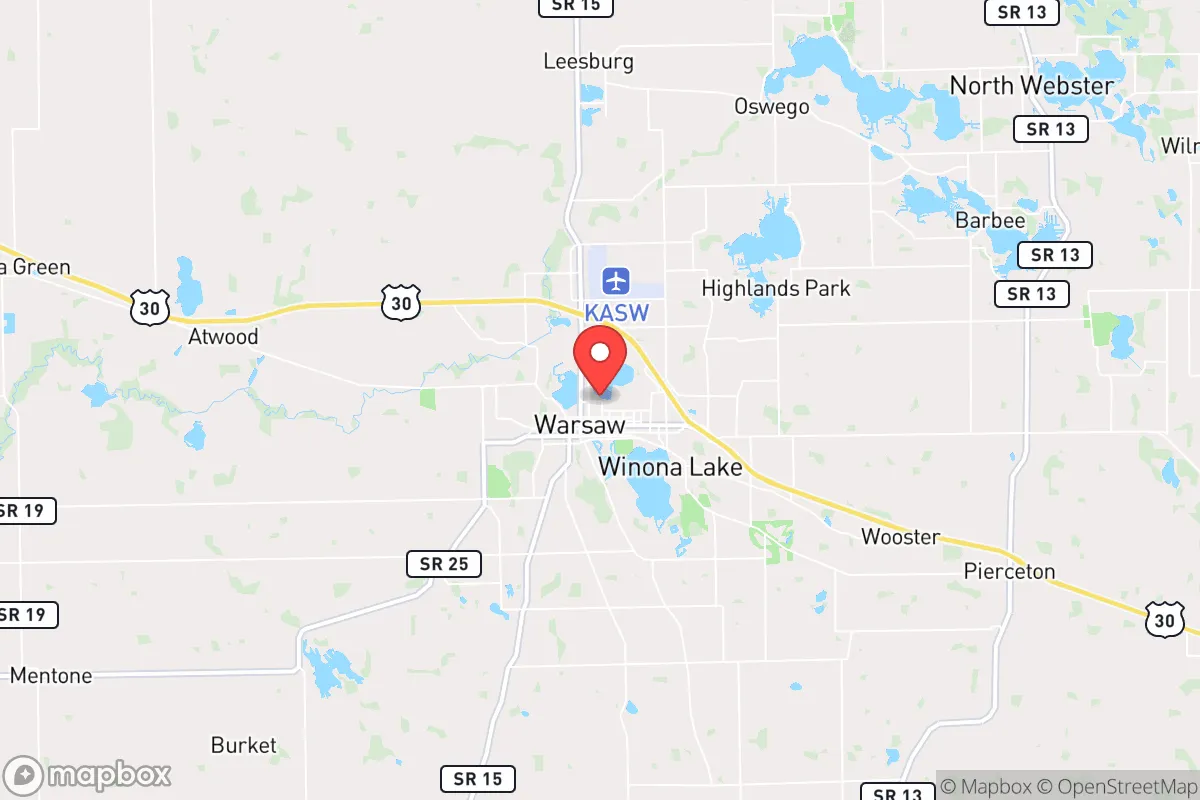
Photo: Wikipedia
Personal Sovereignty in Warsaw, IN
Viable for self-reliance. Generally workable, though some barriers may limit total independence.
What does Personal Sovereignty tell us?
Personal Sovereignty measures your capacity for self-reliance and independence with minimal government friction. Higher scores mean fewer barriers between you and the way you want to live... but it assumes you have the space you need and good neighbors.
What does this tell us?
Personal Sovereignty measures your capacity for self-reliance and independence with minimal government friction. Higher scores mean fewer barriers between you and the way you want to live... but it assumes you have the space you need and good neighbors.
State Policy
Energy independence: Importer (35% of energy produced in-state)
Personal Liberty
Homesteading

Personal Liberty Analysis
Warsaw, Indiana, offers a personal sovereignty environment shaped by the state’s consistently conservative governance and a local culture that prizes self-reliance. As the seat of Kosciusko County, the city sits in a region where individual autonomy is generally respected, with state-level preemptions limiting local overreach on key issues like firearms and property rights. For a relocation-minded reader weighing freedom against community structure, Warsaw presents a low-friction regulatory landscape where the default assumption is that residents can manage their own affairs, provided they operate within broadly defined state statutes.
Tax burden and regulatory posture in Kosciusko County
Indiana’s tax structure is among the most favorable in the Midwest for those prioritizing financial autonomy. The state levies a flat income tax of 3.15% (as of 2025, with scheduled reductions to 2.9% by 2027), and Warsaw residents pay a combined state and local sales tax of 7% — the state maximum. Property taxes in Kosciusko County are notably light: the effective rate on owner-occupied homes averages roughly 0.8% of assessed value, well below the national median of 1.1%. A $250,000 home in Warsaw would carry an annual tax bill around $2,000, a figure that allows homeowners to retain more of their equity. The regulatory posture at the county level is similarly hands-off. Kosciusko County does not impose zoning on agricultural land outside city limits, and Warsaw’s municipal code is relatively thin compared to larger Indiana cities like Fort Wayne or Indianapolis. Building permits are required for structural changes, but the process is straightforward, with typical review times under two weeks. There is no county-level business licensing fee beyond the state’s $50 annual registration, and home-based businesses are permitted by right in most residential zones as long as they do not generate excessive traffic or noise. This combination of low taxes and minimal bureaucratic overhead makes Warsaw a strong fit for entrepreneurs, remote workers, and anyone who values keeping more of their earnings without navigating complex local regulations.
Self-defense and gun law specifics in Warsaw
Indiana is a constitutional carry state, meaning that as of July 1, 2022, any law-abiding adult 18 or older may carry a handgun openly or concealed without a permit. Warsaw fully respects this state preemption, and local ordinances do not add restrictions beyond state law. The city has no “sensitive places” bans beyond those enumerated in state statute (schools, government buildings, and airports), and private businesses are free to set their own policies — though most in the area do not post signage restricting firearms. For those who want a permit for reciprocity when traveling, the Kosciusko County Sheriff’s Office issues licenses with a typical turnaround of 30 days. Use-of-force law in Indiana follows the Castle Doctrine: there is no duty to retreat in one’s home, vehicle, or place of business, and the state’s Stand Your Ground statute extends that principle to any place where a person is lawfully present. Self-defense claims are evaluated under a reasonableness standard, and Indiana courts have historically been deferential to lawful gun owners. The local sheriff’s office is pro-Second Amendment, and the county’s crime rate — violent crime in Warsaw is about 60% lower than the national average — means that defensive firearm use is rare but legally well-supported. For a resident who prioritizes the right to keep and bear arms without government interference, Warsaw offers one of the cleanest legal environments in the Midwest.
Self-reliance and homesteading viability in Warsaw
For those interested in homesteading, off-grid living, or significant self-reliance, Warsaw’s surrounding areas are highly accommodating. Within the city limits, standard residential lots range from 0.15 to 0.5 acres, and keeping chickens, bees, and small livestock is permitted with a simple zoning permit (no fee, just a form). Larger animals like goats or horses require a minimum of one acre and are common in the unincorporated areas of Kosciusko County, where zoning is essentially absent. The county’s soil quality is good for vegetable gardening, and the growing season runs roughly from mid-April to mid-October. Off-grid feasibility is strong: Indiana has no state-level prohibition on rainwater collection, and Kosciusko County does not restrict it. Solar panels are allowed by right, and net metering is available through the local utility, Kosciusko REMC, which credits excess generation at the retail rate. Wells and septic systems are permitted on parcels of one acre or more, with county health department inspections that are straightforward and cost around $200. There are no county-level bans on composting toilets or alternative waste systems, though they must meet state health codes. The main constraint is that Warsaw’s city water and sewer are mandatory within the municipal service area, so true off-grid independence is easier to achieve on rural land outside the city limits. A five-acre parcel with a well and septic can be found for under $50,000 within a 15-minute drive of downtown, making the area accessible for those who want to reduce reliance on municipal infrastructure without moving to a remote frontier.
Personal liberties in Warsaw: parental rights, medical autonomy, speech, and property
Indiana law provides strong protections for parental rights. The state’s “Parents’ Bill of Rights” (enacted in 2023) requires schools to obtain parental consent before administering any mental health or medical survey, and it guarantees parents the right to review curriculum materials and opt their children out of any instruction they find objectionable. Warsaw Community Schools, the local public district, has a conservative-leaning school board that generally defers to parental authority on these matters. Medical autonomy is more nuanced: Indiana has some of the strictest abortion laws in the nation (a near-total ban with narrow exceptions), which aligns with the values of many in the area, but it also imposes vaccine mandates for school attendance that are not subject to philosophical exemptions (only medical and religious). For those who prioritize medical freedom, the county has a robust network of independent healthcare providers, including several direct-primary-care clinics that operate outside insurance networks. Free speech is protected under both the First Amendment and Indiana’s state constitution, and Warsaw has no local ordinances restricting expressive activity in public spaces. Property rights are strongly defended: Indiana’s “right to farm” law shields agricultural operations from nuisance lawsuits, and Kosciusko County has not adopted any form of rent control or inclusionary zoning. Eminent domain is rarely used for private development, and the county assessor’s office is known for reasonable valuations. Overall, the personal liberties environment in Warsaw is one where the default is “yes” unless a specific state or federal law says otherwise, and local governance tends to reinforce rather than restrict that autonomy.
Compared to other areas in the Midwest, Warsaw stands out for its combination of low taxes, strong gun rights, permissive homesteading rules, and robust parental and property protections. It is not a libertarian free-for-all — state-level mandates on school vaccines and building codes still apply — but it offers a level of personal sovereignty that is rare in more urbanized or coastal regions. For a conservative-leaning individual or family who wants to live with minimal government interference while still having access to good schools, healthcare, and a functioning local economy, Warsaw represents a solid, data-backed choice where the regulatory environment is designed to let residents live their own lives.

* Values derived from national, state, county, city and local statistics and may differ in a specific area. Last updated: 2026-09-21T01:28:47.000Z
Narrative content on this page is AI-generated and may contain mistakes. Verify any details that matter before acting on them.
ReloMaps may earn a commission from affiliate links at no extra cost to you.

