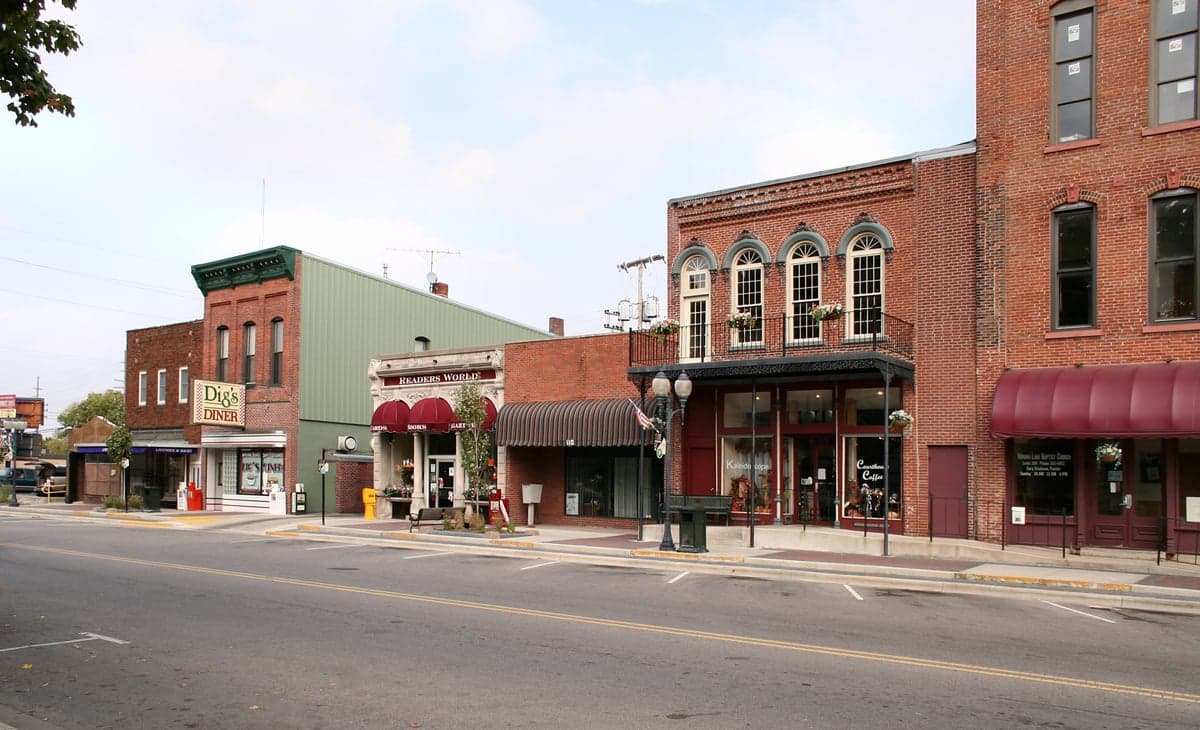
Photo: Wikipedia
Demographics of Warsaw, IN
Affluence Level in Warsaw, IN
A below-average socioeconomic profile. Incomes, home values, and educational attainment trail the U.S., with higher poverty and unemployment.
People of Warsaw, IN
The people of Warsaw, Indiana, today number roughly 16,592, forming a community that is predominantly white (75.5%) but with a significant and growing Hispanic population (15.1%) and a notable Indian-subcontinent community (4.3%). The city’s character is shaped by its historic role as the “Orthopedic Capital of the World,” anchored by medical-device employers like Zimmer Biomet and DePuy Synthes, which have drawn a skilled, college-educated workforce (33.0% with a bachelor’s degree or higher). This is a Midwestern manufacturing town that has evolved into a specialized medical hub, retaining a conservative, family-oriented culture while absorbing new immigrant waves that are reshaping its neighborhoods and schools.
How the city was settled and grew
Warsaw was founded in 1834 on the Tippecanoe River, with its original settlers being primarily Yankee migrants from New England and upstate New York, drawn by cheap land and the promise of water-powered mills. The town’s early growth was modest, centered around the Courthouse Square and the adjacent Central Park area, where the first frame houses and brick commercial blocks were built by these Protestant, English-speaking families. The arrival of the railroad in the 1850s spurred a second wave of German and Irish immigrants, who settled in the East End near the rail yards and the river, working in the new grain elevators and lumber mills. By the early 20th century, the discovery of natural gas and the founding of the Warsaw Cut Glass Company attracted skilled European craftsmen, many of whom lived in the Oakwood and Pike Lake neighborhoods, building modest bungalows and contributing to the town’s growing industrial base. The orthopedic industry took root in the 1920s when a local doctor, Homer Stryker, invented the first modern walking heel, leading to the formation of the Zimmer Manufacturing Company in 1927. This single event transformed Warsaw’s economy and population, drawing engineers, machinists, and salesmen from across the Midwest, who settled in the Winona Lake district and the newer subdivisions south of US-30.
Modern era (post-1965)
The 1965 Hart-Cellar Act opened the door for a new wave of immigration, but Warsaw’s modern demographic shift began in earnest in the 1990s, driven by two distinct forces. First, the orthopedic industry’s global expansion attracted highly skilled professionals from India, particularly from Gujarat and Maharashtra, who took positions as engineers, software developers, and executives at Zimmer, DePuy, and Biomet. This Indian-subcontinent community, now 4.3% of the population, concentrated in the Hidden Lake and Raintree subdivisions, where newer, larger homes were built in the 2000s. Second, a surge of Hispanic immigrants—primarily from Mexico and Central America—arrived to fill labor shortages in manufacturing, construction, and the service sector. The Hispanic population grew from under 2% in 1990 to 15.1% today, with families settling in the East End and along Center Street, where older, more affordable housing stock is available. The East/Southeast Asian community remains small at 0.6%, largely composed of Vietnamese and Filipino families who work in healthcare and hospitality, living scattered across the city rather than in a single enclave. The Black population, at 2.2%, is also dispersed, with no historically Black neighborhood, reflecting Warsaw’s limited role in the Great Migration. Suburbanization after 1970 pushed middle-class white families into the Winona Lake area and the Leesburg corridor, leaving the core city slightly more diverse.
The future
Warsaw’s population is projected to grow modestly, reaching roughly 18,000 by 2035, driven by continued expansion of the orthopedic sector and the construction of new housing developments on the city’s southern and western edges. The Hispanic share is expected to rise to 20-22% as younger families have more children and new arrivals continue to come for manufacturing jobs, with the East End and Center Street corridor becoming increasingly bilingual and bicultural. The Indian-subcontinent community is likely to stabilize or grow slightly, as the orthopedic industry remains a global draw, but new arrivals may disperse into the Hidden Lake area and newer subdivisions near Lake City Skiers. The white population will continue its slow decline in share, though not in absolute numbers, as the city’s overall growth offsets out-migration to larger metros. The cultural identity of Warsaw is evolving from a homogeneous, Protestant, small-town character into a more layered, multi-ethnic community where the local school system and churches are adapting to Spanish-language services and Hindu cultural events. The city remains politically conservative, but the growing diversity is creating new civic dynamics, particularly around housing affordability and public-school programming.
For someone moving in now, Warsaw offers a stable, family-oriented environment with strong schools and a robust job market, but it is no longer the uniformly white, English-speaking town of the 1980s. The new demographic reality means that newcomers will find a community where Indian engineers and Hispanic factory workers live alongside multi-generational white families, and where the local identity is being quietly redefined by the orthopedic industry’s global reach. This is a place where conservative values and economic opportunity coexist with increasing diversity, making it a practical choice for families seeking a safe, growing community with a clear economic anchor.

* Values derived from national, state, county, city and local statistics and may differ in a specific area. Last updated: 2026-09-21T01:28:47.000Z
Narrative content on this page is AI-generated and may contain mistakes. Verify any details that matter before acting on them.
ReloMaps may earn a commission from affiliate links at no extra cost to you.

