Political ClimatePolitical Climate in Petersburg City County
Showing state-level results — no local-only data available.
Local Political AnalysisPolitical Analysis of Petersburg City County
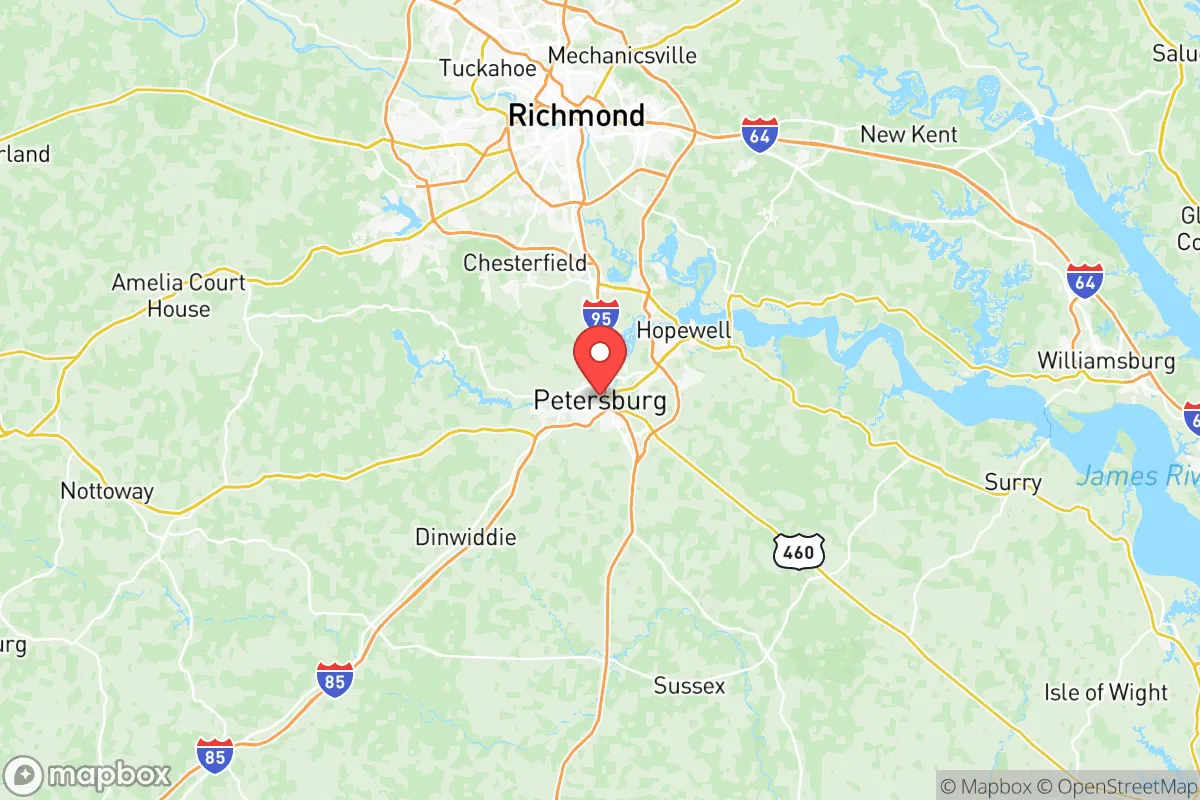
Petersburg City County is one of the most reliably Democratic strongholds in Virginia, carrying a Cook PVI of D+17 that places it far to the left of the state's overall D+4 rating. The city has voted blue in every presidential election since 2000, with margins typically exceeding 40 points — in 2020, Joe Biden won Petersburg by roughly 55 points over Donald Trump. This isn't a recent shift; Petersburg has been a Democratic anchor for decades, driven by a majority-Black population (over 77% as of the 2020 Census) and a strong union presence tied to its industrial and logistics sectors. The trajectory is steady rather than trending: while Virginia's suburbs have swung leftward in recent cycles, Petersburg's voting patterns have remained consistently deep blue with little year-to-year volatility.
How it compares
Virginia as a whole is a D+4 state, meaning it leans Democratic but remains competitive at the statewide level — think gubernatorial races decided by single digits or the 2021 sweep by Glenn Youngkin. Petersburg is a different universe politically. Its D+17 rating puts it in the same league as Richmond (D+18) and Norfolk (D+16), while most of the surrounding Tri-Cities area is more moderate. Colonial Heights, just across the Appomattox River, is R+18 — a 35-point gap from Petersburg that you can feel driving 10 minutes down the road. Within Petersburg itself, there's little internal variation: the entire city is a single jurisdiction with no separate towns, so the political map is uniform. The only meaningful split is between the city's core precincts (which vote 85-90% Democratic) and the more moderate western edge near the Chesterfield County line, where Democratic margins dip to around 60-65%. There are no swing precincts in the traditional sense — Petersburg is a one-party city in a purple state.
What this means for residents
For liberal residents, Petersburg offers a political environment where their values are the default: city council is entirely Democratic, the school board leans progressive, and local policy reflects priorities like affordable housing initiatives and criminal justice reform. Conservative residents, while a clear minority, aren't entirely isolated — they tend to cluster in the western neighborhoods and often cross the county line for shopping, dining, and community events in Chesterfield or Colonial Heights, where the political climate is more to their liking. In practice, the city's deep-blue lean means local elections are decided in the Democratic primary, not the general election, so the real political action happens in June rather than November. For both sides, the most tangible impact is on taxation and services: Petersburg's property tax rate ($1.35 per $100 of assessed value) is higher than surrounding counties, reflecting a city that invests in public services and infrastructure, but also struggles with a smaller tax base.
Culturally, Petersburg's political identity is inseparable from its history as a majority-Black city with deep roots in the civil rights movement — the 1960s sit-ins at the Petersburg Public Library are still a point of civic pride. The city's policy distinctiveness shows up in its embrace of regional transit expansion (the GRTC bus system) and its participation in the Virginia Main Street program for downtown revitalization. Unlike some deep-blue cities that have become cultural islands, Petersburg remains economically intertwined with its conservative neighbors — many residents work at the Fort Gregg-Adams Army base or in Chesterfield's corporate parks — creating a daily rhythm where political differences are more of a background fact than a source of friction. The long-term outlook is stability: Petersburg's demographics and economic base aren't shifting dramatically, so neither is its politics.

State Political ClimatePolitical Climate in Virginia
State Political AnalysisPolitical Environment in the State
Virginia has shifted from a reliably purple swing state to a solidly blue-leaning state over the past two decades, with a Cook Partisan Voting Index of D+4. The transformation is driven by explosive growth in the Washington, D.C. suburbs, particularly in Northern Virginia, which now dominates state elections. While the state still elects Republican governors in off-years (Glenn Youngkin won in 2021), the Virginia General Assembly has been under Democratic control for most of the last decade, and the state has not voted for a Republican presidential candidate since 2004. For a conservative relocator, this means living in a state where state-level policy is set by a Democratic majority, but where local political realities vary dramatically depending on which part of the state you choose.
Urban vs. rural divide
The political map of Virginia is a story of three distinct regions. Northern Virginia — anchored by Arlington, Alexandria, and Fairfax County — is the engine of Democratic power, producing massive vote margins that swamp the rest of the state. These suburbs have grown denser, more diverse, and more liberal with each election cycle. The Richmond metro area, including Henrico and Chesterfield counties, has also trended blue, though more slowly. Meanwhile, Hampton Roads (Virginia Beach, Norfolk, Chesapeake) remains a competitive swing region, with military and defense-industry voters keeping it more moderate. Rural and exurban Virginia — places like Roanoke, Lynchburg, and the Shenandoah Valley — votes heavily Republican, but these areas have been losing population share relative to the booming D.C. suburbs. The result is a state where a Republican can win a statewide race by running up margins in rural areas and holding the line in Hampton Roads, but where Democrats hold a structural advantage in legislative races thanks to the concentration of voters in Northern Virginia.
Policy environment
Virginia's tax structure is moderate compared to other states. The state income tax is a flat 5.75% (as of 2025), and sales tax is 5.3% (higher in some localities). Property taxes are set at the local level and vary widely — Loudoun County has higher rates than Augusta County, for example. The regulatory posture is generally business-friendly in the southern and western parts of the state, but Northern Virginia imposes stricter land-use and environmental regulations. Education policy has been a flashpoint: under Governor Youngkin, the state expanded school choice options and pushed for parental rights in curriculum, but the Democratic legislature has pushed back on many of these initiatives. Healthcare policy leans left — Virginia expanded Medicaid under the Affordable Care Act in 2019, and the state has some of the strongest insurance regulations in the South. Election laws are moderately restrictive: Virginia requires photo ID to vote (though student IDs are accepted) and has no-excuse absentee voting, but does not have same-day voter registration.
Recent policy direction
The last five years have seen Virginia swing sharply on several key liberty dimensions. On gun rights, the 2020 Democratic majority passed a package of gun control laws including universal background checks, a "red flag" law (extreme risk protection orders), and a one-handgun-per-month limit. These remain in effect despite Republican efforts to roll them back. On education and parental rights, Youngkin's administration enacted policies allowing parents to opt their children out of sexually explicit instructional materials and requiring school notification of changes to a student's gender identity — but these remain contested in court and subject to change if Democrats retake the governorship in 2025. On medical and bodily autonomy, Virginia has become a safe haven for abortion access in the South, with no gestational limit on abortion before the third trimester and a Democratic legislature that has repeatedly blocked Republican efforts to restrict it. On property rights, Virginia has relatively weak eminent domain protections compared to states like Texas, and localities have broad zoning authority. On privacy and surveillance, Virginia passed the Consumer Data Protection Act in 2021, giving residents some control over how companies use their personal data, but police surveillance laws remain relatively permissive. On voting access, the state has expanded early voting and no-excuse absentee voting, but has not moved to automatic or same-day registration.
Civil unrest & political movements
Virginia has been a focal point for political activism on both sides. The 2017 "Unite the Right" rally in Charlottesville made national headlines and led to a statewide reckoning with Confederate monuments, most of which have since been removed. The 2020 racial justice protests in Richmond saw clashes around the Robert E. Lee statue on Monument Avenue, which was eventually taken down. On the right, the "Parents Matter" movement has been particularly strong in Loudoun County, where school board meetings became nationally known battlegrounds over transgender policies and critical race theory. Immigration politics are less heated than in border states, but Northern Virginia's sanctuary policies — Fairfax County and Arlington limit cooperation with ICE — are a persistent source of tension with rural and exurban conservatives. Election integrity controversies flared after 2020, with Republican activists challenging voting procedures in Prince William County and elsewhere, though no widespread fraud was ever proven. A new resident would notice that political bumper stickers and yard signs are common in competitive areas, and that local news is heavily politicized depending on which part of the state you're in.
Projection
Over the next 5-10 years, Virginia is likely to continue its slow drift leftward, driven by demographic trends that show no sign of reversing. Northern Virginia's population is growing faster than the rest of the state, and the in-migrants are disproportionately young, college-educated, and liberal. Hampton Roads is aging and growing slowly, which may weaken its moderating influence. Rural Virginia will continue to vote Republican but will have less and less electoral weight. The wild card is whether the state's off-year gubernatorial elections — which tend to draw lower turnout and favor Republicans — will continue to produce divided government, or whether Democrats will eventually consolidate control of the executive branch as well. For a conservative moving to Virginia now, the realistic expectation is that state-level policy will be set by Democrats for the foreseeable future, but that local control in rural and exurban counties will remain strong. The state is unlikely to become a deep-blue stronghold like California, but it is also unlikely to swing back to purple unless there is a major realignment of the D.C. suburbs.
For a new resident, the bottom line is that Virginia offers a genuinely mixed political experience. If you live in Fairfax County or Arlington, you will be surrounded by liberal politics and policies. If you live in Roanoke or the Shenandoah Valley, you will experience a conservative local environment within a blue state. The state's tax burden is moderate, its schools are generally good, and its economy is strong — but the political trajectory is clearly leftward, and anyone moving here should be comfortable with the possibility that state-level policy will continue to move in that direction. The best advice is to choose your locality carefully, as the political reality of Virginia depends far more on your county than on the state as a whole.
* Values derived from national, state, county, city and local statistics and may differ in a specific area. Last updated: 2026-07-05T20:39:50.000Z
Narrative content on this page is AI-generated and may contain mistakes. Verify any details that matter before acting on them.
ReloMaps may earn a commission from affiliate links at no extra cost to you.

