Strategic Assessment of Petersburg City County
Meaningful friction. Expect exposure to either population pressure, blast zones, or natural disaster risk. Consider buying a retreat property.
What does the Strategic Assessment tell us?
Our Strategic Assessment grades tactical survivability of an area. Major population centers, military targets, fallout zones, natural disasters, and border exposure all drive risk — lower exposure means a more defensible position in a crisis.
This is heavily inspired by Joel Skousen's Strategic Relocation book. Highly recommended you checkout the book ($)What does this tell us?
Our Strategic Assessment grades tactical survivability of an area. Major population centers, military targets, fallout zones, natural disasters, and border exposure all drive risk — lower exposure means a more defensible position in a crisis.
This is heavily inspired by Joel Skousen's Strategic Relocation book. Highly recommended you checkout the book ($)Strategic Pillars

Key Distances
Strategic Assessment Analysis
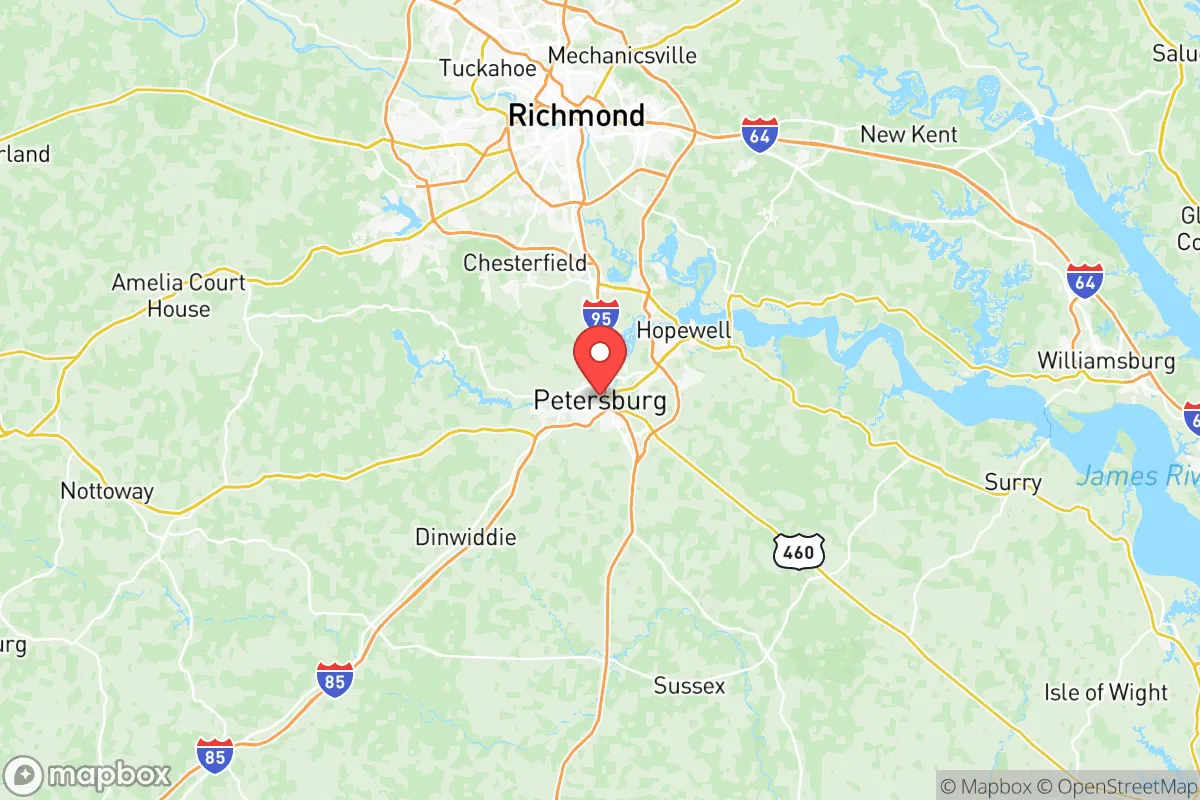
Petersburg City County, Virginia, offers a strategic paradox for the relocation-minded reader: it sits at a historic crossroads of transportation and commerce, yet its very centrality introduces significant vulnerabilities for those prioritizing disaster readiness and self-sufficiency. Located just 23 miles south of Richmond and 30 miles north of the North Carolina border, the city's position along Interstate 95 and the Appomattox River provides undeniable logistical advantages, but also places it within a dense corridor of population, industry, and military infrastructure. For a conservative-leaning individual or family weighing resilience against convenience, Petersburg demands a clear-eyed assessment of its geographic assets and its exposure to risks that come with being near major urban and military hubs.
Geographic position and natural advantages for self-sufficiency
Petersburg's location offers a mix of genuine natural assets and strategic drawbacks. The city sits on the fall line of the Appomattox River, a zone where the Piedmont plateau meets the Coastal Plain, providing access to both riverine resources and slightly more varied topography than the flat Tidewater region to the east. The surrounding area includes the 33,000-acre Fort Lee military installation (now part of the larger Fort Gregg-Adams), which dominates the local economy and landscape. While this base provides economic stability, it also represents a high-value target in any conflict scenario. On the positive side, the region's moderate climate supports a long growing season, and the proximity to the James River and numerous smaller waterways offers potential for independent water sourcing. The city's historic grid layout, with its older neighborhoods and surrounding farmland, provides more defensible terrain than sprawling suburban developments, though much of the immediate area is developed. The nearby Petersburg National Battlefield preserves open space that could serve as a buffer, but also underscores the area's historical role as a contested strategic chokepoint.
Risks, exposures, and proximity to fallout-relevant landmarks
The most significant risk for a Petersburg relocator is the density of high-value infrastructure within a 50-mile radius. Fort Gregg-Adams (formerly Fort Lee) is the U.S. Army's primary sustainment and logistics training center, housing the Combined Arms Support Command and the Army Logistics University. This makes it a premier target for any adversary seeking to degrade U.S. military supply chains. Additionally, the city lies within 30 miles of the Dominion Energy Surry Nuclear Power Plant across the James River, a facility that, while well-regulated, represents a potential radiological hazard in a major incident or attack. The I-95 corridor itself is a critical national artery; a disruption here would choke supply lines up and down the East Coast. Petersburg is also within 100 miles of the Norfolk Naval Station, the world's largest naval base, and the Port of Virginia in Hampton Roads, both of which are Tier-1 strategic assets. For the resilience-minded reader, this concentration of military and industrial targets means that Petersburg sits in a potential "blast shadow" that extends from Richmond to the coast. Natural risks include the area's susceptibility to hurricanes and tropical storms moving inland from the Atlantic, as well as occasional flooding along the Appomattox River. The region's clay soils can complicate well-drilling and septic system installation, a practical consideration for off-grid living.
Practical resilience for a relocator: food, water, energy, and defensibility
For those serious about self-sufficiency, Petersburg presents a mixed picture. Access to reliable water is the strongest asset: the Appomattox River and the nearby James River provide abundant surface water, and the region's groundwater aquifers are generally productive, though well yields vary by location. The city's municipal water system draws from Lake Chesdin, a reservoir southeast of town, but a relocator should plan for independent well or rainwater catchment systems. Food production potential is moderate: the surrounding counties of Dinwiddie, Prince George, and Sussex contain significant agricultural land, with soybeans, corn, and timber as primary crops. The growing season runs from April to October, allowing for substantial home gardening. However, the soil in much of the city itself is urban fill or clay, requiring raised beds or soil amendment. Energy resilience is a concern: the grid is reliable under normal conditions but is vulnerable to storm damage and potential cyber or physical attacks on the regional power infrastructure. Solar potential is adequate but not exceptional, with roughly 200 sunny days per year. Defensibility is limited: the city's flat terrain and dense road network make it difficult to secure a property against determined threats. The best options for a relocator are the rural fringes of the county, particularly toward the southwest in Dinwiddie County or southeast toward Sussex, where larger parcels and lower population density offer more practical defensibility. The presence of Fort Gregg-Adams means a significant law enforcement and military presence, which can be a stabilizing factor in a crisis, but also means the area is a likely staging ground for federal response operations, potentially drawing unwanted attention.
Overall, Petersburg City County is a location of strategic convenience rather than strategic security. Its position along the I-95 corridor and proximity to Richmond, Fort Gregg-Adams, and the Hampton Roads military complex make it a hub of activity and resources, but these same factors create significant exposure to man-made risks. For the relocator prioritizing resilience, the area's best use is as a waypoint or a base for accessing the more defensible rural areas to the south and west. If you are set on the region, focus on the outskirts—southwest toward the Nottoway River or west toward the Appomattox River headwaters—where you can leverage the area's logistical advantages while minimizing proximity to the highest-value targets. Petersburg itself is not a retreat; it is a forward operating base, and should be treated as such in any serious strategic plan.

* Values derived from national, state, county, city and local statistics and may differ in a specific area. Last updated: 2026-07-05T20:39:50.000Z
Narrative content on this page is AI-generated and may contain mistakes. Verify any details that matter before acting on them.
ReloMaps may earn a commission from affiliate links at no extra cost to you.

